முழு விவரக்குறிப்புகள் வேண்டுமா?
அனைத்து சுவிட்ச்கியர் பாகங்களின் விரிவான வரைபடங்கள் மற்றும் தொழில்நுட்ப அளவுருக்களுக்கு, எங்கள் 2025 தயாரிப்புப் பட்டியலைப் பதிவிறக்கவும்.
பட்டியல் பெறுக
அனைத்து சுவிட்ச்கியர் பாகங்களின் விரிவான வரைபடங்கள் மற்றும் தொழில்நுட்ப அளவுருக்களுக்கு, எங்கள் 2025 தயாரிப்புப் பட்டியலைப் பதிவிறக்கவும்.
பட்டியல் பெறுக அனைத்து சுவிட்ச்கியர் பாகங்களின் விரிவான வரைபடங்கள் மற்றும் தொழில்நுட்ப அளவுருக்களுக்கு, எங்கள் 2025 தயாரிப்புப் பட்டியலைப் பதிவிறக்கவும்.
பட்டியல் பெறுக
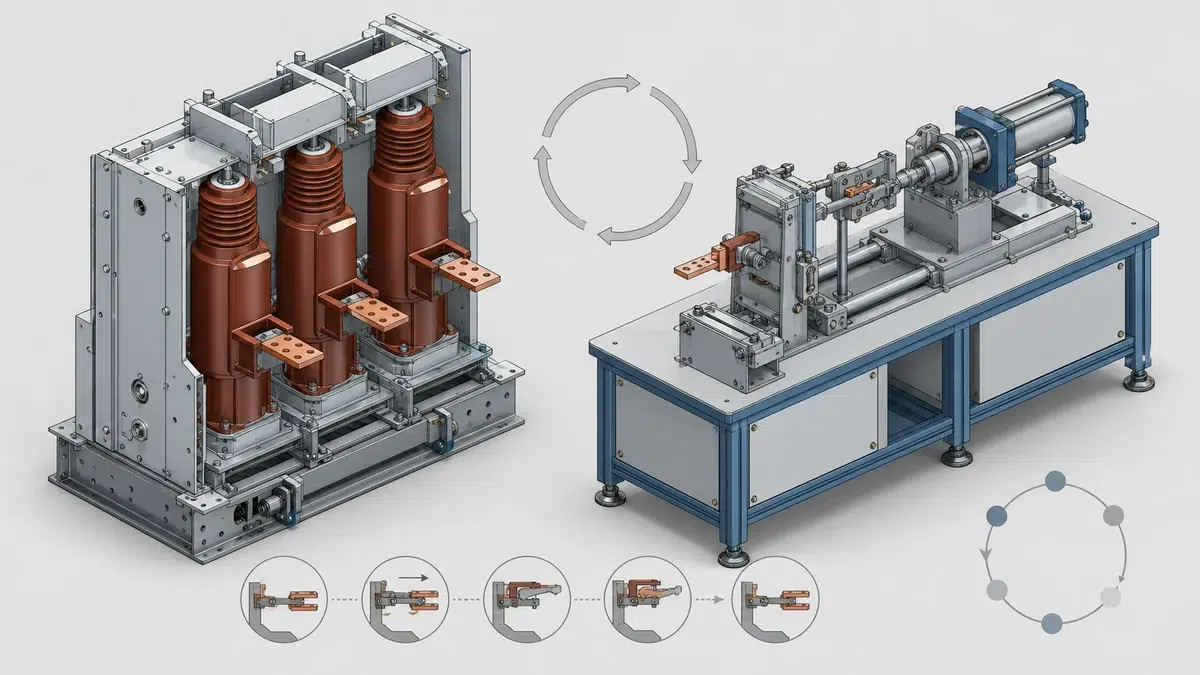
VCB mechanical endurance validation 10k 30k planning should begin with one principle: the cycle target is not a generic promise for every vacuum circuit breaker. It must be tied to the exact VCB type, rating, operating mechanism, maintenance condition, and manufacturer documentation. Siemens documentation for SION VCBs specifies a maximum permissible mechanical operating-cycle number of 10,000, with an optional 30,000-cycle version. Siemens 3AE8 documentation lists 30,000 mechanical-life cycles for stated ratings and notes maintenance-free operation within 10,000 cycles with maintainability within 30,000 cycles. Siemens SION product documentation also states that a 3AE5 may achieve up to 30,000 operating cycles with maintenance work, while emphasizing product-specific rating conditions and tolerances.
A practical endurance validation plan therefore should not treat “10k” and “30k” as interchangeable labels. A 10,000-operation program may verify the standard documented mechanical life boundary for a given VCB. A 30,000-operation program should be used only when the VCB documentation, ordering configuration, and maintenance concept support that target.
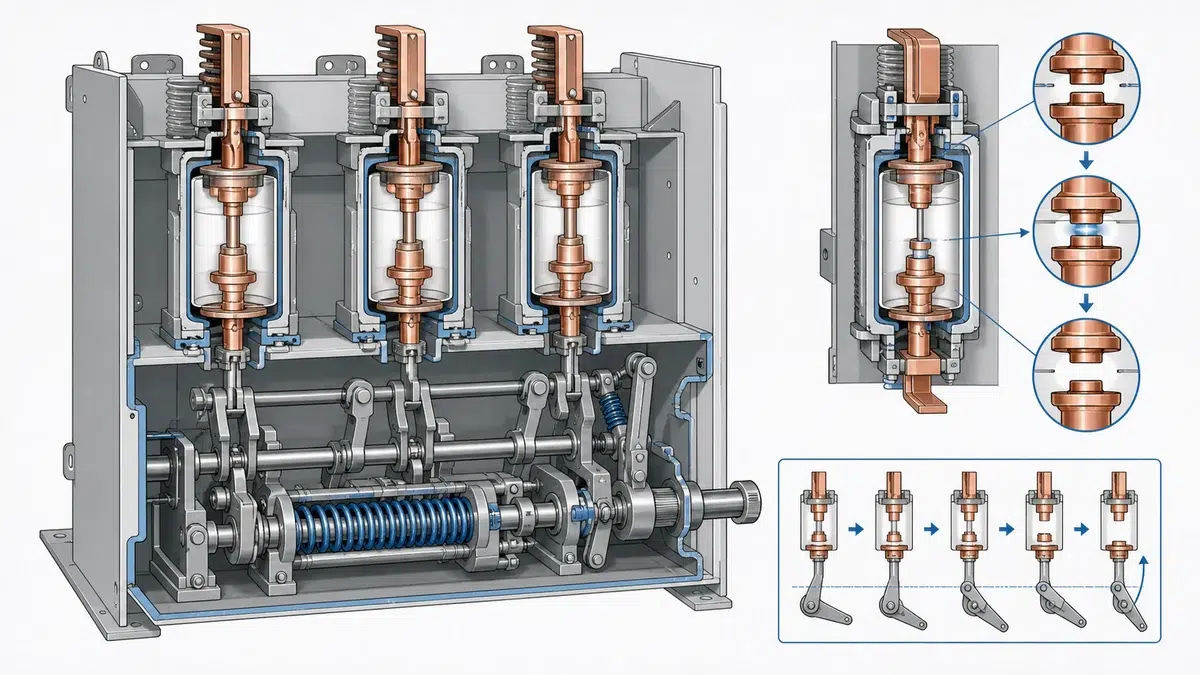
The objective is to confirm that the VCB operating mechanism can complete the specified number of mechanical operations without loss of intended opening and closing function, while staying within the boundaries defined by the applicable product documentation.
For a 10,000-operation validation, the test plan should confirm that the tested VCB configuration corresponds to a documented 10,000 mechanical operating-cycle capability. For a 30,000-operation validation, the test plan should confirm that the tested VCB is the correct 30,000-cycle version or a maintainable design documented for operation up to that level.
The validation should focus on mechanical performance, not on creating new electrical ratings. Mechanical endurance testing does not independently prove short-circuit capability, insulation level, continuous current rating, or switching duty beyond the documented VCB scope. Those ratings remain governed by the applicable type-test evidence, IEC sequence applicability, and product documentation. Cross-check the duty and nameplate fields against the வெற்றிட மின்சுற்று முறிப்பான் மதிப்பீட்டு வழிகாட்டி before acceptance.
This plan applies to VCB products where the manufacturer documentation identifies 10,000 or 30,000 mechanical operating-cycle applicability. It should be used as a validation framework, not as a substitute for the manufacturer’s manual.
The evidence basis includes the following product-specific points:
Siemens SION VCB documentation specifies a maximum permissible mechanical operating-cycle number of 10,000, with an optional 30,000-cycle version. The same manual instructs personnel to isolate the breaker, protect it against reclosing, and discharge the closing spring before maintenance work. The Siemens SION circuit-breaker manual ஆகும்.
Siemens 3AE8 VCB documentation lists 30,000 mechanical-life cycles for stated ratings and notes maintenance-free operation within 10,000 cycles with maintainability within 30,000 cycles. These values are product-specific and should not be transferred automatically to other VCBs.
Siemens SION product documentation states that a 3AE5 may achieve up to 30,000 operating cycles with maintenance work and identifies the ratings as independent within their stated tolerances of switching frequency or standing time.
Schneider guidance on IEC 62271-100 operating sequences states that sequences such as O-0.3s-CO-15s-CO are used for specified short-circuit making, breaking, and mechanical tests, with applicability confirmed against the product documentation.
Before endurance testing starts, the test article should be identified completely. The record should include VCB type, serial number, rated data from the nameplate, mechanism type, auxiliary supply data, closing and opening release details, spring-charging arrangement, and any option code or order confirmation related to 30,000-cycle capability.
The test plan should also record whether the breaker is being tested as a standard 10,000-cycle unit, an optional 30,000-cycle unit, or a maintainable configuration intended to reach 30,000 operations with specified maintenance work. If the documentation does not clearly support 30,000 operations for the exact configuration, the test should not be labeled as a 30,000-operation validation.
This identification step protects both the manufacturer and the user. It prevents a valid endurance result on one product family from being incorrectly applied to another VCB with a different operating mechanism or rating.
Mechanical endurance testing repeatedly stores and releases operating energy. The safety controls should therefore be treated as part of the validation plan, not as laboratory background work.
Before inspection, adjustment, maintenance, or intervention, the VCB should be isolated according to the applicable work procedure. Reclosing should be prevented, and the closing spring should be discharged before maintenance work, consistent with the safety instructions identified in Siemens SION documentation. Stored-energy indicators, auxiliary supply isolation, remote command blocking, and local control restrictions should be verified before personnel access the mechanism.
The test area should include barriers or controls that prevent unintended access during automatic cycling. Any remote test system should include a clear stop function and a defined response for abnormal operation, including incomplete closing, incomplete opening, failure to charge, unexpected trip, or control-supply anomaly.
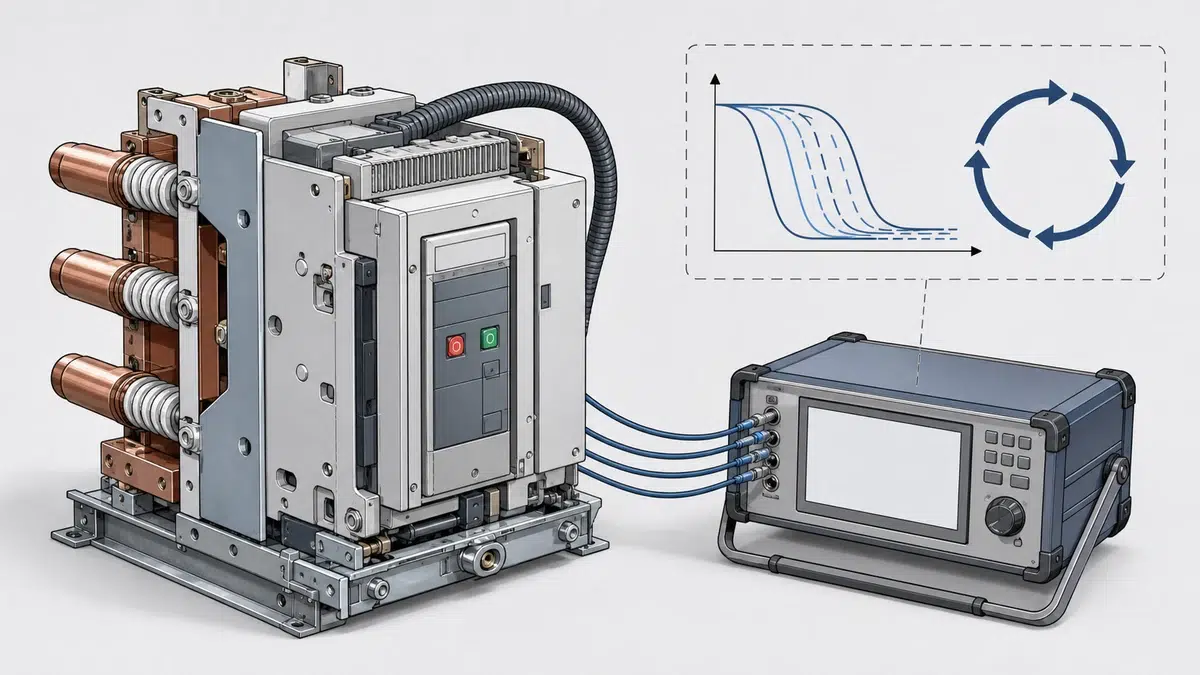
A baseline inspection should be completed before the first operation count is recorded. The inspection should document the condition of the operating mechanism, spring-charging system, closing and opening releases, auxiliary switches, mechanical indicators, interlocks, and visible fasteners. The test record should also capture whether lubrication, adjustment, or maintenance has been performed before the endurance run. If a command or mechanism result is abnormal, continue with the VCB close/trip fault checklist.
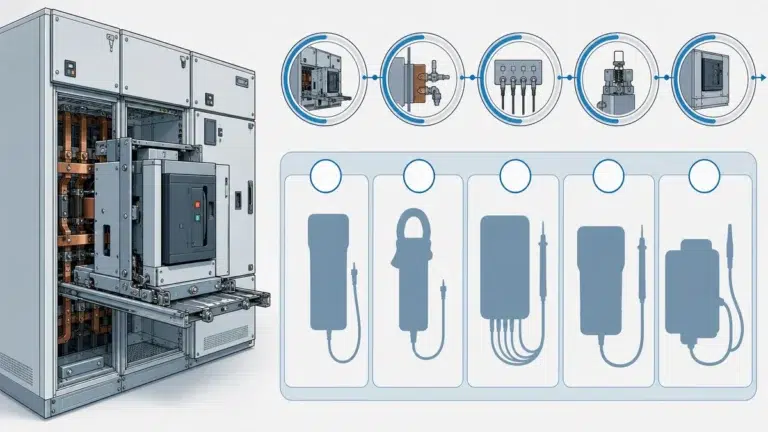
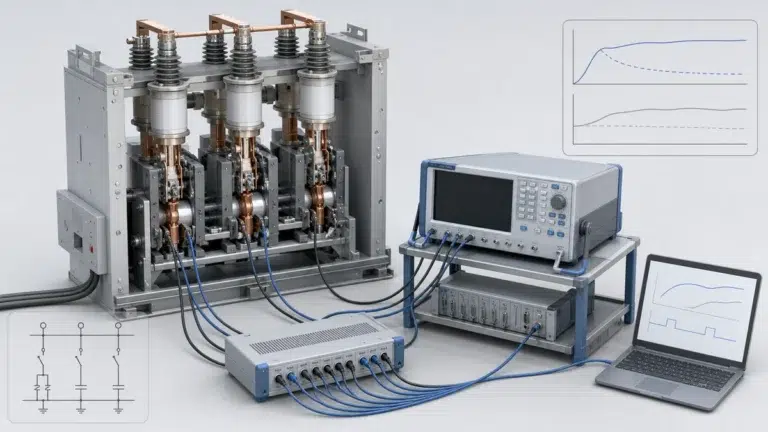
Baseline functional checks should confirm that the VCB can open and close correctly under the intended test control arrangement. Where timing equipment is available, baseline opening and closing time measurements may be recorded for comparison against the manufacturer’s limits. The plan should avoid inventing acceptance tolerances; timing, travel, bounce, coil current, and auxiliary-contact criteria should be taken from the applicable product documentation or agreed inspection procedure. For equipment and configuration options, compare the project duty with the XBRELE வெற்றிட மின்சுற்று முறிப்பான் வகை.
For a 30,000-operation program, the baseline record is especially important because the validation may include maintenance intervals if the documented product concept requires maintainability within 30,000 cycles. The maintenance action should be planned and recorded rather than applied informally after a problem appears.
The cycle definition should be stated before testing begins. A mechanical operation may be counted according to the manufacturer’s documentation or the laboratory’s agreed convention, such as one close operation, one open operation, or one complete close-open sequence. The test report should make this explicit so that “10,000 operations” or “30,000 operations” is not ambiguous.
Where the VCB has a mechanical operation counter, the counter reading should be recorded at the start, at planned checkpoints, before and after maintenance work, and at the end. If an external controller also counts operations, the two counts should be reconciled during the test. Any discrepancy should be investigated rather than corrected silently.
The count should not include invalid partial actions unless the test plan defines how they are handled. For example, an attempted close that does not latch, a trip command that does not open the breaker, or a spring-charge failure should be logged as an event and evaluated against the agreed criteria.
A 10,000-operation test plan is appropriate when the VCB documentation supports a 10,000 mechanical operating-cycle capability. For Siemens SION documentation, 10,000 is identified as the maximum permissible mechanical operating-cycle number for the standard version, while an optional 30,000-cycle version is separately identified.
The 10,000-operation plan should include:
If maintenance is performed during the 10,000-operation test, the timing, reason, and work content should be recorded. If the product documentation describes maintenance-free operation within 10,000 cycles for the specific VCB, unplanned maintenance during the test may require technical evaluation before the endurance result is accepted.
A 30,000-operation test plan should be used only when the exact VCB configuration supports that target. Siemens documentation provides examples where 30,000 mechanical-life cycles are listed for stated ratings, where an optional 30,000-cycle version is available, or where a product may achieve up to 30,000 operating cycles with maintenance work.
The 30,000-operation plan should therefore begin with a configuration gate. The test owner should confirm whether the VCB is a documented 30,000-cycle version or a maintainable configuration that may reach 30,000 operations with specified maintenance work. If maintenance is part of the documented path to 30,000 cycles, the plan should identify when maintenance is permitted, what work is allowed, and how it will be recorded.
The 30,000-operation plan should include staged checkpoints rather than a single final inspection. Each checkpoint should verify operation count, functional behavior, mechanism condition, and any parameters required by the product documentation. The test report should distinguish between continuous endurance without maintenance and endurance with planned maintenance, because those are not the same validation claim.
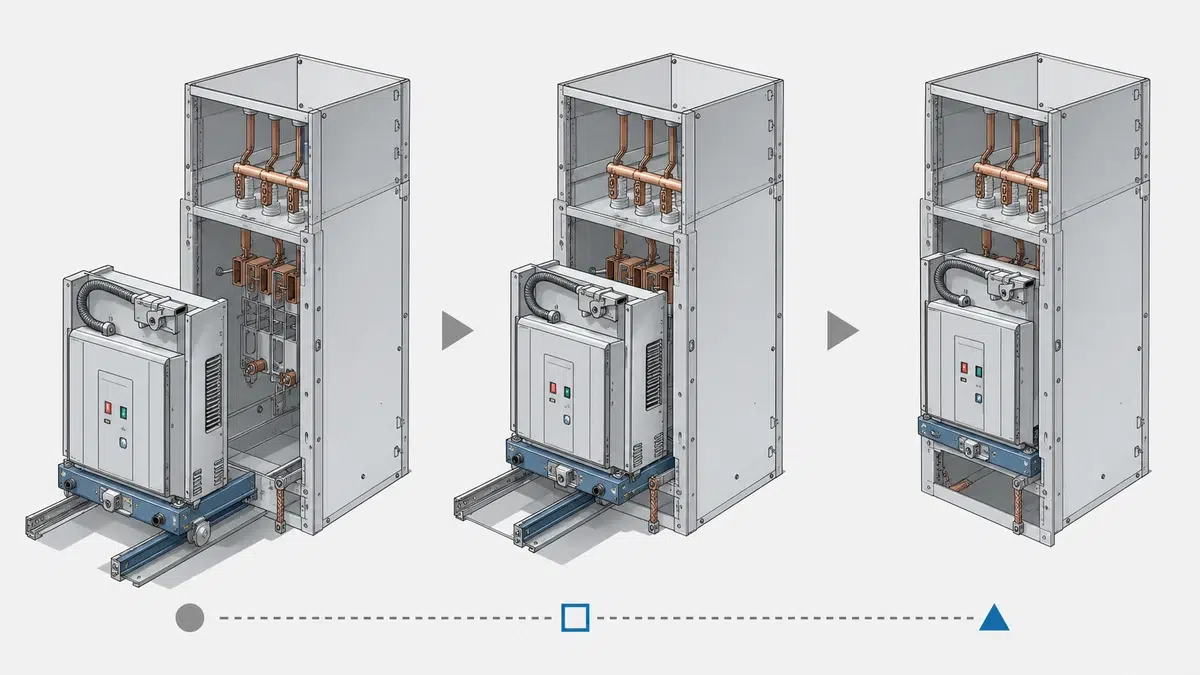
Operating sequence selection should be aligned with the purpose of the test. Schneider guidance notes that IEC 62271-100 operating sequences include O-0.3s-CO-15s-CO for specified short-circuit making, breaking, and mechanical tests, with sequence applicability confirmed against the product documentation.
That sequence should not be copied into every endurance program without review. The test engineer should confirm whether the intended validation is a mechanical endurance run, a short-circuit duty sequence, a functional operation sequence, or a combined test requirement. If an IEC operating sequence is specified by the purchaser or product standard, the applicable product documentation should confirm that the sequence is relevant to the VCB being tested.
For a mechanical endurance validation, the plan may use repeated open and close operations according to the agreed cycle definition. If a specific O-0.3s-CO-15s-CO sequence is required, the report should state why it was used and how the operation count was calculated.
Checkpoints should be defined before the test begins. A checkpoint does not need to interrupt every operation, but it should be frequent enough to detect progressive deterioration before the final cycle count is reached.
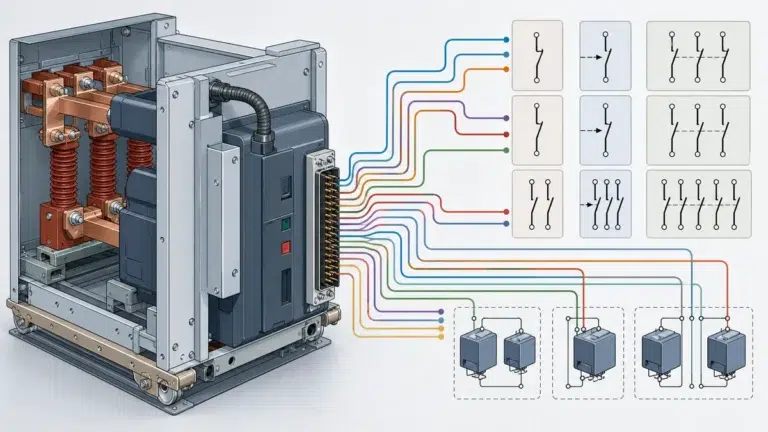
Typical checkpoint records may include the operation counter reading, pass/fail functional result, spring-charging completion, close command response, open command response, visual condition, mechanical indicator behavior, and auxiliary contact response where applicable. If timing, travel, coil-current, or resistance measurements are included, the acceptance limits should come from product documentation or the approved test procedure. The breaker FAT/SAT verification guide provides a companion structure for acceptance criteria, results, and closeout records.
Observed deviations should be logged with the exact operation count. The record should distinguish between a confirmed failure, an operator interruption, a test-equipment issue, and a planned stop. This distinction matters because mechanical endurance validation depends on traceability, not just reaching a final number on a counter.
Maintenance rules are central to the difference between a 10,000-operation validation and a 30,000-operation validation. Siemens 3AE8 documentation notes maintenance-free operation within 10,000 cycles with maintainability within 30,000 cycles for stated ratings, and Siemens SION product documentation states that a 3AE5 may achieve up to 30,000 operating cycles with maintenance work.
The test plan should therefore state whether maintenance is prohibited, allowed only at planned intervals, or required as part of the validation concept. If maintenance is allowed, the work should be limited to the documented procedure for the specific VCB. The report should record the operation count before maintenance, the work performed, parts replaced if any, personnel or organization responsible, and the operation count after maintenance.
A 30,000-cycle result achieved with maintenance should be described as such. It should not be presented as a maintenance-free 30,000-cycle result unless the product documentation supports that exact claim.
Acceptance criteria should be tied to documented requirements rather than invented values. At minimum, the VCB should complete the defined mechanical operation count, perform intended opening and closing functions, and show no unresolved mechanical defect that prevents safe service or contradicts the applicable manufacturer documentation.
If the manufacturer provides limits for timing, mechanism adjustment, lubrication condition, contact travel, contact wipe, auxiliary switch position, spring-charging time, or operating-release performance, those limits should be used. If the purchaser requires additional criteria, they should be stated as project requirements and clearly separated from manufacturer-published ratings.
The final acceptance statement should identify the validated count, such as 10,000 operations or 30,000 operations, the VCB configuration tested, whether maintenance was performed, and the documentation basis for the claim.
The final report should be detailed enough for an independent reviewer to understand what was validated. It should include the VCB identification, documentation references, test equipment identification, cycle definition, baseline inspection, checkpoint records, maintenance records, abnormal event log, final inspection, and conclusion.
The report should avoid broad claims such as “all VCBs are suitable for 30,000 operations.” A correct conclusion is product-specific, for example: the tested VCB configuration completed the defined endurance program to the stated operation count under the recorded test conditions, with or without maintenance as documented.
Photographs or diagrams may be added to show the test setup, mechanism condition, counter readings, and final inspection evidence.
VCB mechanical endurance validation 10k 30k is a test-planning approach for confirming whether a vacuum circuit breaker can complete a documented mechanical operation target of 10,000 or 30,000 operations. The number must come from the applicable product documentation. It should not be assumed across all VCB models or ratings.
The difference is the documented mechanical-life target and, in some cases, the maintenance concept. Siemens SION documentation identifies 10,000 as the maximum permissible mechanical operating-cycle number for the standard version, with an optional 30,000-cycle version. Siemens 3AE8 documentation lists 30,000 mechanical-life cycles for stated ratings and notes maintenance-free operation within 10,000 cycles with maintainability within 30,000 cycles. This means the exact product configuration and maintenance basis must be verified before claiming 30,000 operations.
Before starting, the test owner should confirm the VCB identity, rating, operating mechanism, cycle target, operation-count definition, safety controls, and applicable manufacturer documentation. Safety preparation should include isolation, protection against reclosing, and discharge of the closing spring before maintenance work, consistent with Siemens SION safety instructions.
IEC operating sequences may define how certain making, breaking, and mechanical tests are performed. Schneider guidance notes that IEC 62271-100 includes sequences such as O-0.3s-CO-15s-CO for specified tests, with applicability confirmed against the product documentation. For endurance validation, the sequence should be selected only after confirming that it matches the intended test purpose and the VCB documentation.
A 30,000-operation result should state the exact VCB configuration tested, the cycle definition, the documentation basis for 30,000 operations, whether maintenance was performed, and the final functional condition. If maintenance was part of the validation, the report should clearly say that the result was achieved with maintenance rather than presenting it as maintenance-free.