முழு விவரக்குறிப்புகள் வேண்டுமா?
அனைத்து சுவிட்ச்கியர் பாகங்களின் விரிவான வரைபடங்கள் மற்றும் தொழில்நுட்ப அளவுருக்களுக்கு, எங்கள் 2025 தயாரிப்புப் பட்டியலைப் பதிவிறக்கவும்.
பட்டியல் பெறுக
அனைத்து சுவிட்ச்கியர் பாகங்களின் விரிவான வரைபடங்கள் மற்றும் தொழில்நுட்ப அளவுருக்களுக்கு, எங்கள் 2025 தயாரிப்புப் பட்டியலைப் பதிவிறக்கவும்.
பட்டியல் பெறுக அனைத்து சுவிட்ச்கியர் பாகங்களின் விரிவான வரைபடங்கள் மற்றும் தொழில்நுட்ப அளவுருக்களுக்கு, எங்கள் 2025 தயாரிப்புப் பட்டியலைப் பதிவிறக்கவும்.
பட்டியல் பெறுக

Compare vacuum contactor overhaul and replacement using condition, scope, compatibility, outage paths and a fillable cost worksheet with sensitivity checks.
A vacuum contactor that has stopped performing reliably raises two questions, and they are not the same question. The first is whether the existing unit can be brought back to a defined, supportable condition at all. The second is whether doing so costs less — in money and in lost production — than putting a different unit in its place. Teams that begin with the second question tend to end up comparing one viable option against an option that was never viable, or pricing external parts for a unit whose sealed interrupter has already lost its vacuum.
This worksheet orders the work the other way: condition first, scope second, money third, schedule fourth. Nothing below assumes a particular model, a particular price level or a remaining-life figure. The numbers come from your site and your quotations. The structure is what makes them comparable.
A vacuum contactor is a switching device that interrupts current inside a sealed vacuum envelope rather than in air, oil or gas. Several subsystems matter, and they fail for different reasons.
The interrupting system is one or more sealed interrupters — a bottle with a fixed contact, a moving contact and a metal bellows that lets the moving stem travel while the envelope stays sealed. The drive and mechanism is everything that moves the stem: coil, armature, latch, springs, linkage, and the auxiliary contact blocks that report position. The installation interface is the insulation, the primary and secondary terminations, the drawer or compartment mounting, the shutter and the interlocks.
Each of those ages by its own mechanism, which means each needs its own evidence. The condition gate exists to force that separation before anyone opens a spreadsheet.
Group A covers findings that remove the unit from commercial comparison until they are resolved: a loss of vacuum or a suspect envelope, cracked, tracked or damp insulation, main contacts at the manufacturer’s wear limit, or mechanical damage that affects pole synchronisation or the open gap.
Group B covers the genuinely unknown: no service records, no manufacturer data for the family, or a duty that has changed since the unit was selected. Unknown is not the same as failed, but it is also not an input you can price against. It has to be resolved by inspection or by a decision taken with the uncertainty stated.
Group C covers external findings that may be repairable within a supported scope: coil failure, burned auxiliary contacts, a worn latch, damaged wiring, a failed heater or position switch. These are the cases where a targeted repair competes honestly with replacement, because the part that failed is a part, not the interrupting function.
Contactor selection is a coordination problem before it is a cost problem. If the unit can no longer interrupt the current it will see, or its insulation can no longer hold the system voltage, the cost of restoring that capability is not a maintenance line item — the requirement is set by what the assembly must do and by the protection scheme around it. A cost comparison that places a non-viable option on the same table as a viable one produces a defensible-looking number that answers a question nobody asked. The gate is not caution for its own sake; it is what keeps the comparison meaningful.
The assessment is carried out de-energised, with the unit isolated to the site’s own procedure, by people qualified for that equipment, following the instruction set written for that specific assembly. A manufacturer’s installation and maintenance manual for one medium-voltage control assembly treats mechanical and interlock checks and interrupter integrity as separate inspection items, and notes that contact tip life depends on the severity of service (see the ABB Limitamp installation instructions). Two things follow. The checks answer different questions and neither substitutes for the other. And no interval, instrument setting or wear limit transfers from one product family to another — a number printed in a manual belongs to that manual’s product and to no other.
What checks are performed, with what instrument, at what value, and who is authorised to perform them, is defined by the documentation for the exact unit in front of you. That is deliberately outside the scope of this worksheet; the worksheet assumes the assessment has been done properly and uses its findings.
Four scopes get used loosely in tender conversations, and the cost difference between them is usually larger than the price difference between two bidders quoting the same scope. Pin the scope down first.
| எல்லை | Unit of work | Typical content | What it does not give you |
|---|---|---|---|
| Targeted repair | A part or subsystem | Coil or economiser, auxiliary contact block, latch, spring, secondary wiring, position switch. Parts outside the stated repair scope remain as found | Any statement about interrupter or mechanism condition; any renewal of the assembly |
| Supported overhaul | The contactor as a unit | Wear parts replaced, unit cleaned and adjusted, revised drawings applied, verification to a stated scope, warranty with stated exclusions | Type-test equivalence, or new-unit certification unless that is explicitly claimed and evidenced |
| Contactor replacement | The contactor within its compartment | New or current-production contactor, adapter if the interface differs, control change, commissioning | Compartment-level renewal; protection coordination review unless it is asked for |
| Drawer or panel retrofit | The removable element or the compartment | New element, shutter, interlocks, primary contacts, secondary wiring, protection coordination | A like-for-like swap, or the schedule of a contactor-only change |
The envelope is evacuated and sealed during manufacture. Opening the envelope, cleaning its internal contacts, re-evacuating it or remaking the bellows seal is not a normal field or overhaul-shop maintenance method. Treat the interrupter as a sealed component; any specialized factory remanufacturing proposition would require its own manufacturer-approved process and qualification. There are only two outcomes: the existing sealed part continues in service, or it is substituted by an approved replacement interrupter.
Substitution is itself a design act, not a parts swap. Contact force, travel, bellows stroke, terminal geometry and the mechanical interface all have to suit that particular contactor. That is why interrupter replacement belongs inside an overhaul scope that names the approved replacement, and not inside a generic repair line item.
Once a new interrupter goes into an existing assembly, the assembly around it keeps its own history: mechanism wear, latch condition, insulation exposure, the state of the auxiliary blocks. The new part restores one function. Whether the whole unit is now fit for another decade is a separate judgement, and it should be made from the inspection findings rather than inferred from the invoice.
The same logic applies to the word refurbished. It describes a scope, not a grade. A refurbished unit is a unit that has been worked on to some scope with some verification. Ask which parts were replaced and which were reused as-is, which drawings were revised, what verification was performed and by whom, and exactly what the warranty excludes. A unit that has been cleaned, repainted and functionally checked is not automatically an as-new certified unit, and nothing in a refurbishment offer should be read as certification unless the offer says so and shows the evidence.
Whether the middle option even exists depends on the family. For one manufacturer’s medium-voltage contactor family, the maker’s own service pages place the family outside the active phase and describe lifecycle support as running through original equipment or replacement solutions (see the ABB V-Contact V service page). That is a useful shape for the middle option: support does not necessarily stop at a product-line boundary, but it is defined per family and per lifecycle stage. It is not a general promise. It does not establish that parts exist for every obsolete contactor, it does not transfer to other makers, and it says nothing about XBRELE’s catalogue or service scope.
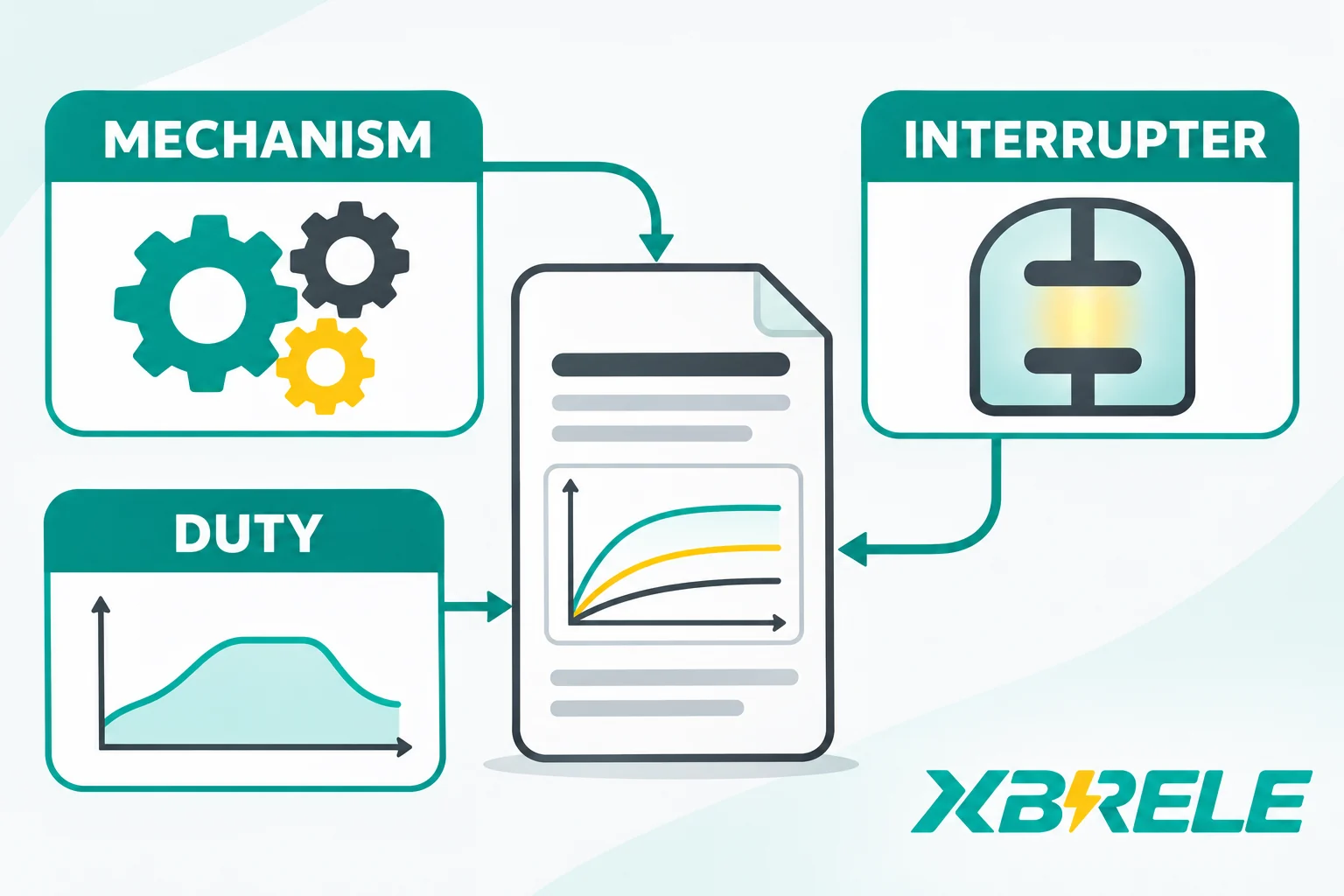
Condition evidence comes in independent categories. Mechanism and drive, interrupter, insulation, and duty fit each answer a different question. A check in one category cannot clear a finding in another, which is why a single measurement never closes the decision.
| கண்டறிதல் | What it tells you | பழுதுபார்த்தல் | Overhaul | மாற்று | பின்னமைத்தல் |
|---|---|---|---|---|---|
| Coil or driver failure, no pickup, chatter, burned coil | Control or drive fault; interrupting function not yet implicated | Yes, if the exact coil and control data are available | ஆம் | Possible, if the compartment interface and control suit | Usually unnecessary |
| Mechanism wear: slow close, latch not holding, poles not together | Mechanical condition degraded; timing and synchronisation at risk | Only if the worn parts are the defined, supported ones | Yes — this is the classic overhaul case | Possible | Possible |
| Main contacts at the wear limit, or vacuum integrity in doubt | The interrupting function itself is degraded or unknown | இல்லை | Only with an approved replacement interrupter in scope | ஆம் | ஆம் |
| Cracked, tracked or damp insulation | Dielectric capability is compromised | இல்லை | Only if the affected insulation is a replaceable, supported part | ஆம் | ஆம் |
| Obsolete, unsupported parts | No reliable route to restore or maintain the unit | Only if a supported part exists | Only where a support route exists for that family | ஆம் | ஆம் |
| Changed duty: higher current, more operations, different load | The unit may not be suited to what it is now asked to do | Does not fix a mismatch | Does not fix a mismatch | Yes, if re-selected for the new duty | Yes, with protection review |
A contact resistance measurement across a closed pole includes the interrupter’s internal contact interface, the external joints and terminals, and the connection points and measurement technique. A proper four-wire method removes lead resistance from the intended measured path. It responds to contact pressure and surface condition, so it can reveal a grossly degraded current path. It cannot measure the pressure inside a sealed envelope, so it cannot confirm vacuum integrity, and it says nothing directly about how much contact material remains. A low reading therefore does not certify the interrupter, and an elevated reading does not by itself prove the bottle is finished. Neither number is a remaining-life figure.
A mechanical operation counter without the current interrupted is an odometer without fuel consumption. Contact tip life depends on the severity of service — that dependence is stated explicitly in the manufacturer documentation referenced above — and the spread between light motor starting and heavy plugging or inching duty is large. An operation count becomes evidence only when it is paired with the duty history: what was switched, at what current, how often. Absent that, it is a number that invites a false conclusion in either direction.
Calendar age correlates with obsolescence and with insulation and elastomer ageing. It is not a retirement date. Two contactors installed in the same year can be in completely different condition if one spent its life starting lightly loaded pumps and the other spent it in a high-frequency plugging duty. Age is a reason to look; the findings are what decide.
If the load, the start frequency or the fault level has changed since the unit was selected, condition is not the only issue. A repair that faithfully restores the original condition restores a unit that may still be undersized for what it is now doing. That is not a maintenance failure, and no amount of overhaul budget fixes it. It is a selection question, and it usually pushes the decision toward replacement or retrofit.
Before any numbers go in, fix the horizon. One comparison horizon, applied to both options — the plant planning interval, or the time to the next major outage. Comparing a ten-year replacement against a two-year repair without costing the second repair inside the same window is the most common way these comparisons go wrong.
| குறியீடு | அர்த்தம் |
|---|---|
| Q | Quoted price for equipment, parts or overhaul labour, against the agreed scope |
| F | Freight both directions, packing, insurance |
| L | Site labour: removal, installation, hours multiplied by your rate |
| E | Engineering and control modifications |
| T | Acceptance and verification testing |
| S | Spares held after the work |
| M | Future maintenance within the horizon |
| H | Planned outage hours on the critical path |
| C_h | Site consequence per outage hour — your estimate, not a market figure |
| p | Assumed probability of a repeat event within the horizon |
| C_r | Assumed consequence of one repeat event |
The comparison is then:
B = Q + F + L + E + T + S + M
K = B + (H × C_h)
Comparison total = K + R, where R = p × C_r, carried separately
B is the planned cost excluding outage consequence. K adds the outage consequence. Quoted and estimated components should remain identifiable in the basis column. R is an assumption and must be labelled as one. Folding R into K hides the difference between a quotation and a guess, and that difference is exactly what the reader of the worksheet needs to see.
| Cost line | குறியீடு | Overhaul | மாற்று | பின்னமைத்தல் | அடிப்படை |
|---|---|---|---|---|---|
| Quoted equipment or overhaul price | Q | Vendor quotation against this brief | |||
| Freight, packing, insurance | F | Carrier or forwarder quote | |||
| Site labour: removal and installation | L | Your labour rate and hours estimate | |||
| Engineering and control modifications | E | Drawing and programming estimate | |||
| Acceptance and verification testing | T | Defined by the acceptance brief | |||
| Spares held afterwards | S | Inventory decision | |||
| Future maintenance in horizon | M | Service plan for this option | |||
| Planned outage hours | H | Critical-path estimate, next section | |||
| Site consequence per outage hour | C_h | Your production and restart estimate | |||
| Known planned cost | K | B + H × C_h, with B as defined above | |||
| Assumed repeat-event probability | p | Explicit assumption, or blank | |||
| Assumed consequence of one event | C_r | Explicit assumption, or blank | |||
| Risk estimate, labelled | R | Kept out of K | |||
| Comparison total | K + R | Used for sensitivity, not for a single answer |
Same scope. Every line must be quoted against the same acceptance brief, described in the next section. A cheap Q against a narrow scope is not a cheap option.
Same horizon. If one option needs two interventions inside the window and the other needs one, both appear in M and in H.
No invented numbers. A blank entry is legitimate and honest. An assumed price that nobody owns is neither, and it will survive into the decision because it looks like data.
C_h belongs to your plant. It is the cost of the plant being unavailable for one hour: restart losses, scrapped or degraded product, idle labour, penalty exposure, downstream storage. If it cannot be quantified, run the comparison as a curve over a plausible range rather than picking a single value.
R stays outside K. If a repeat-event assumption changes the answer, that should be visible, not buried.
When one option has the higher known cost but the shorter outage, the crossover is:
C_h* = (B_high − B_low) / (H_low − H_high)
where high is the option with the higher cost excluding outage consequence, B, and the shorter outage. Using K in this numerator would count the outage consequence twice. Below C_h*, the lower-cost option wins on known cost. Above it, the shorter outage wins. If the outage difference is zero, there is no finite outage-cost crossover. If the higher-B option also has the longer outage, increasing C_h cannot make that option cheaper on these planned-cost terms; other benefits or risk assumptions would have to justify it.
The limits of that formula are worth stating every time it is used. It only covers the rows actually entered, so a missing line breaks it. It ignores how the two options are financed or depreciated. It excludes R by construction. And it assumes the outage hour figures are genuinely on the critical path, which is the subject of the next section and is where optimistic estimates usually fail.
Two clocks run in this decision and they rarely agree. Calendar lead time starts at the purchase order and ends when the goods reach site; most of it can run while the plant is still producing. Outage time starts when the unit comes out of service and ends when it is back in. Only the second one costs C_h.
The outage follows a critical path: isolation and permit, removal, an inspection hold if the scope is not yet fixed, shop work and logistics, refit, control and interlock validation, acceptance, return to service. The longest chain governs, and preparation that can happen before shutdown shortens the chain without changing the lead time at all.
| Critical-path step | Can it run before shutdown? | Carried by | What drives its duration |
|---|---|---|---|
| Isolation and permit | இல்லை | அனைத்தும் | Site procedure and access |
| Removal | இல்லை | அனைத்தும் | Physical access, weight, terminations |
| Inspection hold | No, unless the scope is already known from a prior teardown | Overhaul, mainly | Discovery of additional findings |
| Shop work and logistics | Before shutdown only for another prepared/spare unit; otherwise it follows removal | Overhaul | Shop queue, parts availability, transport |
| Refit and fit-up | இல்லை | அனைத்தும் | Interface fit; adapters for replacement |
| Control and interlock validation | Preparation only | Replacement, retrofit | Coil and control voltage, auxiliary logic, interlocks |
| ஏற்றுக்கொள்ளுதல் | Preparation only | அனைத்தும் | Defined criteria; witnessed or not |
| Return to service | இல்லை | அனைத்தும் | Site procedure |
An overhaul’s scope is partly unknown until the unit is open. That is not a vendor failing; it is what overhaul means. The consequence is a genuine schedule risk that cannot be quoted away, only managed. Three ways to manage it: hold a compatible spare element so the plant is not hostage to the teardown, stage the work with a defined decision point after inspection, or accept the risk explicitly with a contingency in the outage estimate. What does not work is treating the shop’s best-case turnaround as the outage.
A verified compatible spare can shorten the outage when its preparation is complete before shutdown. Isolation, removal, refit, required installed-interface checks and the release procedure still remain on the critical path. The word verified is doing the work in that sentence. Compatible means the frame and mounting interface match, the ratings and duty suit the actual load, the coil and control voltage match the existing control supply, the auxiliary contact configuration satisfies the scheme, the interlocks and shutter work with the compartment, and protection settings are re-checked against the replacement. If any of that is assumed rather than checked, the discovery moves onto the critical path and the outage grows while the plant is down.
Replacement usually has a predictable outage but not necessarily a short one, because an adapter, a control change and a commissioning sequence may all be needed. A retrofit can have a longer installation path because it may touch compartment interfaces, shutters, interlocks, primary and secondary connections and protection coordination. Actual outage duration depends on preparation, access and the defined scope.
Put H on the table as a range rather than a single figure, then read the total at both ends. When C_h is large, a modest difference in outage hours can outweigh a substantial difference in quoted price, and the ranking flips. A repeat-event assumption can flip it the other way: an option with a shorter outage but a higher assumed p × C_r can finish second on the comparison total. Neither flip is a reason to distrust the worksheet. It is the worksheet doing its job — showing which assumption the decision actually rests on, so that assumption gets the attention.
Two quotations written against two different briefs do not produce a comparison. They produce two documents that happen to contain prices. Write the brief once, send it to every bidder, and require each to answer it in the same order.
| Brief item | What to specify | Why it changes the comparison |
|---|---|---|
| Identity and configuration | Family, model, rated voltage and current, poles, mounting or drawer interface, terminal geometry, overall dimensions | A different interface adds an adapter, engineering hours and outage time |
| கடமை | Utilisation category and duty class for the actual load, starts per hour, the current actually interrupted, expected operations in the horizon | A unit selected for lighter duty will not be a fair comparison, whatever its price |
| Coil and control | Voltage, AC or DC, inrush and holding values, economiser arrangement, control terminals | A different control supply means a control modification in E, and often a longer validation step |
| Auxiliary contacts | Number and form of NO and NC, timing, spare capacity for future logic | Insufficient auxiliary capacity forces an external relay scheme |
| Interlocks and mechanical interface | Shutter operation, position indication, mechanical interlock with the compartment and earthing arrangement | Interlock incompatibility can invalidate a replacement option outright |
| Protection coordination | Fuse or relay coordination, short-circuit withstand of the assembly, current-limiting fuse rating and striker arrangement | Coordination work is engineering scope that has to be quoted, not assumed |
| ஆவணங்கள் | Drawings, manual, test records, and the scope of any declaration of conformity supplied | Undocumented units cannot be accepted against defined criteria |
| ஏற்றுக்கொள்ளுதல் | Which tests, performed by whom, against which criteria, witnessed or not, with records handed over | Undefined acceptance becomes a dispute at the worst moment |
| உத்தரவாதம் | Duration, exclusions, proration, who pays return freight, what happens to reused parts | Ask whether reused parts are covered or excluded in this quotation |
| Responsibility split | Who isolates, removes, installs, commissions, and who owns each interface | A gap between two suppliers lands on the critical path |
Ask each bidder to state plainly what they will not do. The exclusions section usually carries more decision-relevant information than the inclusions, because it is where the interface gaps and the reused-as-is parts surface.
A decision is ready to sign when it consists of five documents, not one: the condition-versus-option matrix with the evidence behind each row, the filled worksheet with a basis column that names the source of every number, the outage critical path with its contingency and its sensitivity range, the two quotations written against the single brief, and the acceptance criteria with the actual warranty scope attached. Where a line is blank, the blank is part of the record — it marks a risk carried deliberately rather than a number invented to fill a cell.
If the replacement side of the comparison is still open, the XBRELE vacuum contactor catalogue lists the families available for configuration review — the CKG vacuum contactor, the JCZ vacuum contactor, the LCZ high-voltage series and a low-voltage and solid series — and each entry is a starting point for a configuration discussion, not a confirmation of fit, stock or certification. Send the completed brief and your project data package through the XBRELE contact page so the ratings at your duty, coil and control data, terminal and mounting dimensions, and auxiliary and interlock arrangement can be checked against the actual requirement. None of this constitutes an offer to overhaul another maker’s units, to supply from stock, or to certify a retrofit as equivalent to the original.
No. Age tells you about obsolescence and about slow ageing of insulation and elastomers; it does not tell you the condition of a sealed interrupter, how much contact material remains, or whether the unit suits the duty it now carries. Two contactors installed in the same year can be in completely different condition if one spent its life on light pump starting and the other on frequent plugging duty. Age is a reason to inspect, not a finding — the inputs that actually decide are the condition evidence for this unit, the support route for its family, and the duty it must now meet.
For normal field or overhaul-shop maintenance, treat the interrupter as a sealed replaceable component. Internal cleaning, re-evacuation and resealing are outside that maintenance scope; a specialized factory proposition would need separate manufacturer qualification. The real choice is between keeping the existing sealed interrupter in service and substituting an approved replacement part within a defined overhaul scope. Whether a replacement interrupter exists for a particular contactor is a parts and support question that has to be answered before that option can be priced honestly.
It settles one line of the worksheet. Q sits beside freight, site labour, engineering and control modifications, acceptance testing, spares, future maintenance inside the same horizon, and the planned outage multiplied by your site’s consequence per hour. If the two options also differ in how many interventions they need within the horizon, or in the assumed repeat-event term, the lower Q can still be the higher total. Compare K, keep R separately labelled, and run the outage-hour sensitivity before committing.
Not necessarily. Lead time is calendar from order to delivery, and most of it can run while the plant keeps producing. Outage is the interval from taking the unit out of service to putting it back, and it follows its own critical path: isolation, removal, an inspection hold if the scope is not yet fixed, shop work and logistics, refit, control and interlock validation, acceptance, and return to service. An option with a long lead time but a short critical path — a verified compatible spare already on site, for instance — can deliver a far shorter outage than a quick delivery that then needs an adapter, control changes and commissioning.
No. A contact resistance measurement is a useful cross-check of the current path, and it moves with contact pressure, joint condition and test technique. It does not measure the pressure inside a sealed envelope, so it cannot confirm vacuum integrity, and it says nothing about remaining contact material. It is one reading in one evidence category, sitting alongside mechanism and drive condition, insulation condition and duty fit — and a good reading in one category does not clear a finding in another.
Then the real comparison is between an overhaul that has a support route and a retrofit that includes the interface, and those are different sizes of job. Cost it as a retrofit: adapter or new element, shutter, interlocks, primary and secondary connections, and protection coordination, with the longer critical path that goes with it. Where the existing family is out of active production, lifecycle support through original equipment or replacement solutions may exist, but that support is family-specific and has to be confirmed rather than assumed from another product line.