முழு விவரக்குறிப்புகள் வேண்டுமா?
அனைத்து சுவிட்ச்கியர் பாகங்களின் விரிவான வரைபடங்கள் மற்றும் தொழில்நுட்ப அளவுருக்களுக்கு, எங்கள் 2025 தயாரிப்புப் பட்டியலைப் பதிவிறக்கவும்.
பட்டியல் பெறுக
அனைத்து சுவிட்ச்கியர் பாகங்களின் விரிவான வரைபடங்கள் மற்றும் தொழில்நுட்ப அளவுருக்களுக்கு, எங்கள் 2025 தயாரிப்புப் பட்டியலைப் பதிவிறக்கவும்.
பட்டியல் பெறுக அனைத்து சுவிட்ச்கியர் பாகங்களின் விரிவான வரைபடங்கள் மற்றும் தொழில்நுட்ப அளவுருக்களுக்கு, எங்கள் 2025 தயாரிப்புப் பட்டியலைப் பதிவிறக்கவும்.
பட்டியல் பெறுக
Two dry-type transformers can carry the same rating, fit into the same electrical room, and still age very differently, because moisture, contamination and maintenance affect the complete insulation and cooling arrangement. Cast resin surrounds a coil with a solid moulded envelope; vacuum pressure impregnation (VPI) fills the voids inside a winding that is already insulated. Neither construction is the better answer in the abstract. The decision turns on three things that have to be judged together: what the winding is exposed to, whether the enclosure can still remove heat at the intended loading, and whether anyone can realistically clean, inspect, and eventually replace the unit on the maintenance arrangement the site actually has.
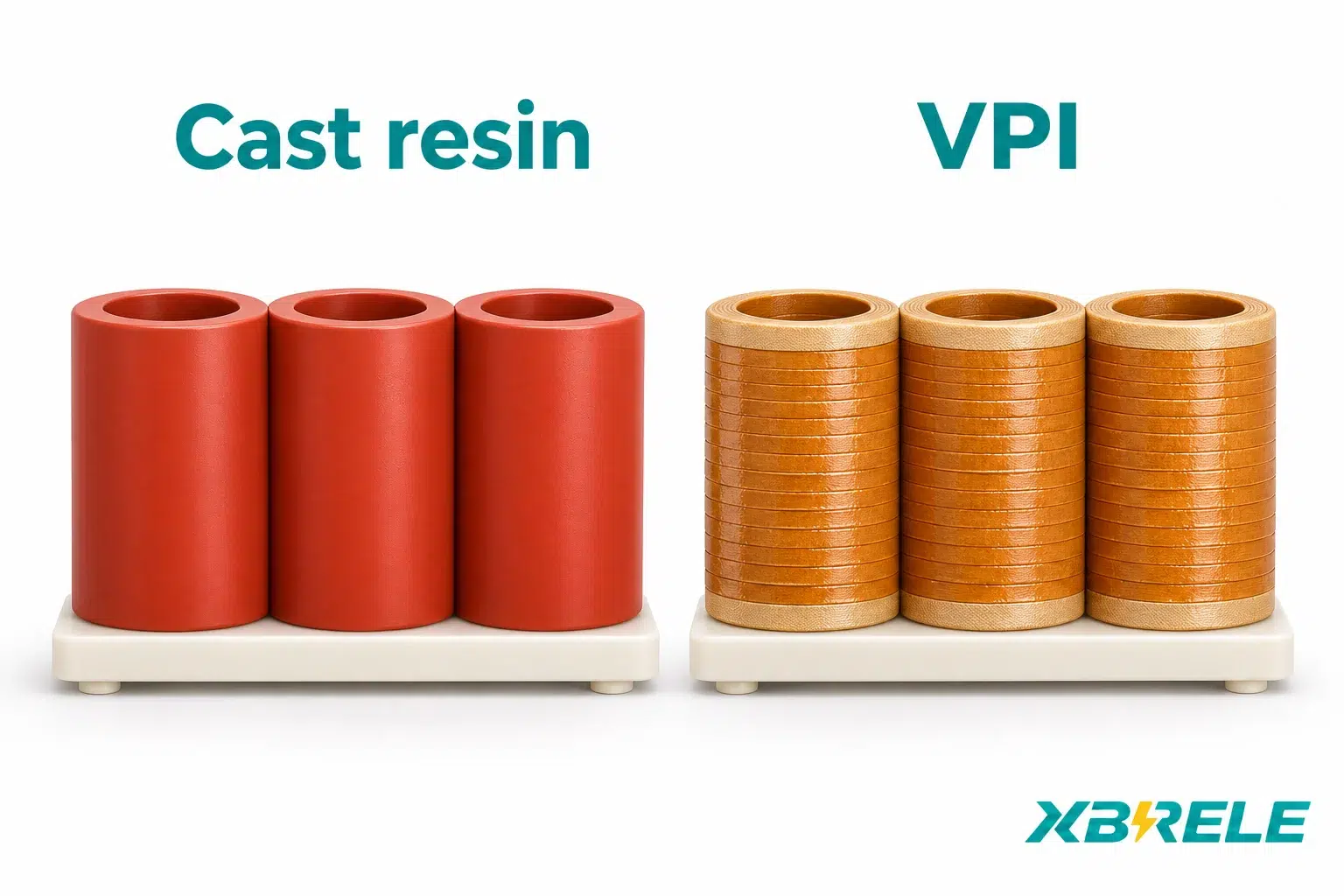
The two terms are often used as if they described competing materials. They describe different material relationships, and the difference matters when you write a specification.
Impregnation is penetration. VPI uses vacuum and pressure to introduce varnish or resin into an already insulated winding. The treatment penetrates the insulation structure and also leaves material on its surfaces; it does not turn bare, uninsulated conductors into a finished coil. The important distinction is how the insulation system is treated, not whether the winding has insulation at all. Hammond Power Solutions distinguishes impregnation from encapsulation by penetration into the winding versus encasement around it.
Encapsulation is encasement. In a moulded cast-resin coil, resin forms a solid envelope around the winding. Vacuum processing helps reduce moisture and voids during casting. The envelope protects embedded insulation and contributes mechanical support, while its outer surface can still collect moisture and dirt. Creepage distance is measured along an insulating surface; electrical clearance is the distance through air. Both remain relevant around terminals and adjacent parts. Resin thickness, winding geometry and cooling ducts are designed together. Eaton’s design guide, in its cast-coil design section, explains the balance between protection and thermal stress; it does not establish that every cast-resin design runs hotter than every VPI design.
The two can coexist. A cast coil is normally impregnated as well as encapsulated, so “cast resin versus VPI” is really shorthand for solid envelope versus consolidated open winding — a difference in how much of the winding is exposed, not a difference between treated and untreated.
VPE is a supplier-specific addition, not a universal standard. Where it appears, it generally means an extra sealant or encapsulation stage applied over an impregnated winding — one manufacturer describes a multiple-sealant process aimed at more demanding contamination, another offers an additional encapsulation option alongside its VPI construction. Because the process name and the number of layers vary by supplier, VPE on a data sheet tells you less than a description of what is actually applied, in what sequence, and how thick. Ask for that description rather than the acronym.
The high-voltage and low-voltage windings need not match. A dry-type transformer is not obliged to use one treatment throughout; some designs cast the primary winding in resin while using VPI or VPE on the secondary, as noted in Schneider Electric’s distribution design guide. Any quotation that assigns a single unqualified label to “the transformer” is incomplete for comparison purposes.
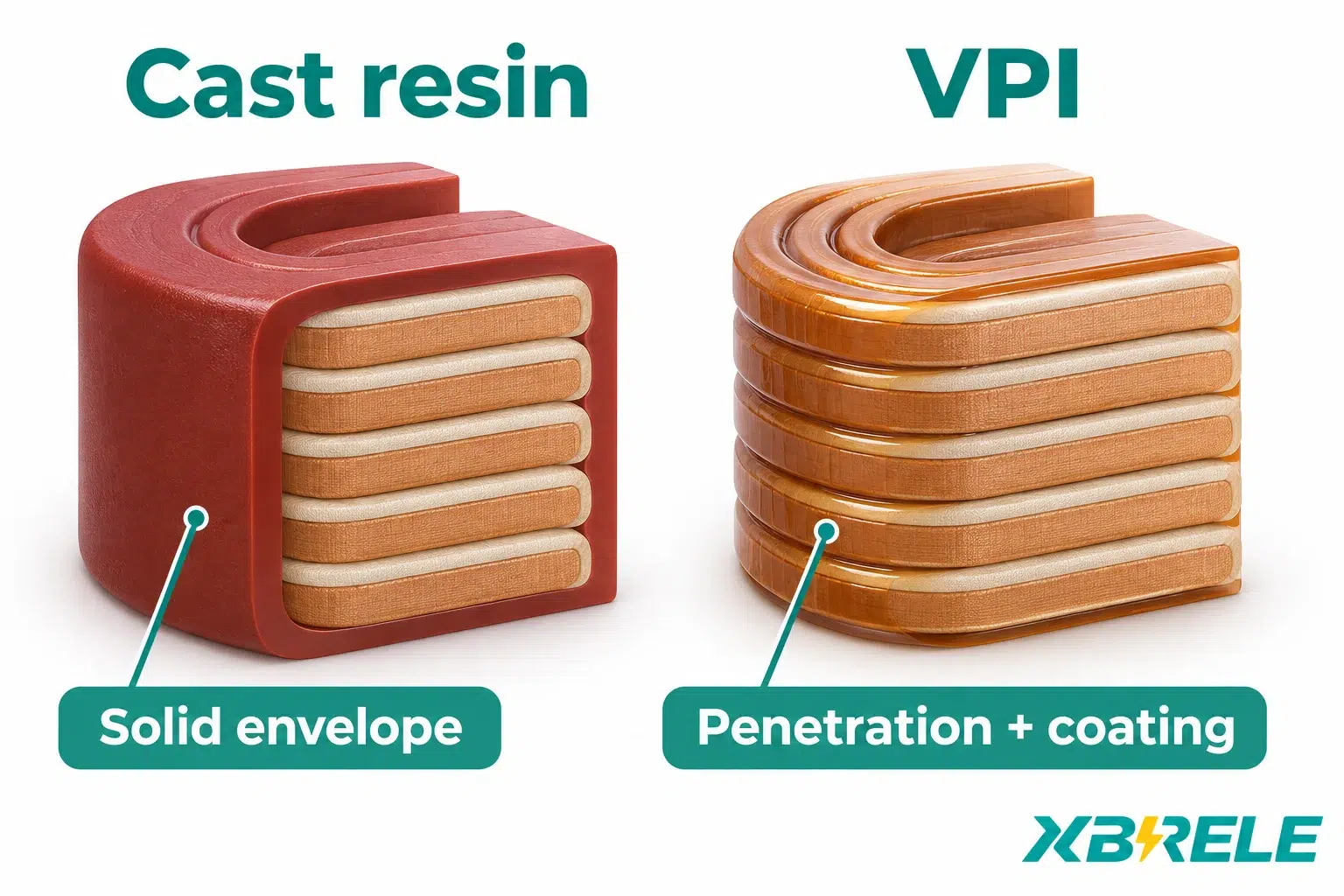
A cast envelope separates embedded winding insulation from contamination on the outside. That protection has a boundary: the resin surface and the rest of the assembly still face the installation environment.
Look at a dry-type unit as a system. The coil body may be sealed, but the following remain exposed to the same air the transformer breathes: terminals and cable lugs, phase barriers and spacers, support insulators, the core and its clamping structure, the cooling ducts between coil sections, fan blades where forced cooling is used, the enclosure louvres or filters, and any control or temperature-sensor wiring. Condensation and conductive deposits form on those surfaces whether or not the coil is cast. A cast-resin coil therefore changes which insulation is directly exposed; it does not remove external leakage paths.
It also helps to separate three conditions that are routinely lumped together as “humidity”:
The failure mode that connects these is surface tracking. Condensation wets a creepage path; conductive dust, cement kiln dust, salt from coastal air or metal-bearing process dust deposits on it; the combination forms a leakage path across a spacer or terminal barrier that the design never intended. Carbonised or damaged insulation needs assessment; removing loose dirt does not establish that its dielectric condition has been restored. That is why the maintenance arrangement matters as much as the construction: the protective construction and the inspection and cleaning plan must address the same actual exposure.
Two practical consequences follow. First, “cast resin” is not a waterproof rating, and neither is “VPI.” Water resistance belongs to the enclosure and the installation, and should be discussed as a property of the complete assembly. Second, when you compare offers, compare the exposed creepage paths — terminal spacing, barrier arrangement, duct geometry — and not only the coil. Evaluate the offered terminal and barrier arrangement, winding treatment and environmental evidence together. The labels alone cannot establish equivalent performance.
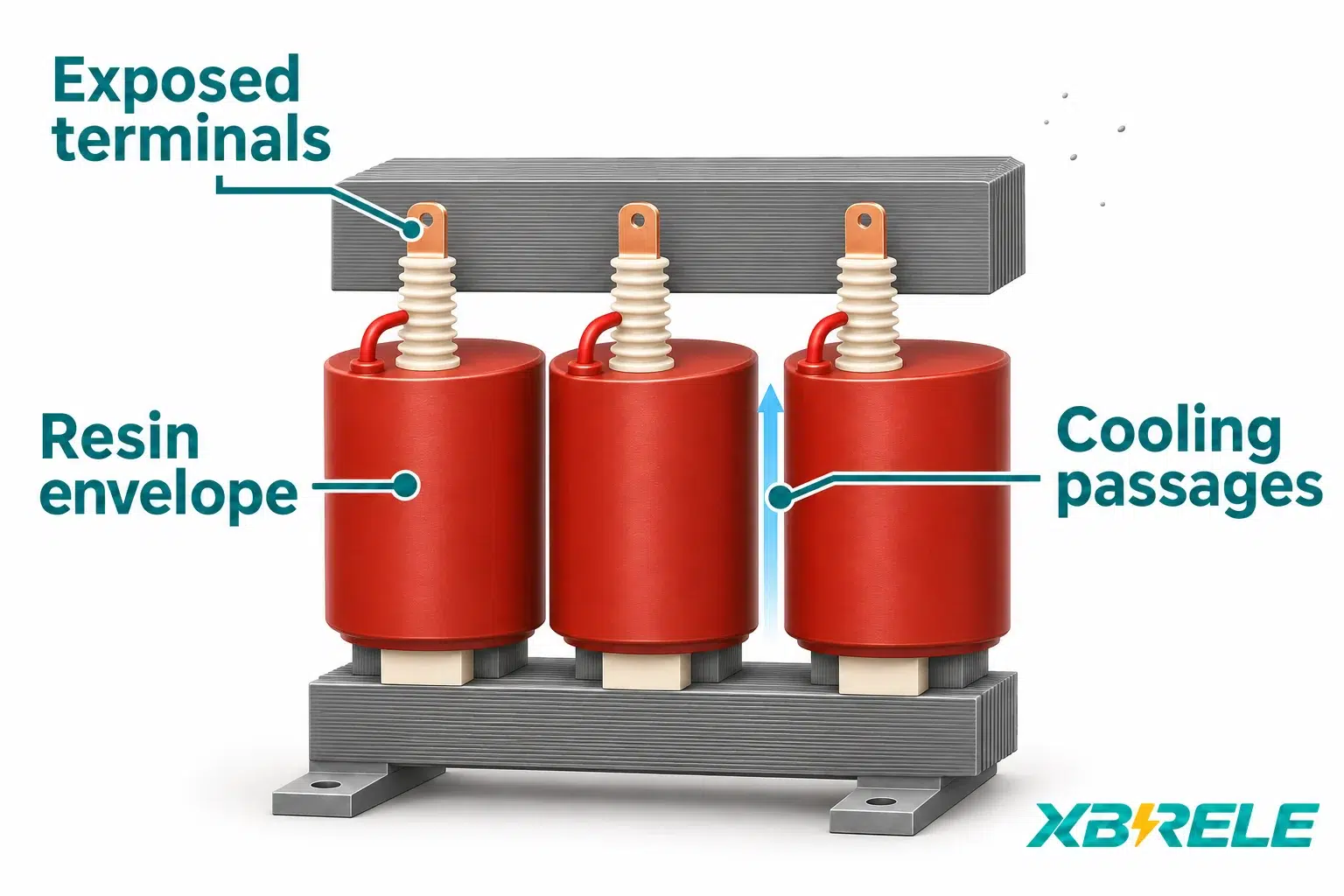
Dry-type transformers reject their losses to air. The same air path that carries heat away also carries dust, salt and moisture in, so every enclosure decision is a trade in both directions.
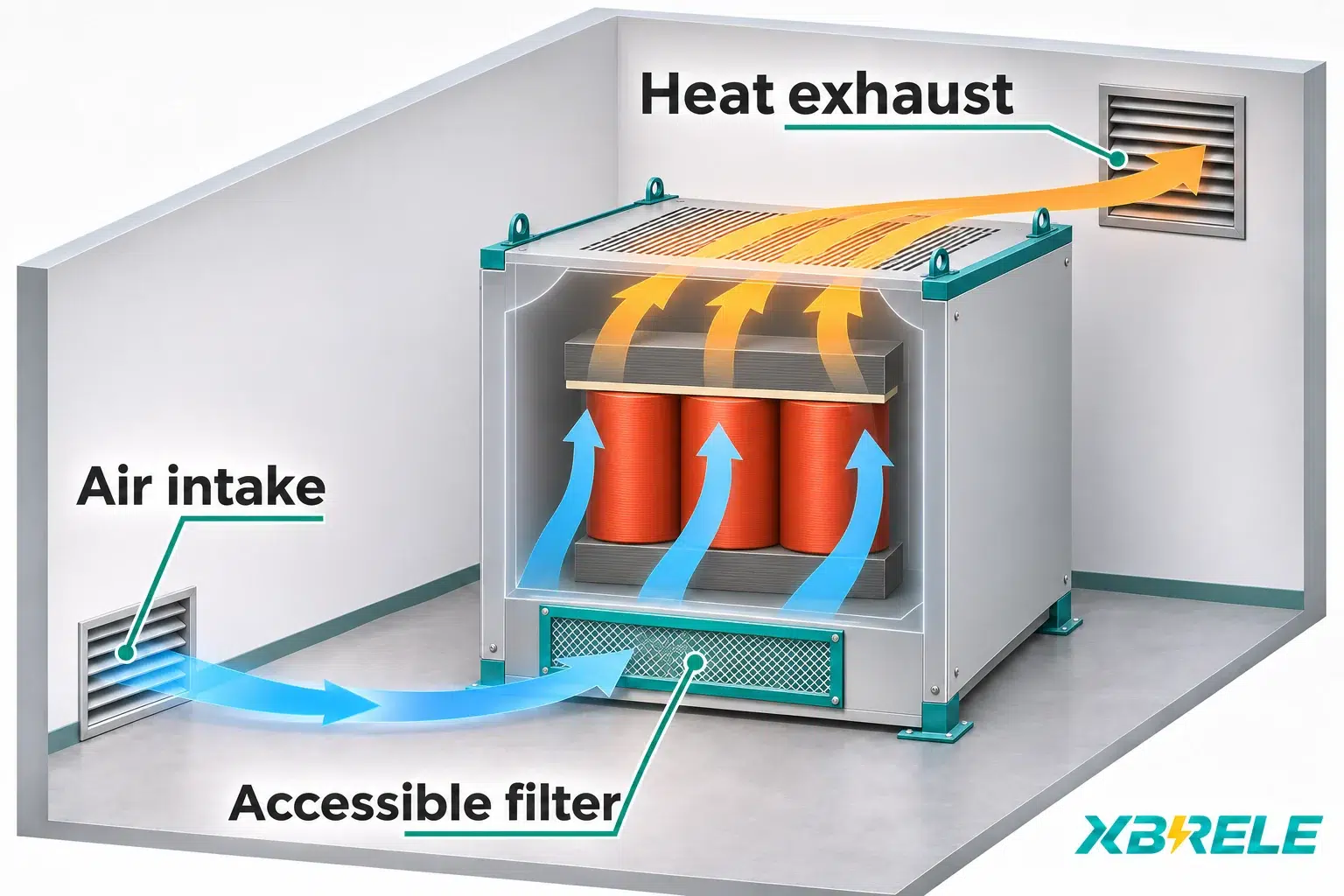
Tightening the enclosure excludes contaminants and simultaneously restricts free convection. If enclosure or filter resistance restricts cooling below the design requirement at the intended loading, winding temperature can rise — and because insulation ageing is strongly temperature-dependent, an enclosure added for environmental protection can introduce a separate thermal ageing problem. Filters do not remove this trade; they relocate it into a maintenance task. A loaded filter bank behaves like a blocked duct, and if the filter is not on a route that someone actually walks with a replacement element, the restriction arrives gradually and silently.
Assess the air at the actual intake, not the room average. A transformer standing beside a roller door that opens onto a yard, or downstream of a nearby grinding operation, sees a very different inlet stream from the one the room’s design condition describes. The common mistake is to size the thermal case on the conditioned-room number and then place the unit in the dirtiest corner of that room.
An example of how the reasoning reverses: a project initially specifies a VPI unit inside a gasketed enclosure with a filtered inlet, because the room adjoins a loading dock and the designer wants the open winding protected. The room is small and has no mechanical extract, and the filter is behind a bolted panel. Once the filter loads up, the enclosure becomes a heat trap and the winding runs hotter than it would have unprotected — the protection strategy has defeated itself. Three legitimate responses exist: move the intake to a cleaner wall and keep the filter accessible from the operating aisle; keep the filter but re-rate the thermal case honestly and accept the derating; or evaluate a different winding and enclosure combination with an adequate heat-removal path and documented suitability for the actual contamination. Cast resin may be one candidate, but it does not justify extending the cleaning interval or removing required enclosure protection. Which one is right depends on the heat loss at the intended loading, the room’s ability to absorb it, and who is available to change a filter.
Virginia Transformer’s installation guidance treats ventilation and accessibility as location-planning inputs, notes that clean dry air is the desirable case, and points to filtered air where contamination justifies it. What it does not do is give a number that transfers to your room. Heat loss at your loading, inlet temperature at your intake, and the maintenance interval your organisation will actually sustain are the inputs that decide the case.
The word “serviceable” hides two very different tasks, and mixing them up is what produces disappointed maintenance teams.
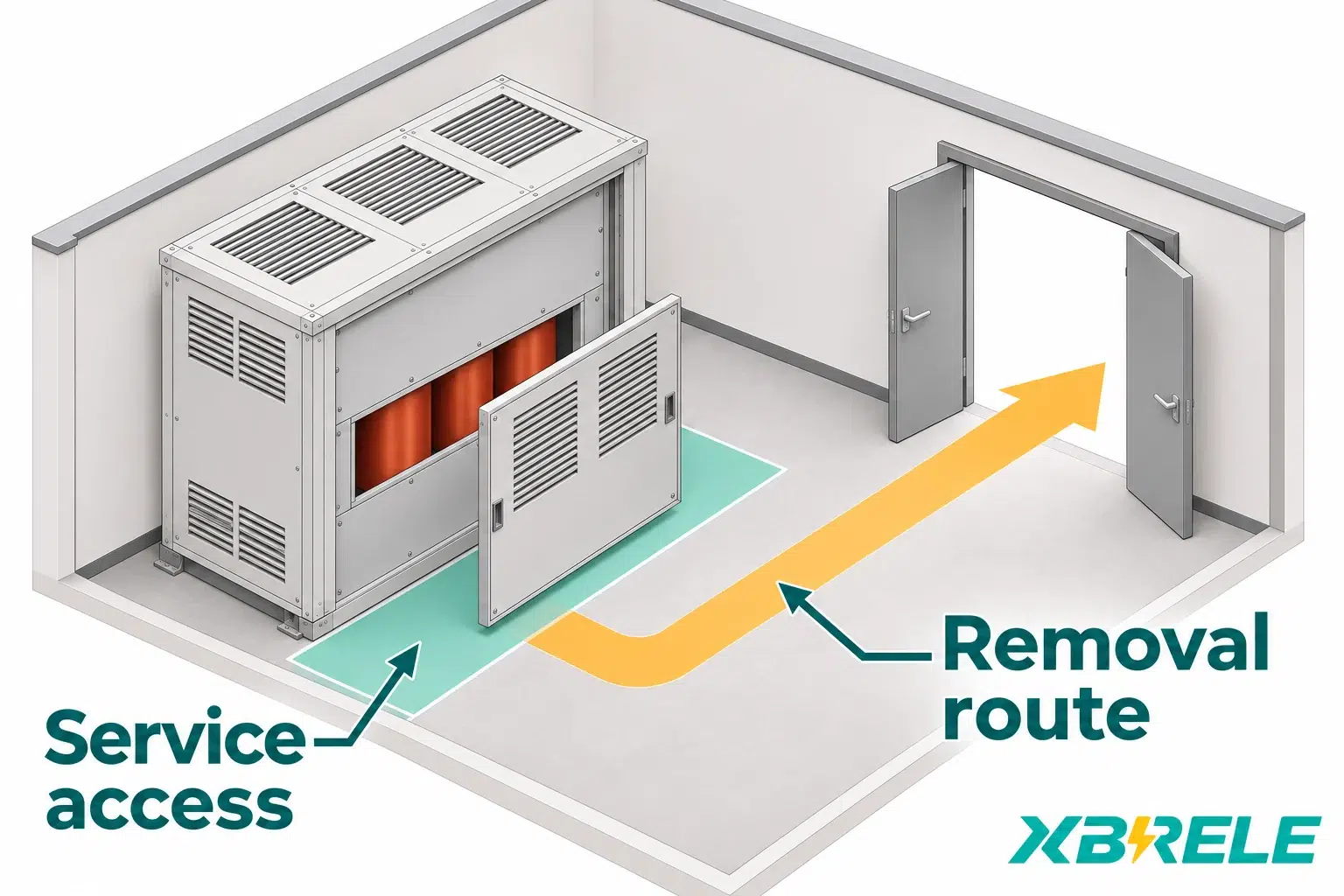
Routine service is inspection, cleaning, connection checks, filter and fan attention. It depends on access: removable enclosure panels for inspection, room to reach terminals with a torque wrench, space to clean duct surfaces, and a route to the front of the unit that does not require dismantling a cable tray. This kind of work is common to both constructions and is the bulk of what a transformer needs over its life. Guidance for dry-type units is consistent on two points — the operating conditions determine how much maintenance is required, and service work is carried out by qualified personnel with the transformer de-energized, following the equipment-specific procedure.
Winding repair is a different category. A cast-resin coil has its turns embedded in a solid body, so an internal winding fault should not be planned as a routine field repair. The manufacturer must assess the damage and whether a qualified repair, coil replacement or unit replacement is appropriate. A cosmetic surface patch does not establish restoration of an internal insulation fault. An impregnated open-wound coil is more accessible in principle, and a supplier may be able to evaluate re-impregnation or rewinding — but that is a supplier capability question with a logistics answer, not a property you can assume from the construction name. For either construction, ask what repair scope the supplier actually supports, where it is performed, and how the repaired assembly would be verified.
What you can compare objectively, and should, is the replacement route:
A cast-resin unit with a documented removal path and a known replacement lead time is often more serviceable in practice than an impregnated unit that looks repairable but is installed where nothing can reach it. Serviceability is a property of the installation as much as of the coil.
Use the site condition to set a provisional direction, then let the evidence change it. No row produces a universal winner.
| Site condition | Provisional direction and reason | Evidence to obtain before committing |
|---|---|---|
| Clean, conditioned electrical room; stable temperature; filtered air; regular inspection | Both are candidates. Where contamination is controlled, compare the actual offered losses, temperature-rise performance, enclosure and access instead of selecting by the process name | Heat loss at intended loading, room cooling capacity, actual inlet temperature, and the enclosure configuration used for the thermal verification |
| Recurring condensation, frequent shutdowns or standby duty | Evaluate cast-resin or a suitably protected impregnated design for the specified exposure. A cast envelope protects embedded insulation; its surface and external interfaces may still condense. Shutdown moisture control and the equipment-specific return-to-service checks remain necessary | Dew-point and shutdown records, heater or ventilation provision, the written energisation routine, and who performs it |
| Conductive dust, cement or carbon dust, coastal salt | Cast resin separates embedded insulation from deposits on its exterior. Additional encapsulation is another candidate, whose protection depends on the actual process and design. Terminal creepage and cleaning access become the deciding details in both cases | Actual inlet air quality, planned cleaning frequency and method, the degree of protection of the complete assembly, and the supplier’s written description of the layers applied |
| Restricted heat-removal path — small room, no duct, high ambient, enclosure added late | A tighter enclosure may raise temperature if its added airflow resistance prevents adequate heat rejection, undermining the environmental benefit. The room, not the winding label, is the binding constraint | Heat loss data at the intended loading, room air-change capability, measured inlet temperature at the intake, and the derating consequence of the proposed enclosure |
| Remote site with scarce repair resources | Favour what can be inspected and cleaned with local skills, and what can be replaced on a known schedule. An internal winding failure in either construction means a supplier conversation | Written replacement lead time and spares proposal, removal drawings, maintenance instructions the local team can actually follow |
Fill this brief before asking for prices, because it is the input a supplier needs to give a meaningful answer:
Two short contrasting cases show how the conclusion moves.
Case one. Consider a clean, conditioned electrical room with high sustained loading and a tight removal route. Contamination control is already good, so an offered VPI design is a reasonable candidate if its losses, verified temperature rise and enclosure suit the room. Compare the cast-resin offer on the same basis. If it has the better verified thermal arrangement or fits the removal route more easily, the label alone provides no reason to reject it. Actual dimensions and weight, not the insulation acronym, determine the handling constraint.
Case two. Move the duty to a dock-side room with salt-bearing air and seasonal shutdowns. The decision now gives more weight to protection of embedded insulation and the exposed terminal arrangement. Cast resin becomes a useful construction to evaluate, alongside a suitably encapsulated alternative, using evidence for the stated environment. If the local cleaning campaign cannot control deposits between visits, change the air treatment, siting or maintenance provision; do not assume a resin envelope makes that interval acceptable. The offer also needs a credible shutdown moisture-control and return-to-service plan.
The difference between the two cases is not the transformer rating. It is the room, the loading, and the maintenance arrangement.
Put these on the inquiry, and require an answer per item rather than a general brochure statement:
For a cast-resin proposal, use XBRELE’s dry-type transformer product page and send the room conditions, duty, proposed enclosure and service-access brief through the contact page. State the required winding construction explicitly so the proposed scope can be confirmed. The transformer knowledge hub provides related selection material. If the earlier choice between dry-type and liquid-filled equipment is still open, start with the dry-type versus oil-filled comparison before specifying the dry-type winding treatment.
No. Cast resin seals the coil, not the transformer. Terminals, phase barriers, spacers, the core, cooling ducts and the enclosure all remain exposed to the same air, and water can still reach them by condensation, spray or drip. Water resistance is a property of the complete assembly — its enclosure, its degree of protection, its siting and its drainage — and it has to be specified and verified there. The resin envelope protects embedded insulation, while its outer surface may still become wet or contaminated. Evaluate the complete assembly for the actual site conditions.
No, and the misconception causes real specification errors. A VPI winding is built from insulated conductors and then dried and impregnated under vacuum and pressure, so the resin penetrates the winding structure and consolidates the insulation system. The winding is treated before it ever sees service. What distinguishes it from a cast coil is that the solid material sits within and around the winding structure rather than forming a thick external shell. If anything, a poorly impregnated winding is a void problem rather than a bare-copper problem, which is why the process control behind the impregnation matters more than the acronym.
No — and the two kinds of work should be separated. Cleaning, inspecting, checking connections and changing filters are routine tasks that both constructions need, and they depend on access, not on the coil type. Repair of an internal winding fault is a different matter: embedded turns in a cast-resin coil restrict access, while an impregnated winding may offer different repair options. The damage, supplier capability and logistics determine what is feasible. Neither should be planned as a field repair. What you can compare is the replacement route — removable panels, connection access, lifting points, the path out of the room and a written lead time.
Yes. Mixed arrangements exist where the primary winding is cast in resin and the secondary is impregnated, and the same pattern appears with additional encapsulation applied to one winding only. This is precisely why a single label on a quotation is not enough for comparison: the exposure, the thermal path and the service implications differ between the two windings, and a unit that is “cast resin” on the HV side may be an open impregnated winding on the LV side. Ask for the treatment of each winding separately, in writing.
No. Humidity is one input among several, and it is not even a single input — ambient vapour, condensation during cooldown and direct water ingress behave differently and call for different responses. Condensation plus conductive dust is a surface-tracking problem that affects exposed creepage paths regardless of how the coil is built, so the cleaning arrangement and the terminal detailing often decide the outcome. Meanwhile the enclosure chosen to exclude that contamination can restrict heat removal and raise winding temperature, which is its own ageing mechanism. The decision needs humidity, contamination, heat path and maintenance access assessed together.