Request a Quote for High-Voltage Components&Equipment

Tell us your requirements — rated voltage, model, quantity, and destination — and our XBR Electric team will prepare a detailed quotation within 24 hours.
Contact Form Demo
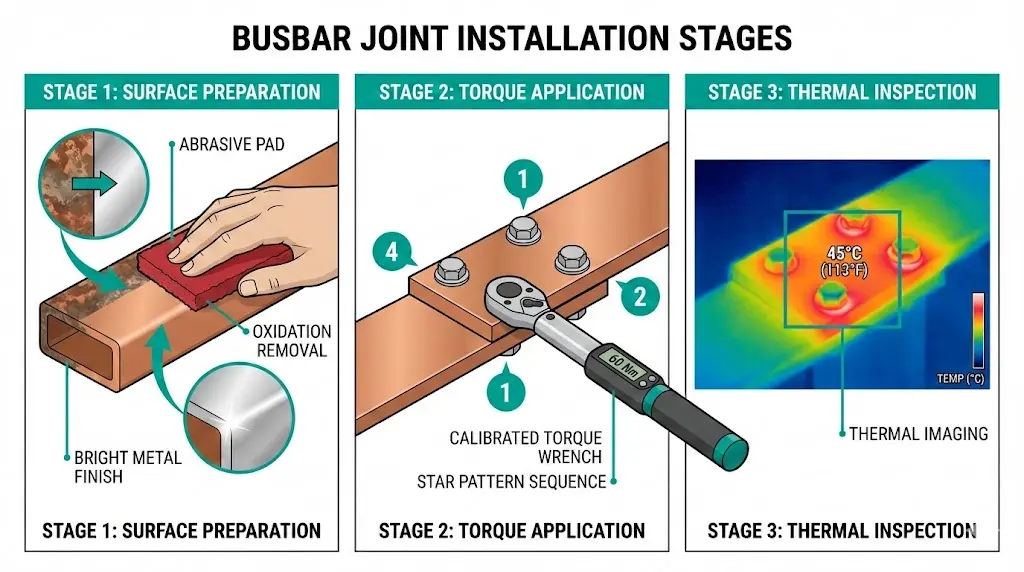
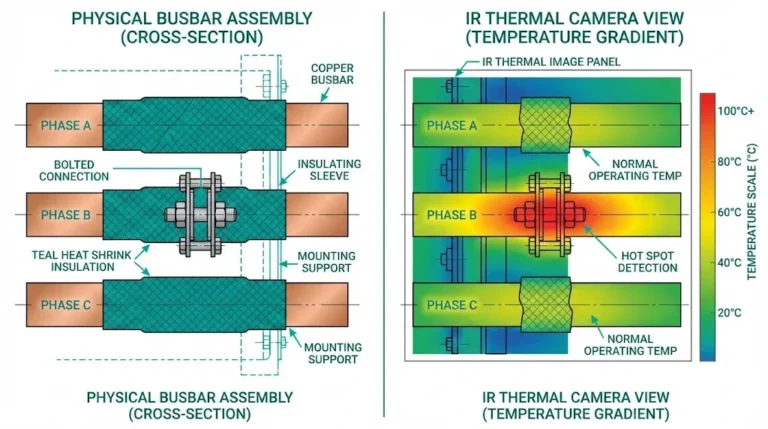
Busbar bolted joint installation showing surface preparation, torque wrench application in star pattern, and thermal imaging inspection

Busbar Bolted Joint Best Practices: Torque, Surface Prep, and Hot-Spot Prevention

Busbar connections fail gradually. A properly torqued joint with clean contact surfaces carries rated current at 30–40°C above ambient. That same joint, undertorqued by 30%, runs 80–100°C above ambient within months as micro-gaps develop, contact resistance increases, and oxidation accelerates.

Hot busbar joints don’t announce themselves until thermal cameras catch them or infrared inspection reveals temperature differentials. By then, damage has started: annealing of copper reducing mechanical strength, oxidation reducing conductivity, progressive loosening from thermal cycling. The path from “slightly warm” to catastrophic failure shortens with each thermal cycle.

Medium-voltage switchgear busbar joints operate at currents from 630 A to 4,000 A. At these current levels, a 50% increase in contact resistance—from 10 μΩ to 15 μΩ—generates 2.25× more heat (P = I²R). A joint running 60°C over ambient at 1,600 A consumes roughly 400 W, enough to visibly glow under thermal imaging and rapidly degrade both the busbar and bolted connection.

Preventing hot joints requires three elements executed correctly: proper surface preparation (removing oxidation and achieving metal-to-metal contact), correct torque application (creating sufficient contact pressure without damaging threads), and ongoing thermal monitoring (catching deterioration before failure).

This guide provides the specific procedures, torque values, and inspection criteria maintenance engineers need to install and maintain reliable busbar connections in vacuum circuit breaker switchgear and MV distribution systems rated 12–40.5 kV.

Busbar bolted joint installation showing surface preparation, torque wrench application in star pattern, and thermal imaging inspection

Why Busbar Joints Fail: The Physics of Contact Resistance

Electrical current crossing a bolted joint must pass through microscopic contact points where metal surfaces actually touch. Even machined flat surfaces contact only at asperity peaks—actual contact area is typically 1–10% of apparent joint surface area.

Contact resistance develops from:

  1. Constriction resistance: Current crowds through small true contact areas
  2. Film resistance: Oxide layers, contamination, corrosion films at interface
  3. Bulk resistance: Conductor material itself (negligible compared to contact effects)

Heat generation:

Power dissipated at joint: P = I² × R_contact

For a 1,600 A busbar joint:

  • Good joint (R_contact = 10 μΩ): P = 1600² × 10×10⁻⁶ = 25.6 W
  • Degraded joint (R_contact = 20 μΩ): P = 1600² × 20×10⁻⁶ = 51.2 W
  • Failed joint (R_contact = 50 μΩ): P = 1600² × 50×10⁻⁶ = 128 W

That 128 W concentrated in a small joint volume creates localized temperatures exceeding 150°C—enough to anneal copper, melt plating, and accelerate oxidation.

Thermal cycling damage:

  1. Joint heats under load → thermal expansion
  2. Copper expands, bolt slightly loosens
  3. Joint cools when load reduces → contraction
  4. Gap develops at interface
  5. Higher resistance on next heating cycle
  6. Progressive degradation

This positive feedback loop explains why hot joints deteriorate exponentially once started.


Surface Preparation: Achieving True Metal Contact

Copper oxidizes in minutes when exposed to air. Aluminum oxidizes even faster, forming tenacious aluminum oxide (Al₂O₃) with high electrical resistance.

Pre-Assembly Cleaning

For copper busbars:

  1. Mechanical cleaning:
    • Use Scotch-Brite pad (red/maroon, medium grit) or fine wire brush
    • Scrub contact surfaces to bright metal
    • Remove all visible oxidation, corrosion, tarnish
    • Clean in direction of current flow (along busbar length)
  2. Chemical cleaning (optional, for heavily oxidized busbars):
    • Degrease with isopropyl alcohol or acetone
    • Apply phosphoric acid-based cleaner (e.g., Naval Jelly) for 2–5 minutes
    • Rinse thoroughly with clean water
    • Dry completely
    • Immediately follow with mechanical cleaning to remove any residual film
  3. Final wipe:
    • Wipe cleaned surface with lint-free cloth dampened with isopropyl alcohol
    • Allow to dry (evaporates in seconds)
    • Proceed to assembly within 30 minutes (oxidation begins immediately)

For aluminum busbars:

  1. Mechanical cleaning:
    • Use stainless steel wire brush (NOT copper/brass brushes which contaminate aluminum)
    • Remove aluminum oxide layer to bright metal
    • Work quickly—aluminum re-oxidizes within minutes
  2. Oxide-inhibiting compound application:
    • Apply joint compound containing zinc dust or petroleum jelly with zinc
    • Coat contact surfaces immediately after cleaning
    • Compound breaks through oxide film and prevents re-oxidation
    • Common products: NO-OX-ID, Penetrox, Noalox

Critical: Never mix dissimilar metals (copper-aluminum) without proper bimetallic transition washers/plates and joint compound. Galvanic corrosion rapidly degrades such joints.

Contact Surface Flatness

Check flatness before assembly:

  • Place straightedge across joint surfaces
  • Look for light gaps
  • Acceptable: <0.1 mm gap over 100 mm length
  • Excessive warping: Machine flat or replace

Warped busbars create uneven contact pressure—some areas make good contact while others gap, creating local hot spots even with correct overall torque.
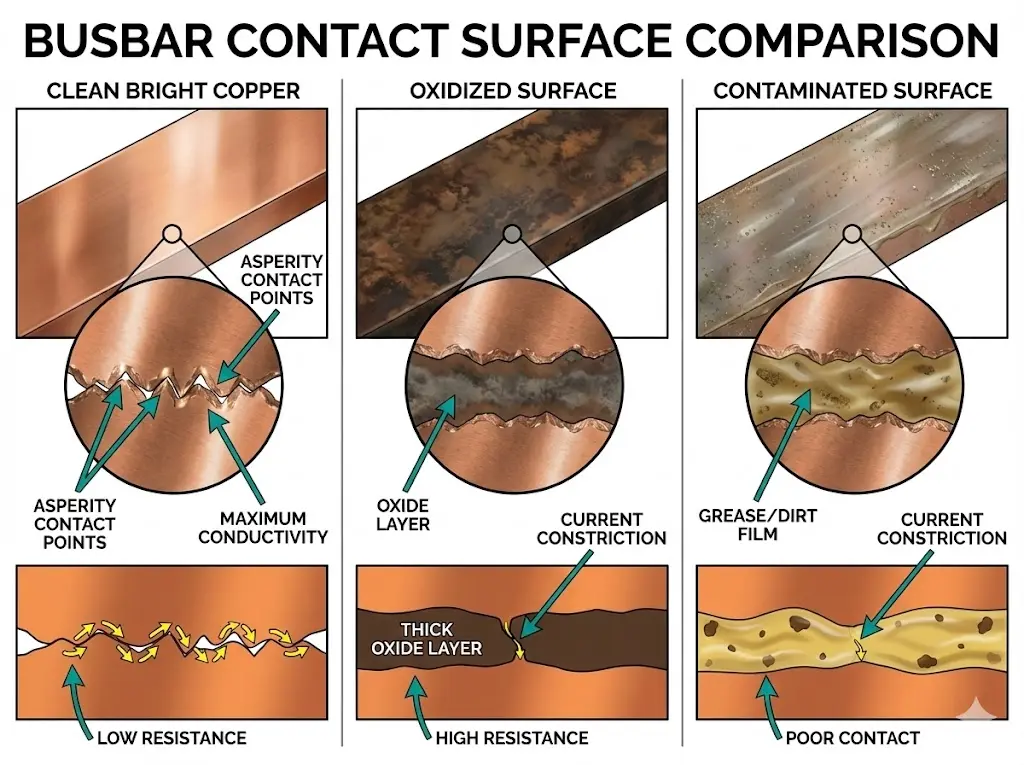
surface-preparation-comparison

Bolt and Hardware Selection

Wrong fasteners compromise even perfect surface preparation.

Bolt Grade and Material

For MV switchgear busbar joints:

  • Preferred: Grade 8.8 or higher (ISO metric) / Grade 5 or higher (SAE)
  • Material:
    • Zinc-plated steel (most common, adequate for indoor applications)
    • Stainless steel (outdoor, corrosive environments)
    • Silicon bronze (for aluminum busbars to reduce galvanic issues)

Never use:

  • Grade 4.6 or lower (insufficient clamping force)
  • Unplated steel in humid environments (rust reduces clamping)

Washer Requirements

Flat washers:

  • Required under bolt head and nut
  • Distributes load, prevents crushing busbar material
  • Use hardened steel washers for copper (Grade 8 minimum)
  • Use aluminum or stainless washers for aluminum busbars

Lock washers:

  • Split lock washers (most common)
  • Belleville (disc spring) washers for high-vibration applications
  • Nord-Lock or similar wedge washers for critical connections

Application:

  • Place flat washer against busbar
  • Place lock washer between flat washer and bolt head/nut
  • Orientation: Split lock washer split faces away from busbar

For aluminum busbars:

  • Belleville washers preferred (maintain tension as aluminum creeps)
  • Flat washers must be large enough to distribute load without embedding

Joint Compound (Anti-Oxidant)

When to use:

  • Mandatory for aluminum-aluminum joints
  • Mandatory for copper-aluminum (bimetallic) joints
  • Optional but recommended for outdoor copper-copper joints
  • Not required for indoor copper-copper if joint is clean and properly torqued

Application:

  • Apply thin layer to both contact surfaces after cleaning
  • Excess compound squeezed out during torquing is acceptable
  • Do NOT apply to bolt threads (affects torque-tension relationship)

Common products:

  • Copper busbars: Burndy Penetrox, Thomas & Betts KOPR-SHIELD
  • Aluminum busbars: NO-OX-ID “A-Special”, Hubbell Burndy PENETROX A

Torque Specifications and Application

Correct torque creates metal-to-metal contact pressure while avoiding thread damage.

Standard Torque Values

For copper busbar joints (indoor switchgear, clean dry conditions):

Bolt SizeGrade 8.8/Class 5Grade 10.9/Class 8
M822–25 N⋅m30–35 N⋅m
M1040–50 N⋅m55–65 N⋅m
M1270–85 N⋅m95–115 N⋅m
M16150–180 N⋅m200–240 N⋅m
M20300–360 N⋅m400–480 N⋅m

For aluminum busbar joints:

Reduce torque by 15–20% compared to copper (softer metal, creeps under load)

Bolt SizeRecommended Torque
M1035–45 N⋅m
M1260–75 N⋅m
M16130–160 N⋅m

Manufacturer specifications always override these general values.

Torque Application Procedure

Equipment required:

  • Calibrated torque wrench (±3% accuracy)
  • Calibration certificate within last 12 months
  • Correct socket size (6-point preferred over 12-point)

Procedure:

  1. Finger-tight: Thread bolt by hand until washer contacts busbar
    • Ensures threads are not cross-threaded
    • Establishes starting point
  2. Snug-tight: Use torque wrench to bring joint to ~30% final torque
    • Example: Final torque 100 N⋅m → snug at 30 N⋅m
    • Compresses joint stack, aligns components
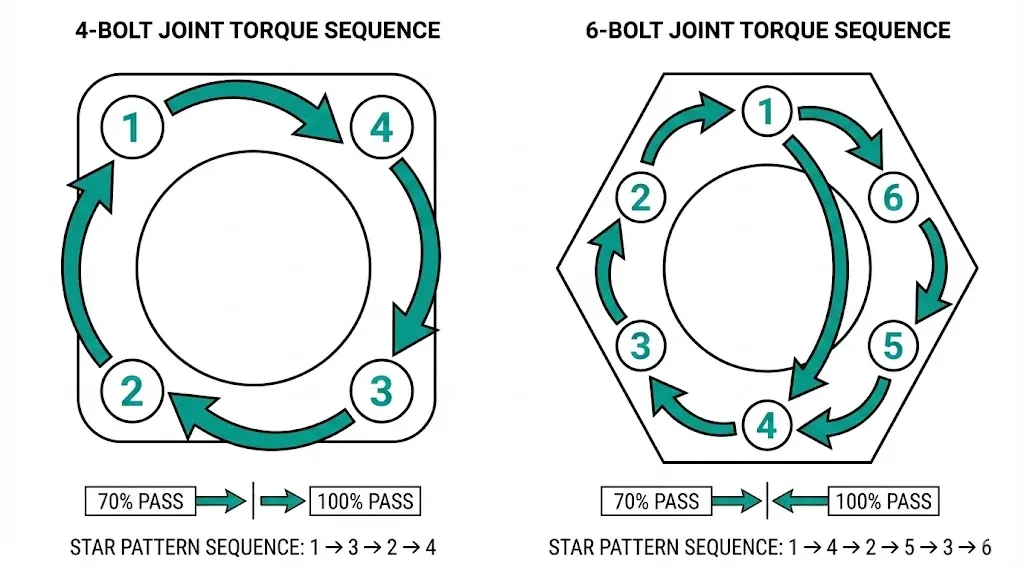
  3. Pattern torquing (for multi-bolt joints):
    • Tighten bolts in star/cross pattern (not sequential)
    • Prevents joint distortion
    • For 4-bolt joint: torque 1 → 3 → 2 → 4
    • For 6-bolt joint: torque 1 → 4 → 2 → 5 → 3 → 6
  4. Final torque (two-pass method):
    • First pass: Bring all bolts to 70% final torque in pattern
    • Second pass: Bring all bolts to 100% final torque in same pattern
    • Ensures even loading across joint
  5. Verification pass:
    • After all bolts at final torque, return to first bolt
    • Check torque (should not turn further)
    • If bolt turns significantly, repeat full pattern
    • Common for multi-bolt joints where later bolts relieve tension on earlier ones

Torque wrench technique:

  • Pull steadily (do NOT jerk or impact)
  • Apply force perpendicular to wrench handle
  • Watch for torque wrench “click” or pointer alignment
  • Do not continue tightening after reaching set torque

Overtorquing damage:

  • Stripped threads (permanent damage, replace hardware)
  • Yielded bolt (stretched threads, reduced clamping force)
  • Crushed busbar material (deformed contact surface)

Undertorquing consequences:

  • Insufficient contact pressure
  • High contact resistance
  • Overheating
  • Progressive loosening from thermal cycling
torque-sequence-star-pattern

Re-Torque After Initial Energization

Copper and aluminum both exhibit stress relaxation and creep under load.

Why Re-Torque Is Necessary

Initial torquing: Creates elastic deformation in metal
Under load: Temperature cycles cause:

  • Thermal expansion/contraction
  • Plastic deformation (permanent settling)
  • Surface asperities crushing under pressure
  • Stress relaxation in bolts

Result: 10–25% loss in clamping force within first weeks of operation

Re-Torque Schedule

First re-torque: 48–72 hours after initial energization

  • Joint has experienced initial thermal cycling
  • Settling has occurred
  • Check all bolts, re-torque to original specification

Second re-torque: 30 days after commissioning

  • Further settling minimal after this point for copper
  • Aluminum may require quarterly re-torque for first year

Subsequent intervals:

  • Copper joints: Annual inspection, re-torque as needed
  • Aluminum joints: Semi-annual inspection/re-torque first year, annual thereafter

How to check:

  1. Set torque wrench to original specification
  2. Apply torque to each bolt in sequence
  3. If bolt turns significantly (>15°), joint has loosened—bring to full torque
  4. If bolt barely turns or holds firm, no re-torque needed

Thermal Inspection and Hot-Spot Detection

Thermal imaging catches degradation before catastrophic failure.

Infrared Thermography

Equipment: Thermal imaging camera (FLIR, Fluke, etc.)

Inspection procedure:

  1. Load condition: Perform inspection under load (>50% rated current preferred)
    • Light load inspection misses thermally-driven problems
    • Schedule during high-demand periods
  2. Thermal stability: Allow 2–4 hours of steady load before scanning
    • Joints reach thermal equilibrium
    • Transient heating from load changes settles
  3. Scan technique:
    • Maintain consistent distance and angle
    • Image each busbar joint
    • Record emissivity setting used (typically 0.85–0.95 for oxidized copper)
    • Document ambient temperature
  4. Temperature measurement:
    • Measure joint temperature (hottest spot)
    • Measure busbar temperature 300 mm away from joint (baseline)
    • Calculate temperature rise: ΔT = T_joint − T_busbar

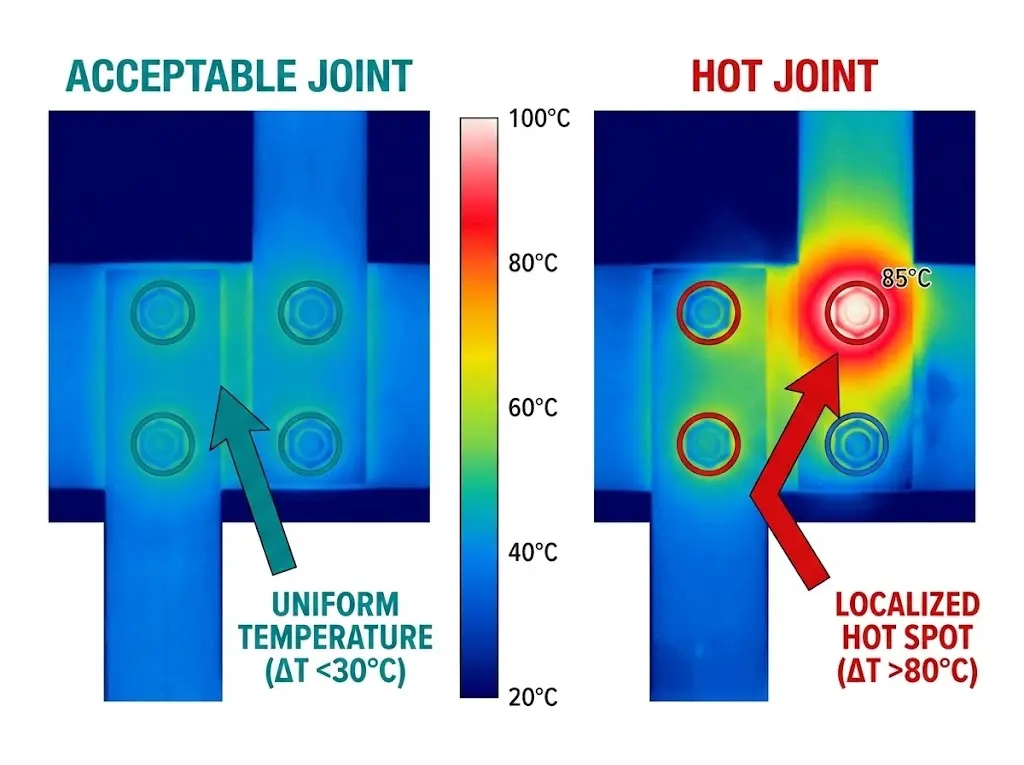
Acceptance criteria:

Temperature Rise (ΔT)AssessmentAction
<30°CAcceptableContinue monitoring
30–50°CElevatedInvestigate during next outage, plan re-torque
50–80°CHot jointSchedule immediate corrective action
>80°CCriticalEmergency shutdown, repair immediately

Phase comparison:

In three-phase systems, compare similar joints across phases:

  • Temperature difference >15°C between phases indicates problem in hotter joint
  • Even if absolute temperature is acceptable, imbalance suggests developing issue

Thermographic Patterns Indicating Specific Failures

Uniform heating along busbar: Normal (I²R heating of conductor itself)

Localized hot spot at bolt:

  • Undertorqued joint
  • Corroded/oxidized contact surface
  • Missing washer

Hot spot offset from bolt center:

  • Uneven contact pressure (warped busbar)
  • Contamination on one side of joint

One bolt hot, others normal in multi-bolt joint:

  • That bolt undertorqued or missing lock washer
  • Thread damage

Progressive temperature gradient:

  • Example: Bolt 1 warmest, Bolt 2 cooler, Bolt 3 coolest
  • Indicates torquing pattern error (sequential instead of star pattern)
thermal-image-hot-joint

Periodic Inspection and Maintenance

Annual inspection catches degradation before emergency failures.

Visual Inspection

Check for:

  • Discoloration: Indicates past overheating
    • Copper: Dark brown/black (oxide), green (corrosion)
    • Aluminum: White powder (aluminum oxide)
  • Physical damage: Deformed washers, elongated bolt holes
  • Corrosion: White/green deposits, rust on steel hardware
  • Joint compound leakage: Excess squeezed out (acceptable if joint is tight)

Vibration-prone installations:

Check for:

  • Bolt backing-out (visible thread length change)
  • Fretting marks (abrasion at contact surface from micro-movement)
  • Cracked washers

Torque Check

Frequency:

  • New installations: After 48 hrs, 30 days, 6 months, annually
  • Established installations: Annually, or after any thermal event

Procedure:

  1. Set torque wrench to 90% of specification
  2. Attempt to turn bolt
  3. If turns easily, re-torque to full specification
  4. If holds firm at 90%, proceed to 100% verification

Document:

  • Date of inspection
  • Torque values applied
  • Bolts requiring re-torque
  • Thermal imaging results (if performed)

Contact Resistance Measurement (Advanced)

Equipment: Micro-ohmmeter (100 A+ test current)

Procedure:

  1. Measure resistance across joint (use Kelvin clips on busbar either side of joint)
  2. Subtract busbar resistance contribution (measure equivalent length of solid busbar)
  3. Calculate joint resistance: R_joint = R_measured − R_busbar

Typical values:

  • Good joint: 5–15 μΩ
  • Acceptable: 15–30 μΩ
  • Marginal: 30–50 μΩ (schedule re-torque)
  • Failed: >50 μΩ (disassemble, re-clean, re-torque)

Not typically performed for standard maintenance (thermal imaging more practical), but useful for troubleshooting specific hot joints or commissioning critical installations.


Common Mistakes and How to Avoid Them

MistakeConsequencePrevention
Skipping surface cleaningOxide layer causes high contact resistanceAlways clean to bright metal before assembly
Using impact wrench for final torqueOvertorque, thread damage, uneven loadingUse calibrated torque wrench for final passes
Sequential torquing (1→2→3→4)Joint distortion, uneven contact pressureAlways use star/cross pattern
Mixing copper/aluminum without joint compoundGalvanic corrosion, rapid failureUse bimetallic transition plates or aluminum washers + compound
Single-pass torquingUneven bolt tension in multi-bolt jointsUse two-pass method (70% → 100%)
No re-torque after commissioningThermal cycling loosens jointRe-torque after 48–72 hours operation
Over-lubricating bolt threadsAchieves higher tension than intended (torque spec assumes dry/lightly lubricated threads)Apply compound only to contact surfaces, NOT threads
Reusing deformed washersUneven load distribution, poor contactReplace washers if visibly deformed
Ignoring manufacturer torque specsIncorrect clamping force for specific designAlways use manufacturer values if provided

Special Considerations for High-Current Applications

Joints carrying >2,000 A require extra attention.

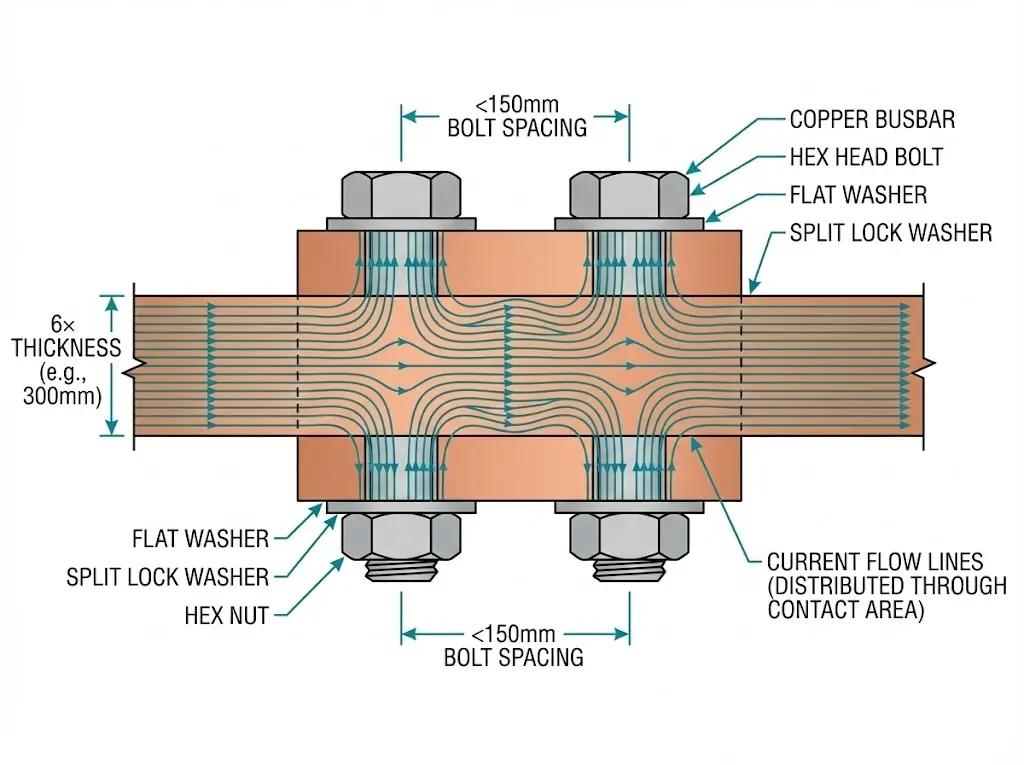
Multi-bolt joints:

For wide busbars requiring multiple bolts:

  • Use minimum 4 bolts per joint
  • Bolt spacing <150 mm (concentrates contact pressure)
  • Star pattern torquing critical (sequential creates gaps)

Busbar overlap length:

Longer overlap distributes current, reduces current density at edges:

  • Minimum: 4× busbar thickness
  • Preferred: 6× busbar thickness
  • Example: 10 mm thick busbar → 60 mm overlap preferred

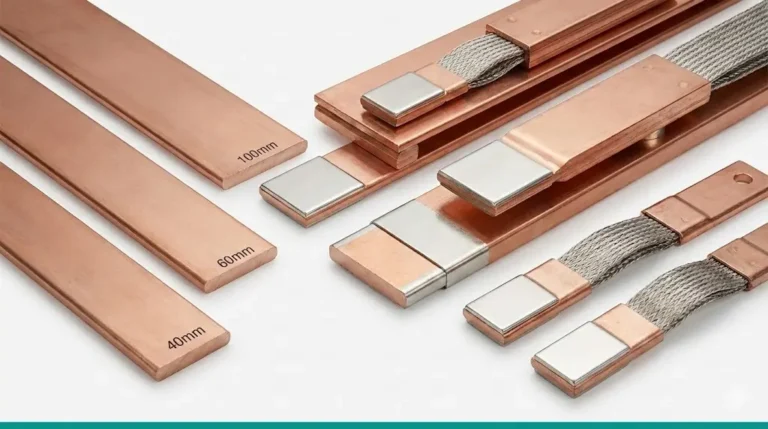
Silver or tin plating:

High-current busbars often plated:

  • Tin-plated copper: Good anti-oxidation, easier to maintain than bare copper
  • Silver-plated copper: Lowest contact resistance, best for >3,000 A
  • Do not remove plating during cleaning—wipe with cloth dampened with isopropyl alcohol only

Flexible braids for vibration:

Fixed busbar joints in vibration environments (generators, reciprocating equipment) crack from fatigue:
  • Use flexible copper braid jumpers across bolted expansion joints
  • Accommodates thermal expansion and vibration without stressing bolted connection
multi-bolt-joint-cross-section

Key Takeaways

  • Busbar joint contact resistance drives heat generation (P = I²R)—50% resistance increase creates 2.25× more heat, accelerating thermal degradation
  • Surface preparation (cleaning to bright metal) and correct torque application (Grade 8.8+ bolts, calibrated torque wrench) are equally critical—one without the other fails
  • Star/cross pattern torquing prevents joint distortion—sequential torquing creates uneven contact pressure and local hot spots
  • Re-torque after 48–72 hours operation captures 10–25% tension loss from thermal cycling and stress relaxation
  • Aluminum busbars require zinc-based joint compound immediately after cleaning, reduced torque (15–20% less than copper), and more frequent re-torquing
  • Thermal imaging under load (>50% rated current) catches degradation early—ΔT >30°C indicates developing problem, >80°C requires emergency repair
  • Annual inspection with torque verification and thermal imaging transforms random failures into planned maintenance

External Reference: IEC 62271-100 — IEC 62271-100 standard for high-voltage switchgear

Frequently Asked Questions

Q1: Can I use an impact wrench to speed up busbar joint installation?
A: Use impact wrench only for initial snugging (30% final torque). ALWAYS use calibrated torque wrench for final torque passes—impact wrenches deliver inconsistent torque and frequently overtighten, damaging threads and yielding bolts.

Q2: How much does contact resistance increase due to oxidation on copper busbars?
A: Clean bright copper: ~5 μΩ contact resistance. Light tarnish: 15–25 μΩ. Heavy oxidation (dark brown/black): 50–200 μΩ. This 10–40× increase explains why surface cleaning is mandatory—oxidation alone can cause joint failure regardless of torque.

Q3: What torque should I use for stainless steel bolts in aluminum busbars?
A: Reduce standard aluminum torque by additional 10% (total 25–30% below copper spec). Stainless steel has higher friction coefficient than zinc-plated steel, achieving higher clamping force for same applied torque—risk of crushing aluminum if full torque applied.

Q4: How often should I perform thermal imaging on busbar joints?
A: Annually minimum for indoor installations, semi-annually for outdoor or harsh environments. Perform additional inspection after any fault event, overload condition, or maintenance work on adjacent equipment. Critical facilities (data centers, hospitals) may scan quarterly.

Q5: Can I repair a hot joint by simply re-torquing without disassembly?
A: If ΔT <50°C and bolts turn significantly when checked, re-torquing may suffice. If ΔT >50°C or bolts don’t turn (indicating oxidation/contamination rather than loose bolts), must disassemble, clean surfaces to bright metal, and re-assemble properly. Attempting to fix severe oxidation with torque alone compresses oxide layer but doesn’t remove it.

Q6: What’s the difference between joint compound and thread anti-seize?
A: Joint compound (e.g., Penetrox) contains conductive particles (zinc, copper) and prevents oxidation at contact surfaces—apply to busbar surfaces. Thread anti-seize (copper or nickel-based) prevents thread galling and eases future disassembly—apply to bolt threads. DO NOT confuse—using thread anti-seize on contact surfaces provides no electrical benefit and may increase contact resistance.

Q7: How do I handle dissimilar metal joints (copper busbar to aluminum equipment terminal)?
A: Use bimetallic transition washer/plate (copper one side, aluminum other side, explosion-bonded or mechanically joined). Apply aluminum-rated joint compound to aluminum side. Alternatively, use all-aluminum hardware (washers, bolts if possible) and compound on both surfaces. Never bolt copper directly to aluminum without transition—galvanic corrosion destroys joint in months.

Hannah Zhu marketing director of XBRELE
Hannah

Hannah is the Administrator and Technical Content Coordinator at XBRELE. She oversees website structure, product documentation, and blog content across MV/HV switchgear, vacuum breakers, contactors, interrupters, and transformers. Her focus is delivering clear, reliable, and engineer-friendly information to support global customers in making confident technical and procurement decisions.

Articles: 65