Angebot für Hochspannungskomponenten und -geräte anfordern

Teilen Sie uns Ihre Anforderungen mit – Nennspannung, Modell, Menge und Bestimmungsort – und unser XBR Electric-Team erstellt Ihnen innerhalb von 24 Stunden ein detailliertes Angebot.
Kontaktformular Demo
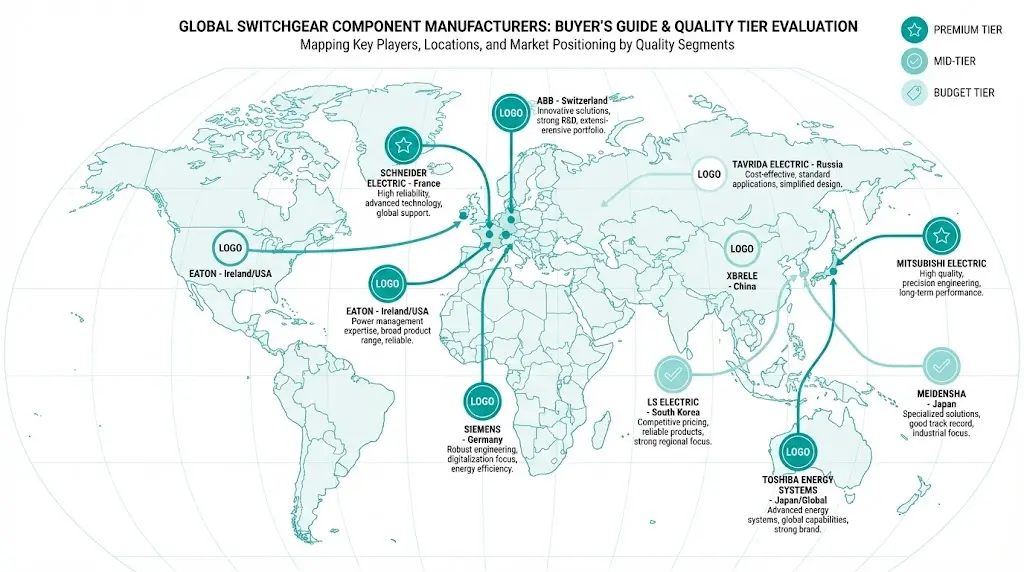
Vergleich der 10 führenden Hersteller von Schaltanlagenkomponenten mit europäischen Premiummarken, asiatischen Anbietern der mittleren Preisklasse und preisgünstigen Herstellern mit Qualitäts- und Preispositionierung

Top 10 Hersteller von Schaltanlagenkomponenten: Shortlist der Einkäufer + Bewertungsrahmen

Medium-voltage switchgear contains dozens of critical components beyond the circuit breaker: epoxy insulators, busbars, interlocks, voltage sensors, earthing switches, cable terminations, and control accessories. A switchgear panel’s reliability depends as much on these supporting components as on the primary interrupting device.

Procurement teams face a complex landscape: European manufacturers commanding premium prices for proven reliability, Asian suppliers offering cost advantages with variable quality documentation, and specialized component makers excelling in specific product categories while outsourcing others.

The right component supplier balances technical capability, quality consistency, delivery performance, and total cost of ownership. The wrong choice creates warranty nightmares, field failures during commissioning, or component obsolescence that forces expensive retrofits years later.

This guide presents ten manufacturers that consistently deliver quality switchgear components across global projects, explains what distinguishes them, and provides an evaluation framework for comparing suppliers on your specific requirements.

Evaluation Framework: How to Compare Component Manufacturers

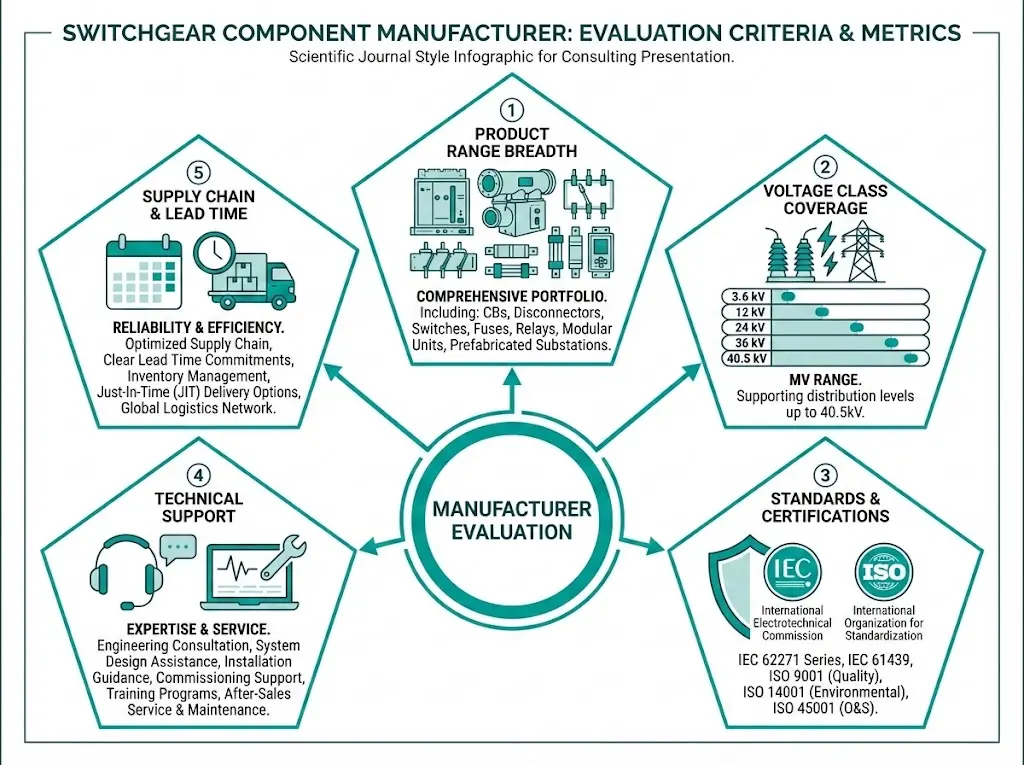
Five-point evaluation framework for assessing switchgear component manufacturers: product range, voltage coverage, certifications, technical support, and supply chain capabilities
**Figure 1**: Comprehensive manufacturer evaluation framework—balance product breadth, voltage capability, certification compliance, technical support, and supply chain performance when selecting component suppliers.

Before diving into specific manufacturers, establish evaluation criteria:

1. Product Range Breadth

Comprehensive suppliers (offer complete switchgear internals):

  • Epoxy insulators (bushings, barriers, supports)
  • Vacuum interrupters (if captive production)
  • Copper/aluminum busbars (punched, machined, plated)
  • Mechanical interlocks (key systems, blocking mechanisms)
  • Voltage sensing (capacitive sensors, VPIS)
  • Earthing switches and ground fault protection
  • Cable termination components

Specialized suppliers (excel in 1–3 categories):

  • May outsource other components
  • Best-in-class for specialty (e.g., epoxy casting, copper work)
  • Requires managing multiple suppliers

Your decision: One-stop procurement simplicity vs best-of-breed performance?

2. Voltage Class Coverage

SpannungsklasseApplication ExamplesManufacturer Coverage
3.6–7.2 kVIndustrial distribution, miningNearly all manufacturers
12–13.8 kVUtility distribution, large industrialAll major manufacturers
24–27 kVUtility substations, transmission interfaceMost manufacturers
36–40.5 kVTransmission, large utility substationsPremium manufacturers only

Verify manufacturer’s actual production capability at your voltage—some “manufacture” via rebranding others’ products at higher voltages.

3. Standards and Certifications

Essential certifications:

  • IEC 62271 series (switchgear and controlgear standards)
  • ISO 9001 (quality management)
  • ISO 14001 (environmental management, increasingly required)

Desirable certifications:

  • Type test reports from independent laboratories (KEMA, CESI, CPRI, etc.)
  • IECEE CB scheme certification (international recognition)
  • UL/CSA listing (North American projects)
  • CCC certification (China projects)

Red flags:

  • “Certified” without specifying which standard or by whom
  • Self-certified without third-party verification
  • Type test reports older than 10 years without revalidation

4. Technical Support Capability

Pre-sales:

  • Application engineering (load calculations, fault analysis)
  • Custom design capability (non-standard dimensions, ratings)
  • Samples availability for validation testing

Post-sales:

  • Commissioning support (field testing, troubleshooting)
  • Spare parts availability and lead time
  • Warranty response time and coverage

Long-term:

  • Technical documentation quality (drawings, maintenance manuals)
  • Obsolescence management (10+ year component availability)
  • Training programs for maintenance personnel

5. Supply Chain and Lead Time

Standard components:

  • Catalog items ship within 4–8 weeks (good)
  • Catalog items ship within 8–16 weeks (acceptable)
  • All items “custom” with 16+ week lead (problematic for spares)

Custom engineering:

  • How quickly can manufacturer respond to RFQ? (2–5 days ideal)
  • Engineering turnaround for custom designs? (2–4 weeks reasonable)
  • Flexibility on order quantities (MOQ requirements)?

Global reach:

  • Manufacturing locations (tariff, logistics implications)
  • Regional warehousing for fast spares delivery
  • Service centers for technical support

Top 10 Manufacturers: Detailed Profiles

1. Schneider Electric (France/Global)

Headquarters: Rueil-Malmaison, France

Global footprint: 100+ countries, manufacturing in France, China, India, Mexico, USA

Product strengths:

  • Complete MV switchgear component portfolio
  • Strong epoxy insulator technology (RM6, SM6 platforms)
  • Integrated vacuum interrupters and contactors (in-house design)
  • Advanced VPIS and sensor systems
  • Comprehensive digital/IoT integration (EcoStruxure platform)

Voltage coverage: 3.6 kV – 40.5 kV

Market position: Premium tier, strong in Europe, Middle East, Africa

Why specify Schneider components:

  • Industry-leading technical documentation
  • Global service network ensures local support
  • Proven interoperability (components designed as system)
  • Long-term availability commitment (15+ years for active products)

Überlegungen:

  • Higher price point than Asian alternatives (typically 20–40% premium)
  • Some components only available bundled with switchgear systems
  • Long lead times during high demand periods

Best for: Utilities, critical infrastructure, projects requiring European standards compliance

Website: schneider-electric.com

2. ABB (Switzerland/Global)

Headquarters: Zürich, Switzerland

Global footprint: 100+ countries, major manufacturing in Switzerland, Sweden, Italy, China, India

Product strengths:

  • Comprehensive switchgear internals portfolio
  • Industry-leading vacuum interrupter technology (own R&D)
  • High-quality copper busbar systems with pre-installed sensors
  • Advanced protection and control IEDs
  • Modular RMU (ring main unit) component systems

Voltage coverage: 3.6 kV – 52 kV

Market position: Premium tier, dominant in utilities and heavy industry

Why specify ABB components:

  • Exceptional reliability track record (documented MTBF data)
  • Strong focus on asset management and lifecycle support
  • Innovative monitoring technologies (online PD detection, temperature sensing)
  • Excellent application engineering support

Überlegungen:

  • Premium pricing (comparable to Schneider)
  • Some legacy product lines being phased out (verify long-term availability)
  • Technical support quality varies by region

Best for: Utility transmission/distribution, renewable energy plants, data centers

Website: abb.com

3. Siemens Energy (Germany/Global)

Headquarters: Munich, Germany

Global footprint: 90+ countries, manufacturing primarily in Germany, China, USA

Product strengths:

  • Premium epoxy casting technology (Resibloc system)
  • Vacuum circuit breaker and contactor components
  • Sophisticated busbar systems with integrated monitoring
  • SF6-free alternatives (clean air insulation)
  • Digital twin and simulation tools for component selection

Voltage coverage: 3.6 kV – 52 kV

Market position: Premium tier, strong engineering-heavy applications

Why specify Siemens components:

  • Cutting-edge R&D (early adopter of new technologies)
  • Excellent integration with Siemens switchgear and automation
  • Strong sustainability focus (SF6 elimination, recyclability)
  • Superior technical training programs

Überlegungen:

  • Highest price tier among European manufacturers
  • Some products tightly integrated with Siemens systems (less flexible for mix-and-match)
  • Lead times can extend during large project loads

Best for: High-reliability applications, projects with sustainability requirements, Siemens ecosystem installations

Website: siemens-energy.com

4. XBRELE (China)

Headquarters: China

Global footprint: Manufacturing in China, growing export to Asia, Middle East, Africa, South America

Product strengths:

  • Vacuum circuit breakers and vacuum interrupters (core competency)
  • Vacuum contactors for motor control and capacitor switching
  • Epoxy insulators for MV switchgear
  • Cost-effective component solutions
  • Flexible customization for OEM requirements

Voltage coverage: 3.6 kV – 40.5 kV

Market position: Mid-tier pricing, growing quality reputation

Why specify XBRELE components:

  • Excellent price-performance ratio (30–50% below European brands)
  • Responsive engineering support for custom requirements
  • Shorter lead times than many competitors (4–6 weeks standard)
  • Increasing adoption by international switchgear OEMs
  • IEC compliance with independent test reports

Überlegungen:

  • Brand recognition lower than established European manufacturers
  • Technical documentation improving but not yet at Schneider/ABB level
  • Service network primarily Asia-focused (expanding globally)

Best for: Industrial projects with cost constraints, OEM switchgear builders, emerging market installations, replacement/retrofit projects

Website: xbrele.com

5. Eaton (Ireland/USA/Global)

Headquarters: Dublin, Ireland (EMEA), Cleveland, USA (Americas)

Global footprint: 175+ countries, manufacturing in USA, Mexico, Czech Republic, China

Product strengths:

  • Vacuum interrupters and circuit breakers
  • Comprehensive busbar and connection systems
  • Fuses and current-limiting components
  • Protection relays and control devices
  • Strong focus on power quality products

Voltage coverage: 3.6 kV – 38 kV

Market position: Mid-premium tier, strong in North America and industrial markets

Why specify Eaton components:

  • Dual certification (IEC and UL/ANSI) facilitates global projects
  • Excellent North American support network
  • Competitive pricing vs European brands (10–20% lower)
  • Strong aftermarket support and spare parts availability

Überlegungen:

  • Product portfolio gaps in some specialized areas (outsources certain components)
  • Asian manufacturing quality variable (verify production location for critical components)

Best for: North American projects, industrial facilities, dual-standard requirements

Website: eaton.com

6. Mitsubishi Electric (Japan)

Headquarters: Tokyo, Japan

Global footprint: Manufacturing primarily in Japan, also China, Thailand

Product strengths:

  • High-reliability vacuum interrupters (proprietary alloy technology)
  • Precision-machined busbar components
  • Advanced sensor and monitoring systems
  • Compact design expertise (space-constrained installations)

Voltage coverage: 3.6 kV – 36 kV

Market position: Premium tier, dominant in Japan, growing presence in Asia

Why specify Mitsubishi components:

  • Exceptional manufacturing precision (tight tolerances)
  • Long product lifetimes (documented installations 30+ years)
  • Strong seismic resistance (critical for earthquake-prone regions)
  • Excellent metallurgy and materials science

Überlegungen:

  • Higher cost than Chinese/Korean alternatives
  • Lead times longer for export orders (12–16 weeks typical)
  • Technical documentation often Japanese-first (English translations may lag)

Best for: High-reliability applications, seismic regions, Japanese OEM projects

Website: mitsubishielectric.com

7. LS Electric (South Korea)

Headquarters: Anyang, South Korea

Global footprint: Manufacturing in South Korea, China, Vietnam; strong presence in Asia, Middle East

Product strengths:

  • Complete switchgear component range
  • Vacuum interrupters and circuit breakers
  • Busbar systems and connections
  • Protection and control devices
  • Competitive pricing with good quality

Voltage coverage: 3.6 kV – 36 kV

Market position: Mid-tier pricing, strong value proposition

Why specify LS Electric components:

  • Cost competitive with Chinese brands, quality closer to European
  • Strong R&D investment (technology improving rapidly)
  • Good technical support in Asia and Middle East
  • Shorter lead times than European alternatives

Überlegungen:

  • Brand recognition limited outside Asia
  • North American/European service network less developed
  • Some reliance on third-party suppliers for specialized components

Best for: Asian projects, price-sensitive applications requiring better than bottom-tier quality

Website: lselectric.com

8. Meidensha (Japan)

Headquarters: Tokyo, Japan

Global footprint: Manufacturing in Japan, subsidiary in Southeast Asia

Product strengths:

  • Vacuum circuit breaker components
  • Epoxy molded products (insulators, bushings)
  • Current and voltage transformers for switchgear
  • Railway traction switchgear components (specialized strength)

Voltage coverage: 3.6 kV – 24 kV

Market position: Mid-premium, specialized applications

Why specify Meidensha components:

  • Excellent epoxy casting quality (low void, high strength)
  • Strong in transportation/rail applications
  • Competitive pricing for Japanese manufacturer
  • Good environmental resistance (humidity, pollution)

Überlegungen:

  • Limited global distribution
  • Smaller product range than major competitors
  • Technical support primarily Asia-Pacific

Best for: Rail systems, Asian infrastructure projects, specialized epoxy requirements

Website: meidensha.com

9. Toshiba Energy Systems (Japan/Global)

Headquarters: Kawasaki, Japan

Global footprint: Manufacturing in Japan, India, China, Vietnam, Brazil

Product strengths:

  • Pioneers of vacuum interrupter technology
  • Solid Insulated Switchgear (SIS) components
  • High-durability vacuum contactors
  • Surge arresters and protection relays

Voltage coverage: 3.6 kV – 72 kV

Market position: Premium tier, technology leader

Why specify Toshiba components:

  • Unmatched vacuum technology heritage (invented the VCB)
  • High seismic and environmental resistance
  • Global support network
  • Excellent long-term reliability records

Überlegungen:

  • Premium pricing strategy
  • Specialized designs may require Toshiba-specific integration
  • Lead times can be longer for specialized Japanese-manufactured items

Best for: Critical infrastructure, utilities, heavy industrial applications requiring maximum reliability

Website: https://www.toshiba-energy.com

10. TAVRIDA ELECTRIC (Russia/International)

Headquarters: Moscow, Russia

Global footprint: Manufacturing in Russia, export to CIS, Asia, Middle East

Product strengths:

  • Vacuum circuit breaker components
  • Vacuum interrupters (own production)
  • Busbar systems
  • Protection and automation devices

Voltage coverage: 3.6 kV – 35 kV

Market position: Mid-tier pricing, strong in CIS markets

Why specify TAVRIDA components:

  • Competitive pricing
  • Strong presence in Russian and CIS markets
  • Good cold-weather performance (designed for harsh climates)

Überlegungen:

  • Geopolitical factors affecting availability (sanctions, trade restrictions)
  • Limited Western market presence
  • Technical documentation primarily Russian

Best for: CIS projects, cold-climate applications, projects in Russian sphere of influence

Website: tavrida.ru
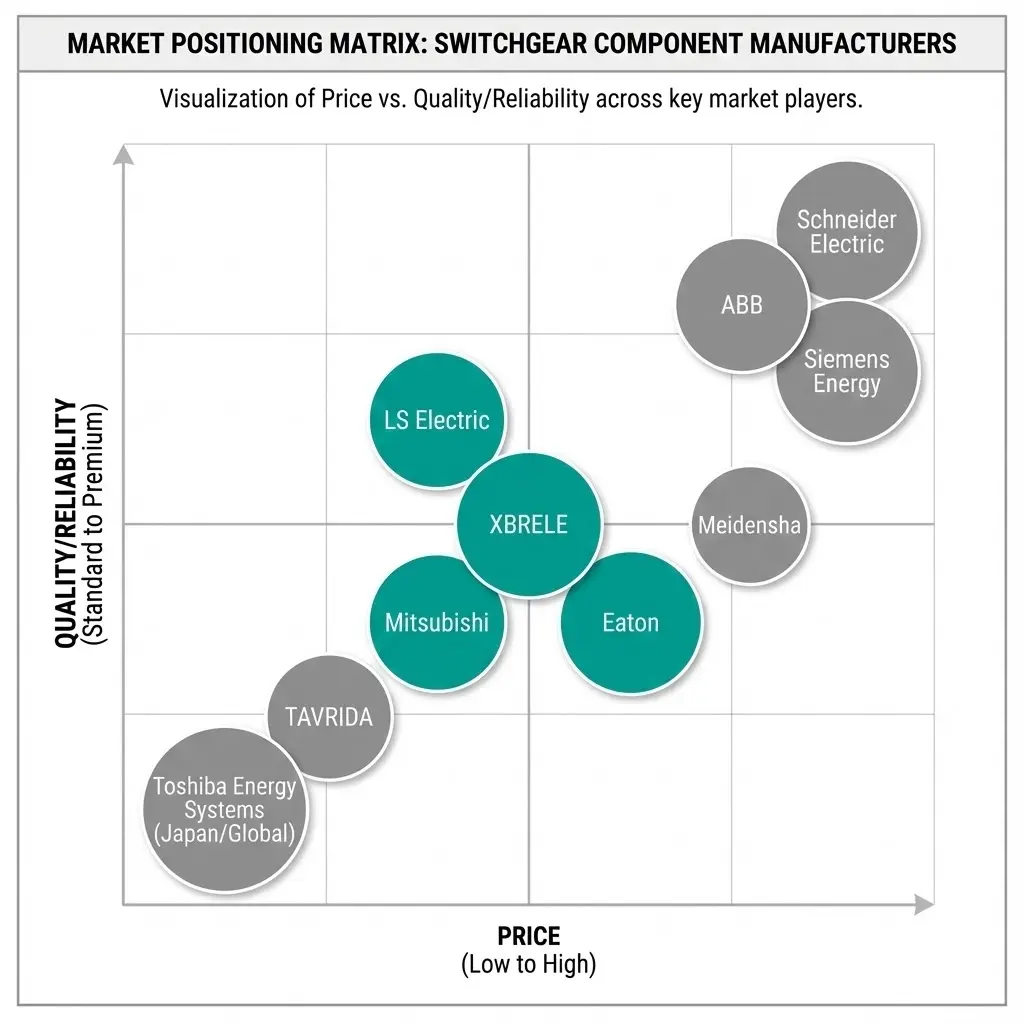
Manufacturer positioning matrix showing quality versus price for top switchgear component suppliers, from premium European brands to budget Asian manufacturers
**Figure 2**: Market positioning reveals distinct tiers—premium European manufacturers (Schneider, ABB, Siemens) command 20-40% price premium, mid-tier suppliers (XBRELE, LS Electric, Eaton) offer balanced value, while budget manufacturers serve cost-sensitive applications.

Regional Sourcing Considerations

North America Projects

First-tier choices:

  • Eaton (strong local support)
  • Schneider Electric (extensive distribution)
  • ABB (utility standard)

Certification essential: UL listing or CSA approval

Lead time: 8–12 weeks typical

European Union Projects

First-tier choices:

  • Schneider Electric
  • ABB
  • Siemens

Sustainability requirements: CE marking, REACH compliance, RoHS, increasing focus on SF6 alternatives

Dokumentation: Expect comprehensive technical files, declaration of conformity

Middle East Projects

Growing preference: Mix of European brands (reputation) and Asian brands (cost)

Common combinations:

  • European primary equipment + Asian support components
  • LS Electric gaining share
  • XBRELE competitive for industrial projects

Climate considerations: High temperature, sand/dust requires IP65+ enclosures, UV-resistant materials

Asia-Pacific Projects

Dominant players:

  • Mitsubishi, LS Electric (local preference)
  • XBRELE (cost-competitive Chinese projects)
  • Schneider/ABB (high-end projects)

Emerging markets: Local content requirements may favor regional manufacturers

Africa and Latin America

Price sensitivity high: Asian manufacturers competitive

Technical support critical: Local representation makes significant difference

Common approach: European/Japanese primary breakers + Chinese support components

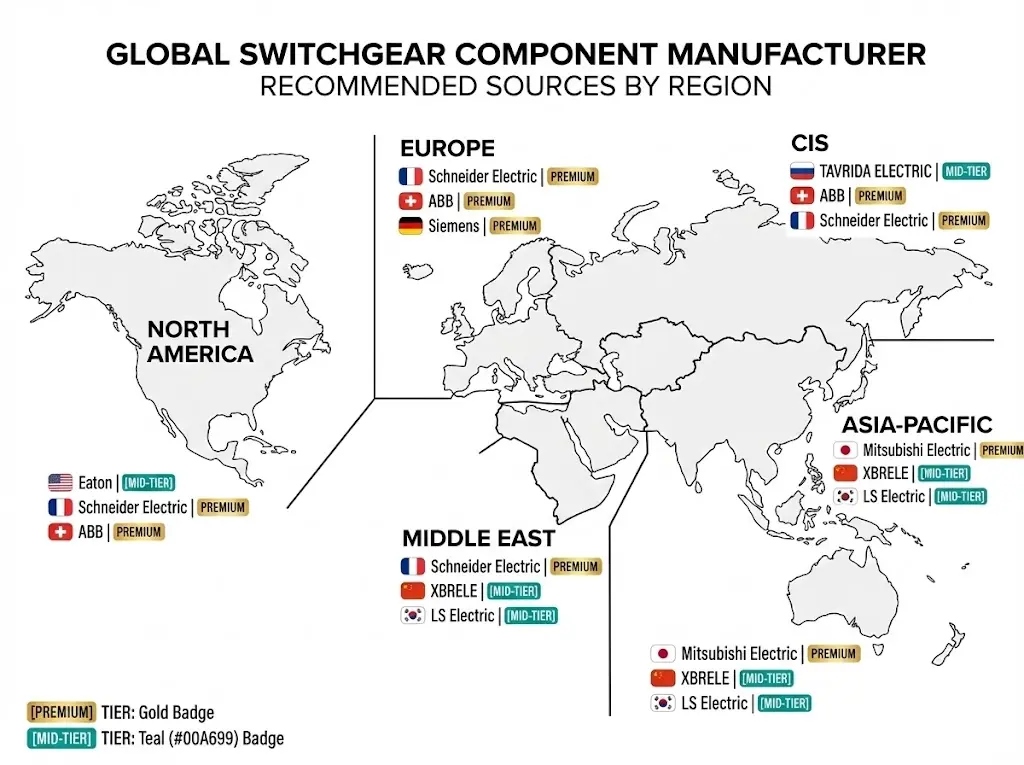
Regional sourcing recommendations map showing top switchgear component manufacturers by geographic region with tier classifications for optimal supplier selection
**Figure 4**: Regional sourcing strategy varies by market—North America favors Eaton for local support, Europe dominated by Schneider/ABB/Siemens, Asia-Pacific benefits from LS Electric/XBRELE cost advantages, while Middle East balances premium quality with mid-tier value options.

Component-Specific Manufacturer Selection

Not all manufacturers excel equally across components. Consider specialized sourcing:

Epoxy Insulators: Top Choices

  1. Siemens (Resibloc technology—premium)
  2. Meidensha (excellent void-free casting)
  3. Qualified Chinese OEMs (cost-effective, suitable for standard applications)

Vacuum Interrupters: Top Choices

  1. Mitsubishi Electric (proprietary alloy, longest life)
  2. ABB (extensive type test data, well-documented)
  3. XBRELE (good value, improving quality)

More details on vacuum interrupter selection at top vacuum interrupter manufacturers guide.

Busbar Systems: Top Choices

  1. ABB (innovative connection systems, integrated monitoring)
  2. Schneider Electric (well-documented short-circuit ratings)
  3. Eaton (good North American availability)

VPIS and Voltage Sensors: Top Choices

  1. Schneider Electric (advanced diagnostics, IoT integration)
  2. ABB (reliable, well-proven designs)
  3. XBRELE (cost-effective solutions)

Detailed guidance at VPIS capacitive sensor selection guide.

Total Cost of Ownership Analysis

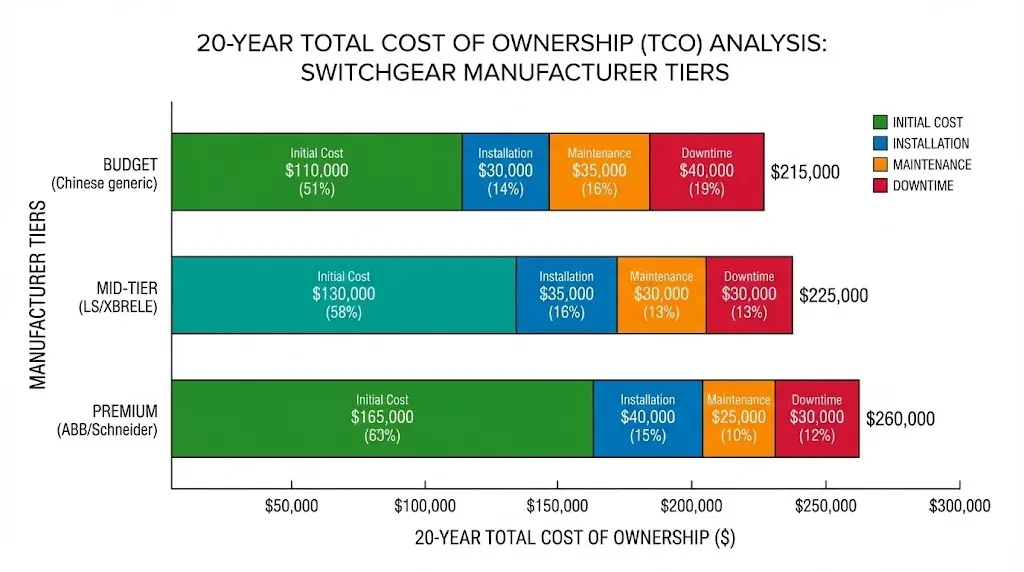
Total cost of ownership comparison for switchgear components showing budget, mid-tier, and premium manufacturers across initial cost, installation, maintenance, and downtime over 20-year lifecycle
**Figure 3**: TCO analysis reveals premium manufacturers only 17% more expensive over 20-year lifecycle—lower maintenance costs ($25K vs $45K) and reduced downtime risk ($15K vs $40K) offset higher initial investment for critical applications.

Initial price represents only 40–60% of total cost of ownership. Comprehensive TCO includes:

Purchase Price (40–60% of TCO)

Component cost:

  • Budget tier: Asian manufacturers (baseline cost)
  • Mid-tier: Korean, some European brands (1.3–1.8× budget tier)
  • Premium tier: Top European/Japanese brands (2.0–2.5× budget tier)

Installation and Commissioning (15–25% of TCO)

Factors affecting installation cost:

  • Documentation quality (poor docs increase field labor)
  • Dimensional accuracy (misalignment requires rework)
  • Pre-commissioning support (manufacturer presence reduces errors)

Premium manufacturers often recover cost through smoother installation.

Maintenance and Spares (15–25% of TCO)

Over 20-year life:

  • Spare parts availability (obsolete components require panel retrofits)
  • Maintenance interval (higher quality = less frequent maintenance)
  • Failure rate (premium components justify cost through higher reliability)

Downtime and Reliability (10–20% of TCO)

Critical for industrial processes:

  • Unplanned downtime cost (production loss)
  • Replacement logistics (fast spares delivery critical)
  • Emergency support availability

Example TCO comparison (12 kV switchgear, 20-year life):

Manufacturer TierAnschaffungskostenInstallationWartungDowntimeTotal TCO
Budget (Chinese generic)$100,000$30,000$45,000$40,000$215,000
Mid-tier (LS/XBRELE)$140,000$25,000$35,000$25,000$225,000
Premium (ABB/Schneider)$200,000$20,000$25,000$15,000$260,000

Premium tier 17% higher TCO but significantly lower operational risk.

RFQ Process and Supplier Evaluation

Technical Specification Checklist

Include in RFQ to enable fair comparison:

  • Voltage class and insulation level: 12 kV, 28 kV BIL (example)
  • Rated current and short-circuit rating: 630 A, 25 kA for 3s
  • Environmental conditions: Temperature range, humidity, altitude, pollution level
  • Standards compliance: IEC 62271 series, specific clauses
  • Testing requirements: Type test report, routine tests, witness testing
  • Spare parts: Minimum 10-year availability guarantee
  • Technical support: Commissioning assistance, training, documentation language

Evaluation Criteria Weighting

Suggested weighting for component procurement:

KriteriumGewichtScoring Method
Technical compliance30%Pass/fail + margin analysis
Preis25%Relative to lowest bidder
Delivery time15%Meets schedule = full points
Quality/certification15%Independent test reports, ISO certs
After-sales support10%Local presence, spare parts commitment
Financial stability5%Company financials, references

Reference Checks

Request and verify:

  • 3+ similar projects (voltage, application, geography)
  • Contact details for end users (not just contractors)
  • Failure rates/warranty claims (ask references directly)
  • Delivery performance on referenced projects

Wichtige Erkenntnisse

  • Top-tier manufacturers (Schneider, ABB, Siemens) offer comprehensive portfolios, premium quality, and global support at 2–2.5× cost of budget options
  • Mid-tier manufacturers (XBRELE, LS Electric, Eaton) provide strong value proposition: reliable products at moderate cost
  • Budget manufacturers (Generic Chinese suppliers) suitable for non-critical applications with careful quality control
  • Total cost of ownership often favors premium manufacturers for critical applications despite higher initial cost
  • Component-specific sourcing can optimize: premium vacuum interrupters + mid-tier epoxy insulators + budget busbar supports
  • Regional support capability matters as much as product quality—local presence reduces commissioning risk and downtime
  • Evaluation should balance technical compliance, price, delivery, and lifecycle support based on application criticality

Häufig gestellte Fragen

Q1: Can I mix components from different manufacturers in a single switchgear panel? A: Yes, but verify interface compatibility (dimensions, electrical ratings, mounting provisions). Most manufacturers design to IEC standard dimensions, but confirm before ordering. Custom integration may affect panel manufacturer’s warranty.

Q2: How do I verify a manufacturer’s claimed certifications and test reports? A: Request certificate numbers and contact accreditation body (e.g., IECEE CB database). Independent test laboratories (KEMA, CESI) maintain public records. Beware self-certified claims without third-party validation.

Q3: What is a reasonable lead time for standard switchgear components? A: Catalog items: 4–8 weeks for European/Japanese manufacturers, 3–6 weeks for Chinese manufacturers. Custom-engineered items add 3–6 weeks for design. Expedited delivery possible with premium (often 20–30% surcharge).

Q4: Should I specify component brands in my switchgear RFQ or allow panel builder to select? A: Depends on project criticality and your confidence in panel builder. Critical installations: specify primary components (circuit breakers, interrupters), allow flexibility on supports/hardware. Less critical: performance specification only, pre-approve alternate brands.

Q5: How do Asian manufacturers’ quality compare to European brands? A: Top Asian manufacturers (Mitsubishi, LS Electric, XBRELE) approaching European quality. Budget Chinese manufacturers variable—require batch inspection and quality audits. Gap narrowing rapidly as Asian manufacturers invest in R&D and certification.

Q6: What documentation should I require from component suppliers? A: Essential: Type test reports, routine test certificates per IEC 62271, operation/maintenance manuals, dimensioned drawings, spare parts lists. Desirable: Application guides, troubleshooting procedures, training materials, CAD files for panel design.

Q7: How long should I expect components to remain available for spare parts? A: Premium manufacturers commit 10–15 years minimum after discontinuation notice. Budget manufacturers may offer only 5 years or no commitment. Negotiate minimum availability period in purchase terms for long-life installations.

Weiterführende Literatur

Hannah Zhu, Marketingdirektorin von XBRELE
Hannah

Hannah ist Administratorin und Koordinatorin für technische Inhalte bei XBRELE. Sie ist verantwortlich für die Website-Struktur, die Produktdokumentation und die Blog-Inhalte zu den Themen Mittel- und Hochspannungsschaltanlagen, Vakuumunterbrecher, Schütze, Unterbrecher und Transformatoren. Ihr Schwerpunkt liegt auf der Bereitstellung klarer, zuverlässiger und ingenieursfreundlicher Informationen, um Kunden weltweit dabei zu unterstützen, fundierte technische und Beschaffungsentscheidungen zu treffen.

Artikel: 58