Request a Quote for High-Voltage Components&Equipment
Tell us your requirements — rated voltage, model, quantity, and destination — and our XBR Electric team will prepare a detailed quotation within 24 hours.
“Indoor vs outdoor” is a boundary condition. It changes what must be sealed, what ages first, and what you’re actually buying: a breaker core that lives in a controlled cubicle, or a breaker system that must survive weather and contamination in the field.
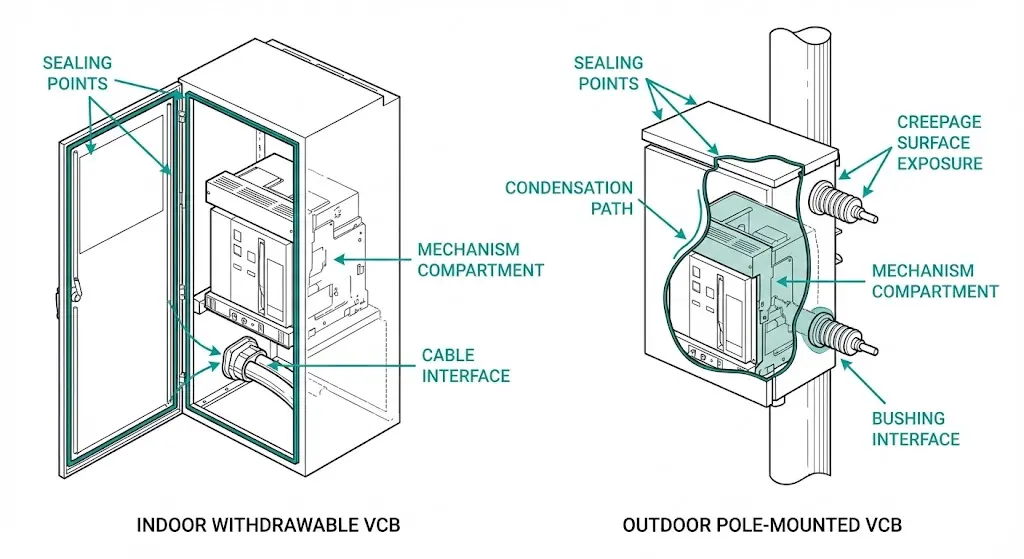
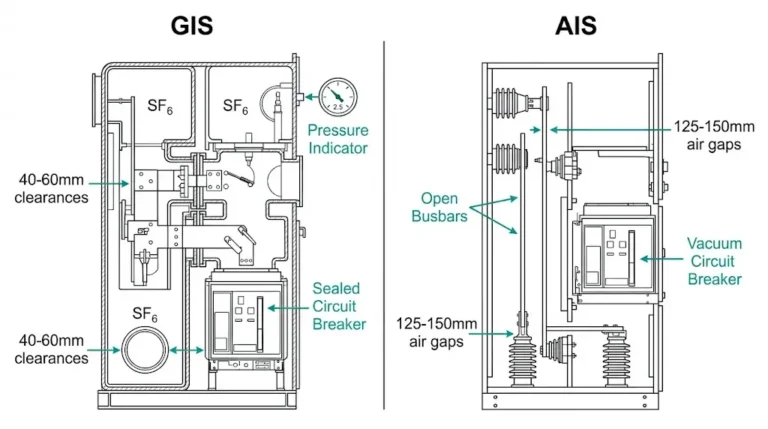
Indoor VCBs assume the switchgear lineup provides shielding, controlled clearances, and a relatively stable atmosphere. Outdoor VCBs must tolerate rain, dust, UV, salt fog, pollution film, and daily thermal breathing—so the design shifts toward sealing, moisture management, and field wiring interfaces. For how AC circuit-breakers are specified and tested (including indoor and outdoor installation), IEC 62271-100 is the key reference standard.
Side-by-side cutaway highlights how sealing, interfaces, and exposure drive indoor vs outdoor VCB design choices.
What meaningfully changes when the breaker goes outdoors:
Enclosure + sealing strategy: Outdoor units are built around ingress control and cabinet “breathing.” In practice, control cabinets often target IP54 to IP65 class sealing depending on exposure and maintenance expectations.
Insulation surface management: Wet contamination film drives tracking risk outdoors; indoor designs rely more on clean air gaps and controlled cubicle geometry.
Creepage/clearance sensitivity: At elevations above 1000 m, lower air density reduces dielectric margin. That pushes you toward altitude options or derating practices, especially on exposed external insulation.
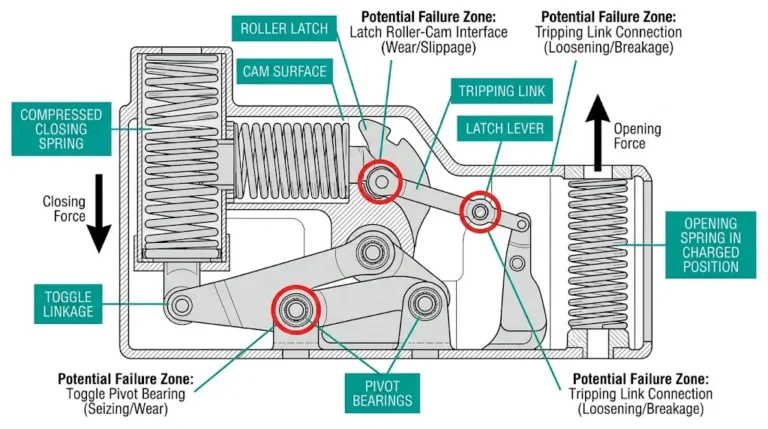
Mechanism compartment protection: Outdoor designs isolate the operating mechanism from dust/salt and temperature cycling; indoor designs prioritize service access and truck compatibility.
Corrosion/UV controls: Outdoor fasteners, terminals, and polymer accessories need coatings and UV-stable material choices; indoor hardware can be optimized for compactness.
Cable/bushing interface: Outdoor packages often integrate termination strategy and routing into the product; indoor breakers assume the switchgear lineup owns terminations.
Condensation mitigation: Outdoor cabinets commonly include heaters (often 30 W to 100 W, sized by cabinet volume) plus drip-loop routing and drainage paths.
ZW20 / ZW32 live inside the environment (sealed compartments, outdoor interfaces, field controls).
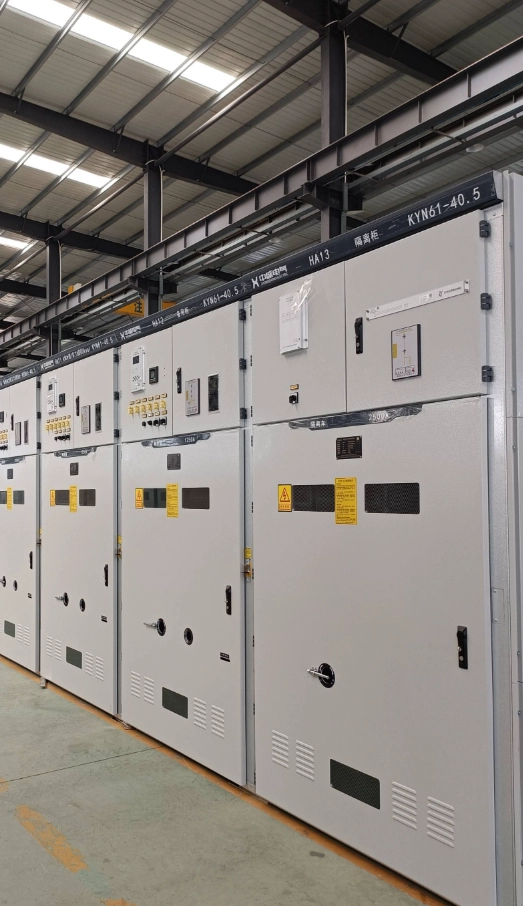
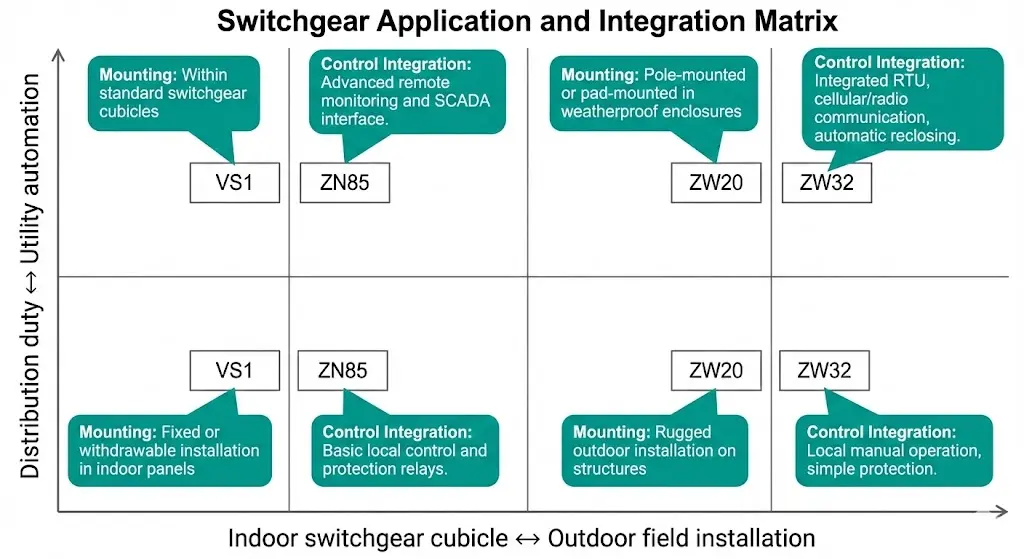
Indoor panel VCB (VS1 / ZN85) Best-fit deployment: metal-clad switchgear lineups, indoor substations, industrial plants with stable room conditions. Typical system anchors: VS1 commonly aligns with 12 kV to 24 kV indoor distribution projects; ZN85 is positioned for 40.5 kV, 3-phase AC 50 Hz indoor networks. The real value is cubicle compatibility and planned service access.
Outdoor network VCB (ZW20 / ZW32) Best-fit deployment: overhead distribution nodes and field-installed sites where the VCB must tolerate weather and contamination as part of the product. Typical system anchors: ZW20 is commonly applied in 12 kV overhead distribution; ZW32 is often deployed across 12 kV and 40.5 kV outdoor networks. The real value is sealing + cabinet integration + field wiring/control readiness.
If a vendor can’t provide the mounting interface drawing early (truck geometry vs pole/structure mounting), treat it as a selection risk—not a paperwork delay.
For outdoor projects, ask “Where does condensation go?” before you debate features; cabinet and interface decisions drive a large share of field reliability.
For indoor retrofits, interlocks and racking positions can consume more schedule than the breaker itself—confirm them first.
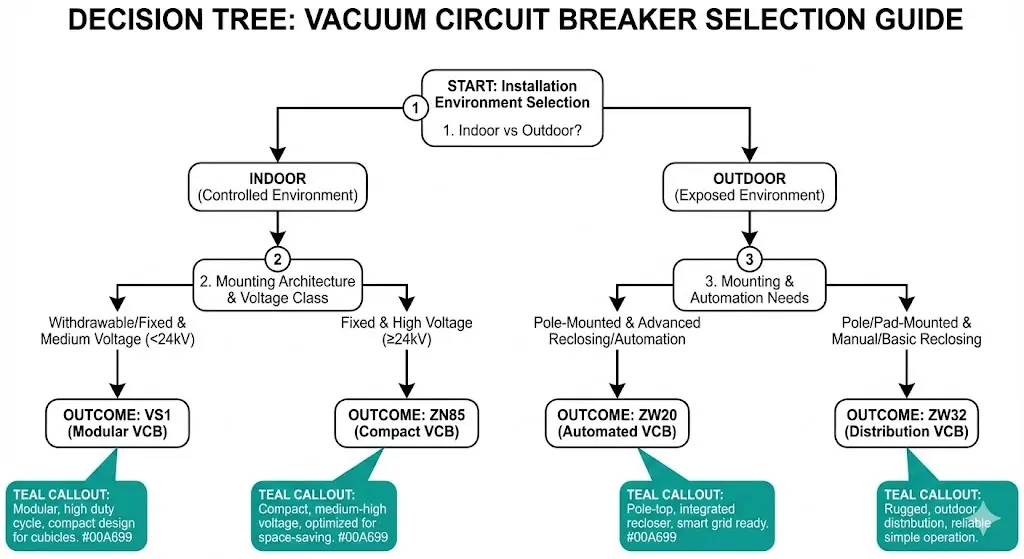
Selection flow: choose indoor or outdoor first, then pick the right series
Selection flowchart routes projects to the correct VCB family using environment, mounting, and controls requirements.
Use this flow to keep the decision selection-first instead of brochure-first.
Confirm environment: indoor switchgear room or outdoor exposure. If it’s outdoors, start in the outdoor family space.
Confirm mounting architecture: withdrawable/fixed inside cubicle vs pole/field mounting. This one check removes most wrong paths.
Confirm voltage class anchor: many projects center on 12 kV; some require 40.5 kV class equipment—often a hard boundary.
Decide whether reclosing/automation is required: if “yes,” your decision tends to move toward outdoor packages with controller integration.
Indoor branch—lineup compatibility check: verify the cubicle interface and interlocks are feasible before you commit to any indoor series.
Outdoor branch—site hardness check: salt fog, heavy dust, and condensation cycles push you toward stronger sealing and cabinet design.
Indoor family split:
VS1 when you need mainstream indoor integration for 12 kV to 24 kV class distribution projects.
ZN85 when the project is 40.5 kV, 3-phase AC 50 Hz, and the lineup is designed for that insulation class and structure.
Outdoor family split:
ZW20 for 12 kV overhead distribution where outdoor installation is the core requirement.
ZW32 when you need broader outdoor coverage (commonly 12 kV and 40.5 kV) and a more integrated package approach.
Stop condition: if your chosen family conflicts with mounting (truck vs pole) or environment (indoor assumptions vs weather), restart at Steps 1–2. Don’t “adapt” the wrong breaker as a shortcut.
Comparison matrix: the 12 checks that decide VS1 vs ZN85 and ZW20 vs ZW32
This matrix is meant to align engineering, procurement, and commissioning. It avoids fake precision: you’re scoring fit, not guessing numbers from marketing tables.
Selection check (12)
VS1 (Indoor)
ZN85 (Indoor)
ZW20 (Outdoor)
ZW32 (Outdoor)
1) Environment envelope
Indoor-focused
Indoor-focused
Outdoor-focused
Outdoor-focused
2) Mounting architecture
Cubicle/truck
Cubicle/truck
Pole/field
Pole/field
3) Typical voltage class anchor
12–24 kV
40.5 kV
12 kV
12 kV / 40.5 kV
4) Switchgear lineup compatibility
Strong
Lineup-dependent
Not intended
Not intended
5) Weather sealing dependency
Relies on cubicle
Relies on cubicle
Designed-in
Designed-in
6) Reclosing / feeder automation packaging
Low
Low
Medium (config-dependent)
High (config-dependent)
7) Field terminations & outdoor interfaces
Cubicle-owned
Cubicle-owned
Product-owned
Product-owned
8) Maintenance model
Planned outages
Planned outages
Field service-friendly
Field service-friendly
9) Condensation + contamination resilience
Room-dependent
Room-dependent
Better
Stronger (typically)
10) Indoor retrofit likelihood
High
Medium
Low
Low
11) Controls cabinet integration depth
Minimal
Minimal
Medium
High
12) Risk if forced into wrong context
High
High
High
High
How to use it:
If checks 1–2 point to cubicle, your real decision is VS1 vs ZN85; checks 3–4 usually decide quickly.
If checks 1–2 point to outdoor, your decision is ZW20 vs ZW32; checks 6–11 decide whether you need deeper control integration and stronger environmental strategy.
Field realities: altitude, pollution, salt fog, condensation, and temperature swings
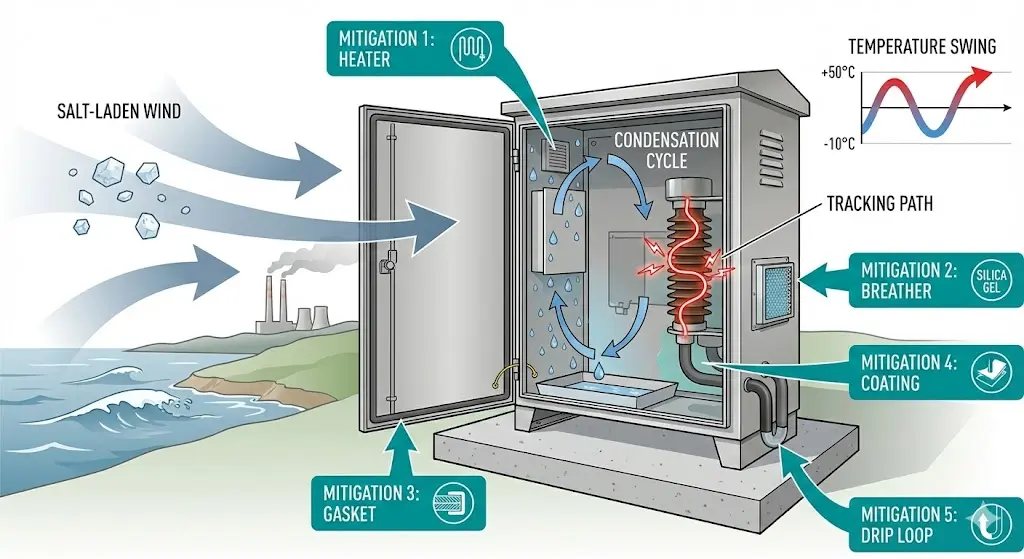
Field-risk diagram links salt fog, condensation, and temperature cycling to practical outdoor VCB mitigation measures.
Outdoor VCB reliability is often decided by surfaces and cabinets: wet contamination film, condensation, and mechanical friction shifts across seasons. Treat site conditions as selection inputs and maintenance triggers.
Risk → likely field failure mode → mitigation that works in practice
High altitude (above 1000 m) → reduced dielectric margin, higher flashover sensitivity on exposed insulation → request altitude-rated option or apply derating practice; increase inspection frequency for external insulation surfaces.
Coastal salt fog (within about 5 km shoreline) → corrosion at terminals/fasteners; tracking on bushings → corrosion-resistant hardware + sealed terminations + hydrophobic coating strategy; schedule rinse/clean cycle every 3 months in peak season.
Industrial pollution (cement/coal/chemical mist) → conductive film forms; tracking starts at edges/crevices → improve sealing/shields; plan cleaning every 6 months; prioritize smooth profiles that shed contamination.
Condensation cycles (day/night swings) → moisture causes logic faults, coil issues, and wet surface conditions → cabinet heater (often 50 W to 100 W), breathers/drain paths, drip-loop routing, and disciplined cable gland practice.
Large temperature swing (example -25 degC to +55 degC) → mechanism timing drift, gasket stiffening, lubricant viscosity shifts → specify low-temp lubrication, confirm gasket material, and verify close/trip operations at temperature extremes during commissioning.
Rain + dust (mud packing at joints) → gasket leakage, dust ingress, surface tracking → upgrade sealing strategy and protect joints; keep insulation surfaces accessible for wipe-down.
UV exposure → polymer aging/cracking on boots and accessories → use UV-stable accessories, add sun shields where practical, inspect annually.
Field grounding/bonding shortcuts → nuisance control issues, degraded surge performance → enforce bonding checklist; verify cabinet earth continuity and surge protection installation.
[Expert Insight]
When sites are harsh, spend effort on cabinet moisture control (heater sizing, drains, breathers, gland practice). It often moves reliability more than a “higher tier” interrupter.
If you can’t commit to a realistic cleaning cadence (every 3–6 months in severe sites), select the configuration that tolerates contamination better—don’t rely on ideal maintenance.
Commissioning should include cold/heat functional checks. A breaker that “meets ratings” can still misbehave if the mechanism and cabinet aren’t matched to the climate.
Controls & system integration: protection, reclosing, CT/PT sensing, and SCADA readiness
A breaker that fits electrically can still be a poor selection if the control package doesn’t match your protection scheme and wiring reality. Indoor families tend to win on lineup integration; outdoor families tend to win on field controls and restoration speed.
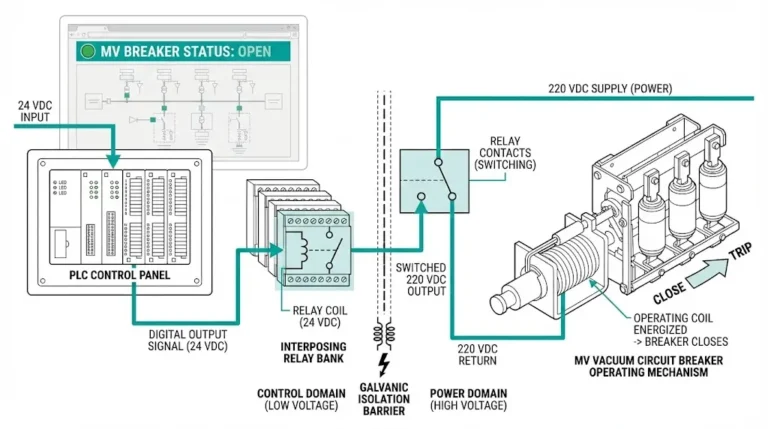
Trip/close supply: confirm control voltage early (common options include 110 VDC or 220 VDC; some auxiliary circuits use 24 VDC).
Interlocks: ensure the cubicle interlock chain matches breaker truck position logic (door, earthing switch, racking position, mechanical blocking).
Protection location: typically in the panel relay; confirm the breaker provides the status points you need (open/close, spring charged, trip circuit healthy).
CT/PT ownership: validate secondary wiring routes, terminal plans, and test blocks before production.
Aux contacts count: confirm enough dry contacts for SCADA, interlocks, and annunciation—especially in retrofit projects.
Scenario B — Outdoor line / pole (ZW20 / ZW32): integration checklist
Reclosing & sectionalizing: confirm the controller supports your logic and setting workflow (not only that “reclosing exists”).
Sensing package: confirm whether CTs and VTs/PTs are integrated or external and how the scheme meets protection/metering needs.
SCADA interface: confirm physical interface (common are RS-485 or Ethernet) and what the site can actually support.
Cabinet environment: specify heater power and supply (typical 50 W to 100 W), grounding layout, and surge protection details in the drawing package.
Wiring deliverables: require IO list, terminal plan, and point-to-point diagram before production.
Cost, lead time, and lifecycle trade-offs + when to talk to XBRELE
Selection isn’t only CAPEX. It’s commissioning time, site work, controls complexity, and how fast you can restore service after a fault. Indoor VCBs are often the cleanest path when the cubicle is the system. Outdoor packages often reduce field risk when the environment is the system.
Three scenario recommendations
Budget / controlled environment: go indoor when the breaker sits in a proper lineup and room conditions are stable. For many indoor projects in the 12 kV to 24 kV range, VS1-type integration is a practical baseline.
Balanced / mixed priorities: outdoor exposure but limited automation needs—select an outdoor family with a straightforward control package and plan site checks every 6 months to keep moisture/pollution from accumulating into failures.
Harsh environment / automation-driven: coastal pollution, heavy condensation cycles, or feeder automation needs—prioritize the outdoor family that delivers stronger sealing + cabinet integration to reduce truck rolls and shorten restoration time.
To get a fast, engineering-grade recommendation from XBRELE, send these inputs in one message:
Voltage class (e.g., 12 kV or 40.5 kV) and rated current target (in A)
Indoor lineup type (if indoor) or environment details (if outdoor: altitude in m, pollution/salt severity, temperature range in degC)
Control needs: reclosing yes/no, SCADA interface preference, available control supply (e.g., 110 VDC or 220 VDC)
Quantity, delivery window, retrofit constraints (panel drawings or pole-top layout)
FAQ
1) If a project is outdoors, is an outdoor VCB always the right answer? Often, but not automatically—if the breaker is installed in an enclosure that genuinely controls moisture, contamination, and interfaces, an indoor approach can be workable.
2) What’s a quick way to avoid picking the wrong family early? Start with mounting architecture (cubicle truck vs pole/field) and environment exposure, then confirm voltage class anchors such as 12 kV or 40.5 kV before comparing options.
3) When does ZW32 tend to make more sense than ZW20? When the site benefits from deeper control integration or a broader deployment envelope, especially where environment and automation requirements are stronger.
4) Which field condition deserves the most attention in design reviews? Condensation combined with contamination is a common driver; it’s worth validating cabinet moisture strategy and insulation surface exposure early.
5) For indoor switchgear, what should be confirmed before placing an order? Interface drawings, interlock logic, and a terminal plan that matches your protection/SCADA points usually prevent the most expensive surprises.
6) Does a “higher spec” breaker always translate to better field reliability? Not necessarily—correct sealing, wiring discipline, grounding practice, and realistic maintenance cadence can matter as much as the breaker’s nominal capability.
Hannah is the Administrator and Technical Content Coordinator at XBRELE. She oversees website structure, product documentation, and blog content across MV/HV switchgear, vacuum breakers, contactors, interrupters, and transformers. Her focus is delivering clear, reliable, and engineer-friendly information to support global customers in making confident technical and procurement decisions.