Request a Quote for High-Voltage Components&Equipment
Tell us your requirements — rated voltage, model, quantity, and destination — and our XBR Electric team will prepare a detailed quotation within 24 hours.
Mining environments destroy equipment that survives elsewhere. Dust penetration defeats standard IP ratings within months. Vibration from blasting and heavy equipment cracks epoxy insulators designed for static installations. Altitude at open-pit and underground mines reduces air-insulated component ratings by 10–20%. Temperature swings from -30°C surface conditions to +45°C underground stress thermal management systems designed for controlled substations.
Medium-voltage switchgear selection for mining cannot simply specify IEC ratings and lowest bid. A 12 kV panel rated IP54, tested at sea level, performing flawlessly in a clean substation will fail catastrophically when installed in a crushing plant at 3,500 meters elevation with airborne silica dust and shock loading from ore processing.
Manufacturers who understand mining applications engineer solutions beyond catalog specifications: sealed contactors immune to dust ingress, vibration-hardened busbar supports, altitude-corrected insulation coordination, and modular designs enabling rapid replacement during the narrow maintenance windows mining operations permit.
This guide identifies manufacturers with proven mining portfolios, explains what distinguishes mining-grade switchgear from standard industrial equipment, and provides selection criteria procurement teams need when specifying MV distribution systems for surface operations, underground installations, and mobile equipment at mining sites worldwide.
Why Mining Switchgear Requirements Differ
Standard switchgear specifications assume controlled environments. Mining defies every assumption. ### Environmental Challenges
Dust and contamination:
Airborne silica, coal dust, mineral particulates
Standard IP54 enclosures fail—dust penetrates cable entries, ventilation paths
Requires: Reinforced mounting, vibration-damped components, mechanical interlocks that don’t depend on precise alignment
Altitude effects:
Many mines operate 2,000–4,500 m elevation
Air density reduced → lower dielectric strength, reduced cooling
Requires: Altitude correction factors (multiply BIL by 1.10–1.25), oversized ventilation, derating
Temperature extremes:
Surface: -40°C (Arctic/high-altitude mines) to +50°C (tropical open-pit)
Underground: +30 to +45°C with 90%+ humidity
Requires: Heaters/thermostats for outdoor, oversized cooling for underground, condensation management
Corrosive atmosphere:
Acidic drainage (sulfur-bearing ores)
Salt spray (coastal operations)
Chemical processing (flotation, leaching)
Requires: Stainless/galvanized enclosures, conformal coating on electronics
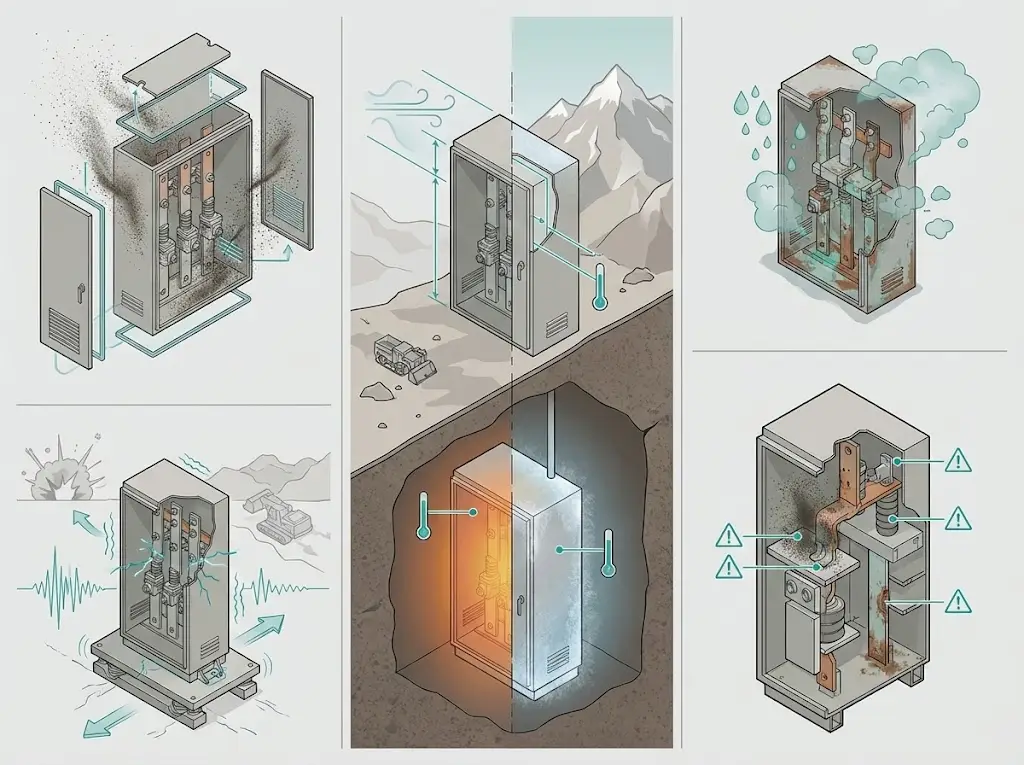
Mining environments impose combined stresses—dust ingress, vibration, altitude derating, temperature extremes, and corrosion—that standard industrial switchgear is not designed to withstand.
Operational Requirements
Rapid fault clearing:
Personnel safety paramount—miners work in confined spaces
Equipment protection critical—replacing 4,000 HP mill motor costs weeks of production
Requires: Fast-acting protection (VCB preferred over fuses), selective coordination
Maintenance accessibility:
Downtime costs $50,000–500,000/hour for large operations
Maintenance windows measured in hours, not days
Requires: Modular/withdrawable designs, local spare parts availability, 24/7 manufacturer support
Mobile equipment compatibility:
Trailing cables for draglines, shovels, continuous miners
Altitude: Derate or uprate per IEC 62271-1 for site elevation
Temperature: -40 to +55°C operating range (surface), +40 to +60°C (underground)
Vibration: Test per IEC 60068-2-6 or IEEE 693 seismic qualification
Corrosion: NEMA 4X/IP66 stainless or epoxy-coated steel for corrosive atmospheres
Verify manufacturer testing: Request test certificates showing actual environmental qualification, not just claims of “suitable for mining.”
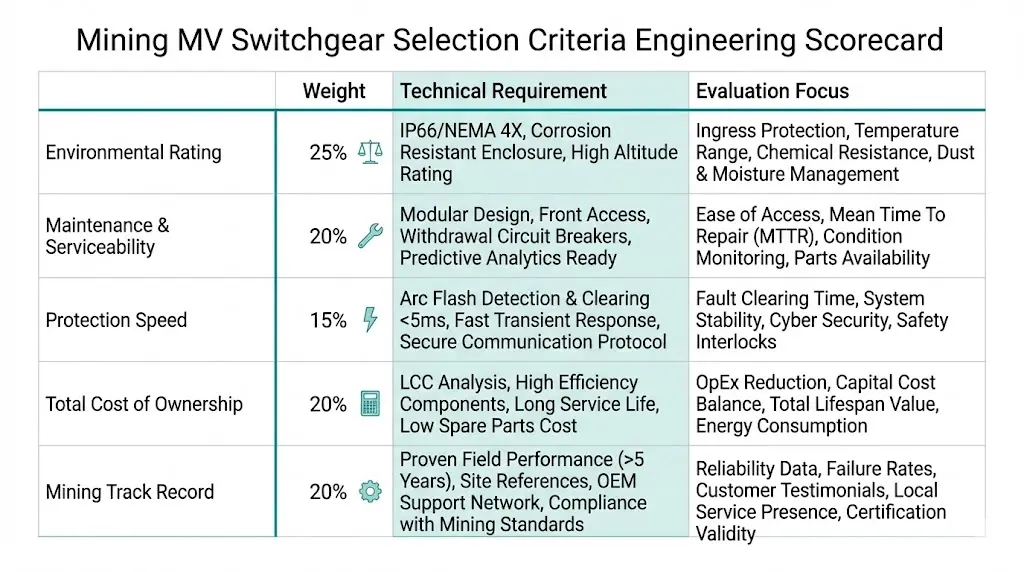
2. Maintenance and Serviceability
Evaluate:
Modular design: Withdrawable vs fixed breakers (withdrawable enables replacement without dismantling busbars)
Local spares availability: Manufacturer maintains inventory within 24-hour delivery?
MTTR (Mean Time to Repair): <4 hours for common failures?
Training: Manufacturer provides on-site training for maintenance crew?
Red flag: Manufacturer with no local service presence, requiring international dispatch for repairs
3. Fault Protection Speed and Coordination
Mining-specific requirements:
Ground fault protection: Sensitive (5–10 A pickup) for personnel safety, but selective (avoid nuisance trips from leakage currents in trailing cables)
Arc flash reduction: MaintenanceSwitches, zone-selective interlocking, or optical arc flash systems
Coordination: Verify with upstream mine utility and downstream equipment protection
Tool: Request manufacturer perform arc flash study and coordination analysis for your specific installation
4. Total Cost of Ownership (20-Year Horizon)
Consider beyond purchase price:
Cost Component
Typical % of TCO
Initial capital cost
40–50%
Installation/commissioning
10–15%
Maintenance (parts + labor)
15–25%
Downtime cost (production loss)
15–30%
Energy losses
5–10%
Mining context: Downtime cost often dominates—premium switchgear with better reliability and faster repair may have lower TCO despite higher capital cost
5. Manufacturer Track Record in Mining
Questions to ask:
“Provide 3 reference sites in similar mining applications (ore type, location, environment)”
“What is your largest mining installation by power capacity?”
“How many switchgear installations do you have operating above 3,000m elevation?”
“What is typical lead time for mining-duty configurations?”
Site visit: If project is large, visit a reference mine using that manufacturer’s equipment—observe actual condition after years of service
Mining Application-Specific Considerations
Surface Operations
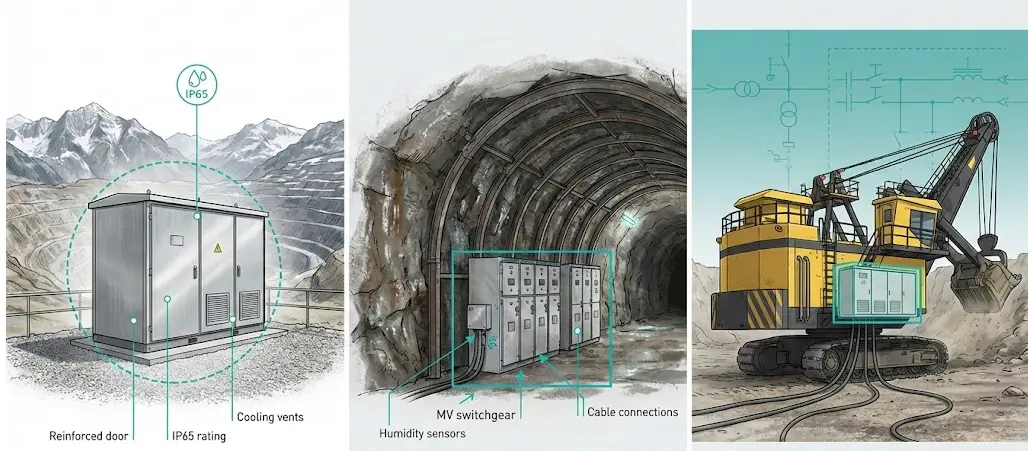
Primary challenges: Dust, temperature extremes, altitude (for high-elevation mines)
Preferred configurations:
IP65+ metal-clad outdoor enclosures
Positive-pressure ventilation with filtered air intake
Specialist (Lucy Electric if underground, GE if arc flash critical): Specific strengths
Evaluation matrix:
Criterion
Weight
Scoring Method
Technical compliance
35%
Pass/fail + margin to requirements
Price (capital + 10-year maintenance)
30%
Relative to lowest bidder
Delivery schedule
15%
On-time penalty provisions
Mining experience
10%
Reference projects, years in mining
Local support
10%
Service presence, spares stock
Standardization vs Best-of-Breed
Standardization approach:
Single manufacturer for all MV switchgear
Advantages: Spares commonality, single training program, volume pricing leverage
Disadvantages: May not get optimal solution for each application
Best-of-breed approach:
Different manufacturers for different applications (e.g., Schneider underground, ABB surface, XBRELE mobile)
Advantages: Optimal technical fit for each environment
Disadvantages: Multiple spares inventories, training complexity, higher procurement burden
Recommendation: Standardize within categories (e.g., one manufacturer for all underground, another for all surface) but allow different manufacturers per category
Key Takeaways
Mining switchgear requirements exceed standard industrial specifications—dust (IP65+ vs IP54), vibration (seismic/blast qualified), altitude (correction factors 1.10–1.25× for >2,000m), and temperature extremes demand purpose-built designs
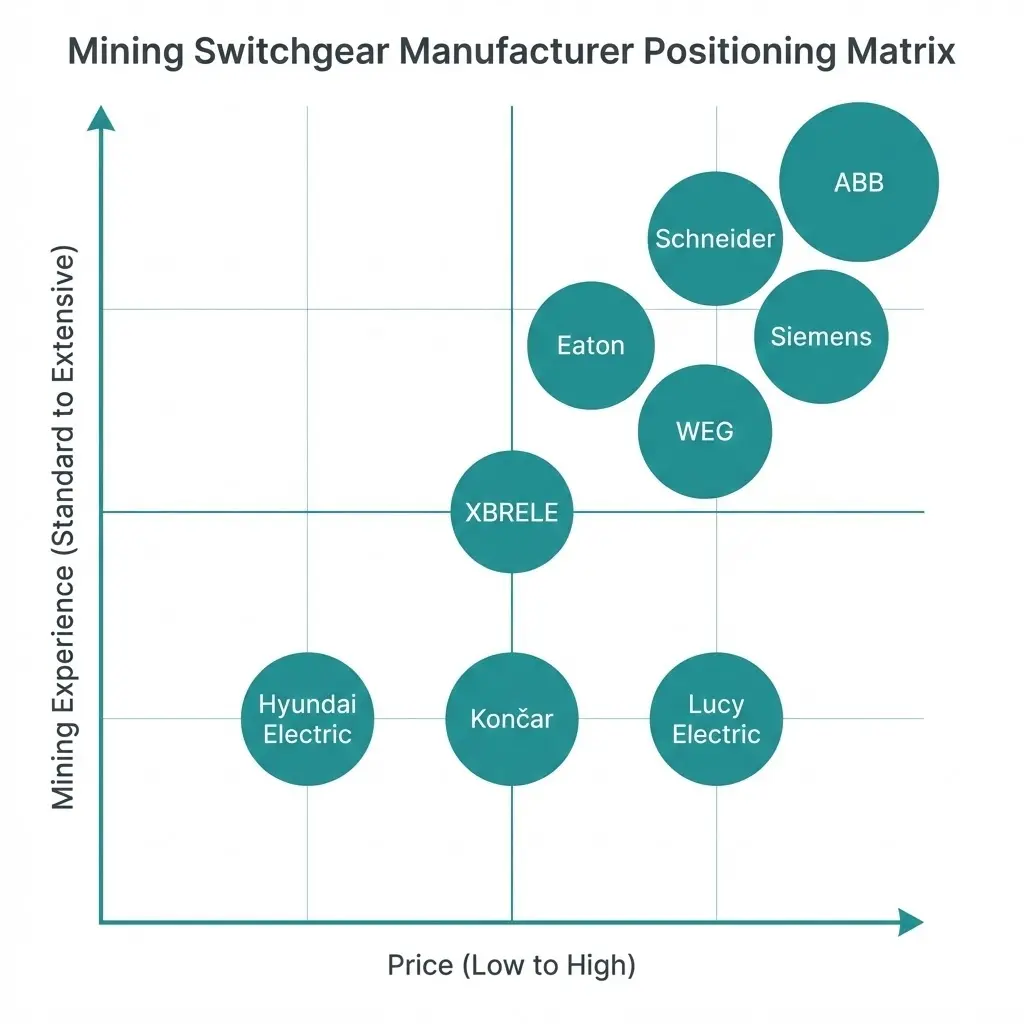
Premium manufacturers (ABB, Schneider, Siemens) justify 20–40% cost premium through proven mining portfolios, global service networks, and arc flash mitigation expertise—essential for large, safety-critical operations
Mid-tier manufacturers (XBRELE, WEG, Eaton) offer 30–50% cost savings with adequate performance for budget-conscious projects, emerging markets, or replacement applications—verify mining references and local support before selection
Downtime cost (15–30% of TCO) often dominates capital cost—modular/withdrawable designs enabling <4-hour MTTR provide better value than lowest-bid fixed installations requiring days to repair
Underground applications prioritize compact footprint (gas-insulated, RMUs) and personnel safety (ground fault <10A, arc flash systems), while surface emphasizes environmental protection (IP65+, altitude correction) and mobile equipment requires high-endurance contactors (100,000+ ops)
Request manufacturer-specific mining references at similar altitude/environment, perform site visits to observe actual equipment condition after years of service, and require arc flash/coordination studies as part of bid evaluation
External Reference:IEC 62271-106 — IEC 62271-106 standard for AC contactors
Frequently Asked Questions
Q1: Can I use standard industrial switchgear in a mine with just higher IP ratings? A: No—mining requires integrated design changes beyond enclosure rating: vibration-hardened components (reinforced busbars, lockwired fasteners), altitude-corrected insulation (higher BIL at elevation), enhanced cooling (oversized for high-ambient underground), and modular designs for rapid repair. Simply adding IP66 enclosure to standard switchgear fails in mining environments.
Q2: What altitude correction factor should I apply for a mine at 3,500m? A: Per IEC 62271-1, correction factor Ka = 1 + 0.012(H – 1000) where H is altitude in meters. At 3,500m: Ka = 1 + 0.012(3,500 – 1,000) = 1.30. Multiply required BIL by 1.30 or derate equipment rated current by 1/1.30 ≈ 0.77 (23% derate). Always verify manufacturer-specific altitude ratings.
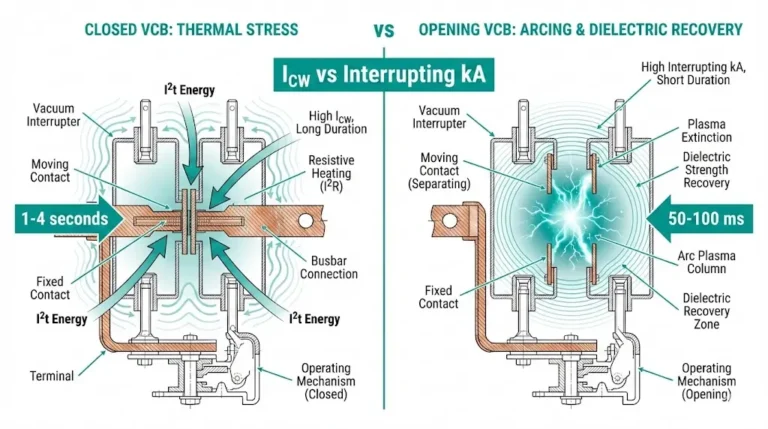
Q3: Should I specify SF6 or vacuum interrupters for mining applications? A: Vacuum circuit breakers (VCBs) preferred for mining: no SF6 environmental compliance issues, maintenance-free (no gas monitoring), performs well in dusty environments (sealed interrupter), and suitable for frequent operations. SF6 acceptable for compact gas-insulated designs (underground space constraints) but adds environmental reporting burden.
Q4: How do I evaluate manufacturer “mining experience” claims? A: Request specific reference projects with: mine name, ore type, environment (surface/underground, altitude, climate), installation year, rated capacity, contact name for verification. Visit reference site if possible—observe actual condition after service. Generic “suitable for mining” claims without verifiable references are red flags.
Q5: What’s more important for mining switchgear: lowest capital cost or fastest repair time? A: Fastest repair time (MTTR) dominates for large operations where downtime costs $50,000–500,000/hour. Calculate downtime cost × MTTR difference vs capital cost difference. Example: Premium switchgear $200,000 vs budget $120,000 ($80K premium), but premium has 2-hour MTTR vs 8-hour (6-hour difference). If downtime = $100K/hour, single failure saves 6 × $100K = $600K—premium pays for itself in one incident.
Q6: Can Chinese manufacturers (XBRELE, etc.) meet stringent mining requirements? A: Top-tier Chinese manufacturers (XBRELE, CHINT, etc.) meet IEC standards and have substantial mining portfolios, especially in Asia/Africa/Latin America. Key is verification: request certified test reports (not self-certified), mining references (verify independently), and assess local service capability. Quality gap vs European brands has narrowed significantly—cost savings often justify selection for appropriate applications.
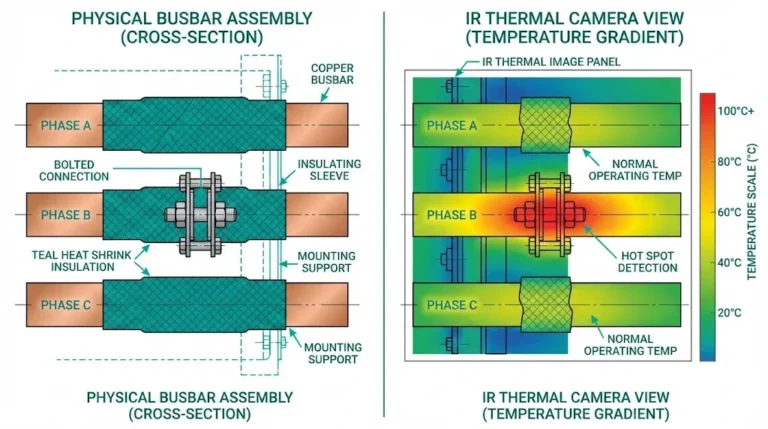
Q7: How often should mining switchgear undergo maintenance compared to standard industrial? A: More frequent due to harsher conditions. Standard industrial: annual inspection. Mining surface: semi-annual (dust accumulation, vibration effects). Mining underground: quarterly (heat, humidity, corrosive atmosphere). Mobile equipment: monthly or every 10,000 operations (frequent switching duty). Thermal imaging quarterly regardless of application (catches developing hot spots).
Hannah
Hannah is the Administrator and Technical Content Coordinator at XBRELE. She oversees website structure, product documentation, and blog content across MV/HV switchgear, vacuum breakers, contactors, interrupters, and transformers. Her focus is delivering clear, reliable, and engineer-friendly information to support global customers in making confident technical and procurement decisions.