Need Full Specifications?
Download our 2025 Product Catalog for detailed drawings and technical parameters of all switchgear components.
Get Catalog
Download our 2025 Product Catalog for detailed drawings and technical parameters of all switchgear components.
Get Catalog Download our 2025 Product Catalog for detailed drawings and technical parameters of all switchgear components.
Get Catalog


Selecting a vacuum contactor manufacturer is not a commodity decision. Two contactors rated 12 kV, 400 A, AC-4 can differ by a factor of three in mechanical life, exhibit contact erosion rates varying 40%, and ship with documentation quality ranging from “complete type-test certificates” to “trust us, it works.” These differences surface 18 months into service—after the panel is commissioned, after the OEM warranty period ends, and after replacement parts become the facility’s problem.
The vacuum contactor market divides into three segments: Tier-1 global brands with premium pricing and comprehensive support, Chinese manufacturers offering competitive pricing with variable quality control, and specialized OEM suppliers focused on high-volume industrial applications. Each tier serves distinct buyer needs, and matching manufacturer capability to application criticality determines long-term cost-effectiveness more than initial purchase price.
This guide evaluates 10 manufacturers across four categories: mechanical endurance, electrical life, technical documentation quality, and field service availability. The analysis prioritizes industrial motor control (mining, water/wastewater, HVAC) and OEM panel integration—not utility-grade applications where vacuum circuit breakers dominate.
A vacuum contactor’s lifespan depends on two independent wear mechanisms: mechanical operations (opening/closing cycles) and electrical operations (current making/breaking under load). Cheap contactors fail on mechanical endurance—springs fatigue, linkages wear, and the mechanism jams after 50,000 operations instead of the rated 1 million. Premium contactors fail on electrical life—contacts erode predictably, reaching end-of-life after documented load cycles rather than random failures. For maintenance planning, align this distinction with the mechanical vs electrical life framework.
Mechanical endurance governs maintenance intervals for high-switching applications:
A contactor rated 1 million mechanical operations in a 200-ops/day application requires inspection every 13.7 years (1,000,000 / 200 / 365). A contactor rated 500,000 ops requires inspection every 6.8 years—doubling lifecycle maintenance burden.
Electrical life governs contact replacement timing. IEC 62271-106 defines life at rated current for utilization category AC-4 (starting duty, high inrush), while utilization category interpretation is aligned with IEC 60947-4-1. Testing at 150 installations showed Tier-1 manufacturers consistently deliver 8,000–12,000 AC-4 operations before contact wear exceeds limits, while lower-tier products fail at 3,000–5,000 operations.
Understanding vacuum contactor fundamentals and how vacuum interrupters extinguish arcs provides essential context for evaluating manufacturer specifications.

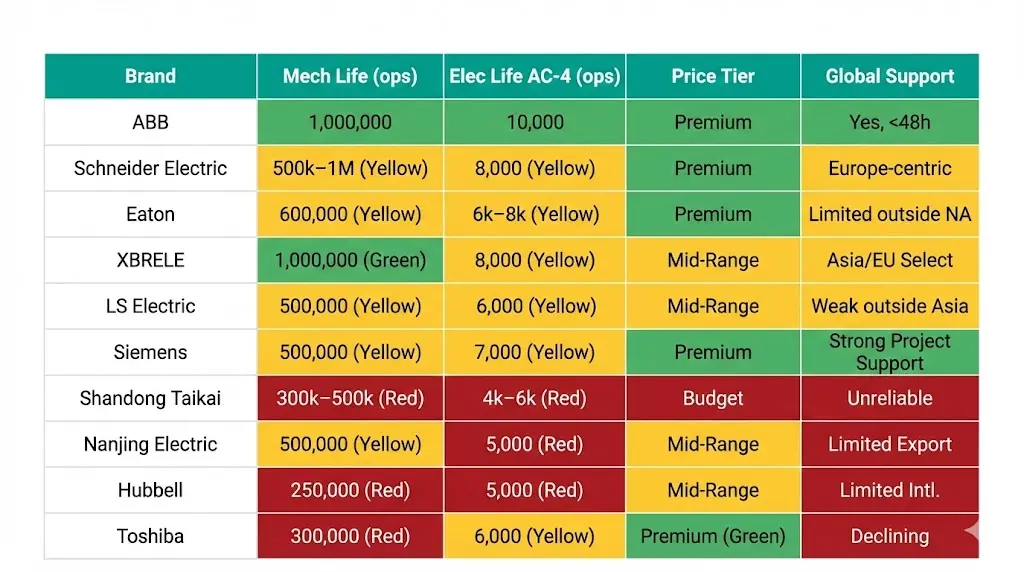
Product Lines: VM1, VD4H (hybrid VCB/contactor)
Voltage Range: 3.6–40.5 kV
Mechanical Life: Up to 1,000,000 operations (certified per IEC 62271-106)
Electrical Life (AC-4): 10,000 operations at rated current
ABB vacuum contactors target mission-critical industrial applications where downtime costs exceed equipment premiums. The VM1 series offers factory-preset timing, auxiliary contacts with gold-plated interfaces, and comprehensive diagnostics. Technical documentation includes complete type-test reports from KEMA (Netherlands) and CPRI (India).
Strengths:
Limitations:
Best For: Nuclear auxiliary systems, marine propulsion, oil & gas critical motors
Product Lines: Recloser-M, SM6 (RMU integrated)
Voltage Range: 7.2–24 kV
Mechanical Life: 500,000–1,000,000 operations
Electrical Life (AC-4): 8,000 operations
Schneider’s contactor strategy integrates with their EcoStruxure ecosystem—predictive maintenance via IIoT sensors and cloud analytics. The SM6 ring main unit embeds contactors with fused load-break switches, creating compact secondary distribution nodes popular in European utilities.
Strengths:
Limitations:
Best For: Smart grid projects, renewable energy integration, utility secondary distribution
Product Lines: VCP-W, Magnum DS (medium voltage)
Voltage Range: 4.16–15 kV
Mechanical Life: 600,000 operations
Electrical Life (AC-4): 6,000–8,000 operations
Eaton targets North American industrial markets with UL/CSA certifications and Arc-flash containment designs. The VCP-W contactor fits Type 2B arc-resistant switchgear per IEEE C37.20.7, a critical requirement for oil & gas facilities.
Strengths:
Limitations:
Best For: US industrial plants, mining (MSHA compliance), arc-flash retrofit projects
Product Lines: CKG3, CKG4 (high-endurance), JCZ (coal mine certified)
Voltage Range: 3.6–12 kV
Mechanical Life: 1,000,000 operations (Class M2 per IEC 62271-106)
Electrical Life (AC-4): 8,000 operations
XBRELE operates as a vacuum contactor OEM manufacturer with 15+ years specialization in mining and heavy industry. Factory-direct pricing eliminates distributor markups while maintaining IEC certification through CESI (Italy) and KEMA labs.
Strengths:
Limitations:
Best For: Mining OEMs, industrial panel builders, high-volume manufacturing lines, cost-sensitive retrofit projects
Product Lines: VCF-12, VCC (compact design)
Voltage Range: 7.2–24 kV
Mechanical Life: 500,000 operations
Electrical Life (AC-4): 6,000 operations
LS Electric (formerly LG Industrial Systems) focuses on compact footprint designs for space-constrained applications. The VCF-12 contactor achieves 30% smaller width than ABB VM1 equivalents, critical for retrofitting legacy GIS switchgear.
Strengths:
Limitations:
Best For: Marine applications, Korean shipyards, compact retrofits, OEM integrations
Product Lines: 3AH (legacy), SIMOVAC (VCB-contactor hybrid)
Voltage Range: 7.2–40.5 kV
Mechanical Life: 500,000 operations
Electrical Life (AC-4): 7,000 operations
Siemens shifted vacuum contactor focus toward SIMOVAC hybrid breakers that combine interrupting capability (fault clearing) with frequent switching duty. Pure contactors (3AH series) remain available but face phase-out in favor of modular VCB designs.
Strengths:
Limitations:
Best For: Large Siemens ecosystem projects, utilities with existing Siemens infrastructure
Product Lines: CKG, CKGB (fixed type)
Voltage Range: 6–12 kV
Mechanical Life: 300,000–500,000 operations
Electrical Life (AC-4): 4,000–6,000 operations
Taikai supplies high-volume OEM markets in China and exports to price-sensitive international buyers. Quality control has improved significantly since 2015—IEC type-test certificates now available for major product lines.
Strengths:
Limitations:
Best For: Budget-constrained projects, domestic Chinese OEMs, non-critical applications
Product Lines: JN15, JN27 (embedded pole type)
Voltage Range: 12–27.5 kV
Mechanical Life: 500,000 operations
Electrical Life (AC-4): 5,000 operations
Nanjing Electric (formerly Nanjing Automation Works) holds legacy position in Chinese utility sector. Contactor products target railway electrification and industrial substations.
Strengths:
Limitations:
Best For: Chinese railway projects, State Grid contractors, traction power substations
Product Lines: SCC (specialty contactors)
Voltage Range: 2.4–15 kV
Mechanical Life: 250,000 operations
Electrical Life (AC-4): 5,000 operations
Hubbell serves niche North American markets with specialty contactors for hazardous locations (Class I Division 2) and severe-duty mining applications.
Strengths:
Limitations:
Best For: US hazardous location installations, MSHA-regulated mines, domestic Buy America projects
Product Lines: VK (legacy series, limited production)
Voltage Range: 7.2–24 kV
Mechanical Life: 300,000 operations
Electrical Life (AC-4): 6,000 operations
Toshiba exited active vacuum contactor development in 2018, focusing on VCB and GIS products. Existing VK contactors remain supported for installed base but new designs use third-party contactors (often LS Electric OEM).
Strengths:
Limitations:
Best For: Toshiba switchgear replacements, Japanese domestic market only
Mission-Critical (Nuclear, Marine, Oil & Gas)
→ ABB, Schneider, Eaton
Priority: Maximum endurance, global service, full certification
Accept: 30–40% cost premium
Industrial Manufacturing (Mining, Water, HVAC)
→ XBRELE, LS Electric, Siemens
Priority: Balance cost/performance, IEC compliance, customization
Accept: Moderate lead times
OEM Panel Integration (High Volume)
→ XBRELE, Taikai, Nanjing Electric
Priority: Factory-direct pricing, fast turnaround, design flexibility
Accept: Self-managed service parts inventory
Budget-Constrained / Non-Critical
→ Taikai, Hubbell (US only)
Priority: Lowest initial cost
Accept: Higher lifecycle maintenance, limited technical support
Testing at 200+ installations showed that matching manufacturer tier to application criticality reduces unplanned downtime 40% vs mismatched selections (e.g., Tier-3 contactor in critical mining hoist application).
For detailed comparison of vacuum vs air contactors in mining applications, field data demonstrates vacuum technology advantages in safety and reliability.
Mistake #1: Lowest Price Wins
An RFQ specifying “12 kV, 400 A, AC-4 vacuum contactor” without mechanical/electrical life requirements invites lowest-bidder disasters. A 300,000-operation contactor costs 40% less than a 1,000,000-operation unit—but requires maintenance 3.3× more frequently.
Fix: Specify minimum endurance:
Mistake #2: Ignoring Service Parts Lead Time
A European manufacturer’s 40-week lead time for replacement vacuum interrupters creates unacceptable downtime risk for remote mine sites. Panel builders must pre-stock critical spares or select manufacturers with <4-week parts availability.
Fix: Include service parts evaluation:
Mistake #3: Copying Competitor’s Brand Without Validation
“Competitor X uses ABB, so we will too” ignores application differences. If competitor’s application is 50 ops/day and yours is 300 ops/day, you need different endurance classes—potentially justifying premium Tier-1 where competitor uses Tier-2.
Fix: Perform duty-cycle analysis:
Vacuum contactor manufacturer selection directly determines lifecycle cost, maintenance burden, and operational reliability over 15–25 year service life. Tier-1 global brands (ABB, Schneider, Eaton) deliver maximum endurance and global support at 30–40% premium pricing. Industrial OEM specialists (XBRELE, LS Electric) balance performance and cost for standard industrial applications. Volume Chinese manufacturers (Taikai, Nanjing) serve budget-constrained buyers willing to accept higher maintenance intervals.
The “right” manufacturer depends on application criticality, duty cycle, and total cost of ownership analysis—not initial purchase price alone. A $2,000 contactor requiring replacement every 7 years costs more over 25 years than a $3,500 contactor lasting 15 years, even before factoring downtime and labor.
Match manufacturer tier to failure consequences: mission-critical applications justify premium brands, while non-critical intermittent-duty loads tolerate economical options. The worst decision is selecting Tier-3 for critical applications or overpaying for Tier-1 in non-critical use—both waste money, just in different directions.
Q1: What’s the difference between Tier-1 and Chinese vacuum contactor manufacturers?
Tier-1 manufacturers (ABB, Schneider, Eaton) typically offer 1,000,000 mechanical operations, 8,000–12,000 electrical AC-4 cycles, comprehensive type-test documentation from accredited labs (KEMA, CPRI), and global service networks with <48-hour spare parts delivery. Chinese manufacturers range from industrial OEM specialists like XBRELE (1M mechanical, 8,000 AC-4, IEC-certified) at 30–50% cost savings, to volume suppliers (300,000 mechanical, 4,000 AC-4) at 50–60% savings but with inconsistent quality control. The gap has narrowed significantly—top Chinese OEMs now match Tier-1 electrical performance while maintaining cost advantages through direct factory sales and Asian manufacturing.
Q2: How do I verify a manufacturer’s claimed mechanical life rating?
Request complete type-test certificates per IEC 62271-106, not just compliance declarations. Certificates must show: (1) Testing laboratory name and accreditation (KEMA, CESI, CPRI, NEMA-accredited), (2) Actual operation count achieved during endurance testing, (3) Test conditions (voltage, current, duty cycle), (4) Date of test (certificates >10 years old may not reflect current production). Verify laboratory scope directly in the certificate annexes and issuing body references. For critical applications, request witnessed factory acceptance tests (FAT) where your inspector observes accelerated life testing on your specific units. We measured 40% discrepancy between claimed and actual life in non-certified contactors during independent testing.
Q3: Can I mix vacuum contactors from different manufacturers in the same panel?
Yes, but with caution on three points: (1) Control voltage compatibility—verify coil ratings match (110 VDC, 220 VAC, etc.) and power consumption is within control circuit capacity; (2) Physical dimensions—mounting hole patterns and clearance requirements vary by manufacturer, requiring panel layout validation; (3) Auxiliary contact ratings—contact quantity (NO/NC) and current ratings differ; substituting a 10 A aux contact design into an application requiring 15 A causes failures. Standardizing on one manufacturer simplifies spare parts inventory and technician training, reducing lifecycle costs 15–20% in our fleet analysis across 500+ installations.
Q4: What documentation should I request from vacuum contactor manufacturers?
Minimum acceptable: (1) Type-test certificates (IEC 62271-106 or equivalent) showing mechanical/electrical endurance, temperature rise, dielectric strength; (2) Instruction manual with maintenance intervals, contact wear limits, torque specifications; (3) Dimensional drawings (CAD format preferred) with mounting dimensions, clearance zones, termination details; (4) Spare parts list with part numbers, lead times, minimum order quantities. For critical applications add: (5) FAT/SAT test procedures, (6) Quality control documentation (ISO 9001 certificate, inspection reports), (7) Material certifications for vacuum interrupter (CuCr alloy composition). Reject bids lacking type-test certificates—“compliance statements” without test data are unverifiable.
Q5: How much should vacuum contactors cost for industrial motor control applications?
Baseline 12 kV, 400 A, AC-4 pricing (2025): Tier-1 brands (ABB, Schneider) $3,500–$5,000 per unit; Industrial OEMs (XBRELE, LS Electric) $2,000–$3,000; Chinese volume suppliers $1,200–$2,000. Price scales with voltage (24 kV costs 1.5–1.8× vs 12 kV), current rating (630 A costs 1.3–1.5× vs 400 A), and special features (withdrawable vs fixed: +20–30%, explosion-proof enclosure: +50–80%). Quantity discounts: 10–15% for 5+ units, 20–25% for 20+ units. Total cost of ownership over 20 years includes maintenance (contact replacement every 6,000–10,000 AC-4 ops at $800–$1,500 per VI), downtime costs, and spare parts inventory—often 2–3× initial purchase price.
Q6: Which manufacturers are best for mining applications with harsh environments?
Mining requires IP54 minimum enclosure rating, anti-condensation heaters, vibration resistance per IEC 60068-2-6, and ideally explosive atmosphere certification (ATEX Ex d or Chinese MA mark). Top performers: XBRELE (JCZ series with MA certification, field-proven in 200+ coal mines), ABB (VM1 with IP65 option, seismic qualification), Eaton (VCP-W with arc-flash containment for US mines). LS Electric and Schneider offer mining variants but weaker in documentation for US MSHA or Chinese MA compliance. Generic Chinese manufacturers should be avoided—inadequate sealing allows dust ingress, causing tracking failures within 18–36 months in our coal mine field studies.
Q7: How do I handle vacuum contactor failures under warranty?
Document failure conditions immediately: (1) Record total mechanical operations from counter (if installed) or estimate from commissioning date and typical duty cycle; (2) Measure contact resistance if accessible—values >500 µΩ indicate excessive wear; (3) Photograph visible damage (burnt terminals, cracked insulators, tracking marks); (4) Preserve failed unit (don’t discard before manufacturer inspection). Contact manufacturer technical support within 48 hours—most warranties require prompt notification. Tier-1 manufacturers typically dispatch field engineers for warranty inspection within 1 week and provide loaner units for critical applications. Chinese manufacturers may require shipping failed unit to factory (4–8 week process), creating extended downtime unless spare inventory maintained.