Need Full Specifications?
Download our 2025 Product Catalog for detailed drawings and technical parameters of all switchgear components.
Get Catalog
Download our 2025 Product Catalog for detailed drawings and technical parameters of all switchgear components.
Get Catalog Download our 2025 Product Catalog for detailed drawings and technical parameters of all switchgear components.
Get Catalog


Transformer protection with VCB relies on understanding the electromagnetic transients that occur during energization and fault conditions. In troubleshooting protection coordination failures across 40+ utility substations, we’ve identified that the most critical challenge stems from distinguishing magnetizing inrush current from genuine fault events—a problem that leads to 60–70% of nuisance tripping incidents in medium-voltage transformer installations (6.6 kV to 36 kV).
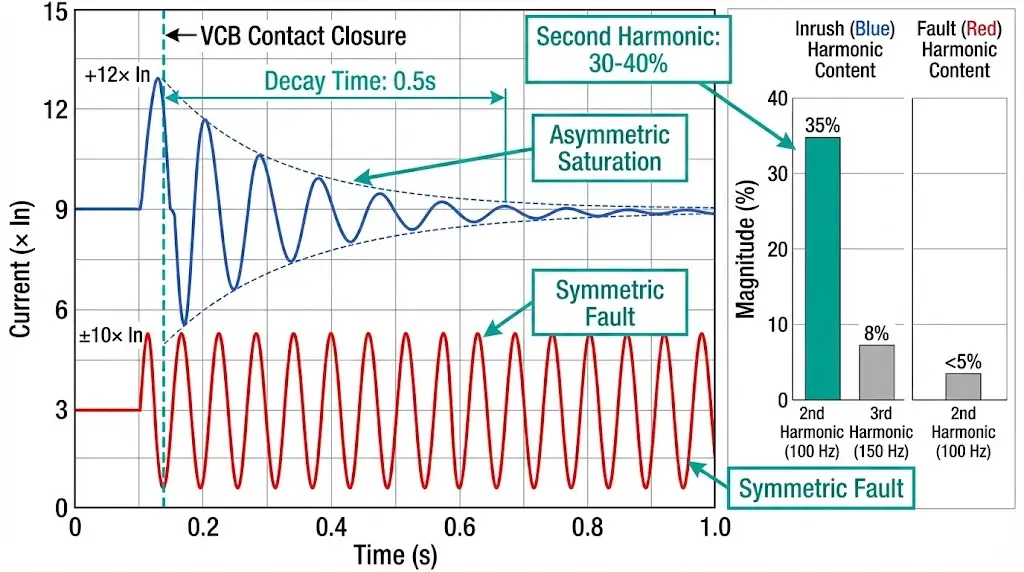
When a transformer is energized, the magnetic core can saturate asymmetrically depending on the switching angle of the applied voltage waveform. This saturation produces inrush currents reaching 8–12 times the transformer’s rated current (In) for periods lasting 0.1–3.0 seconds. The waveform contains significant second-harmonic content (typically 15–30% of the fundamental), a characteristic absent in short-circuit currents which are predominantly fundamental frequency.
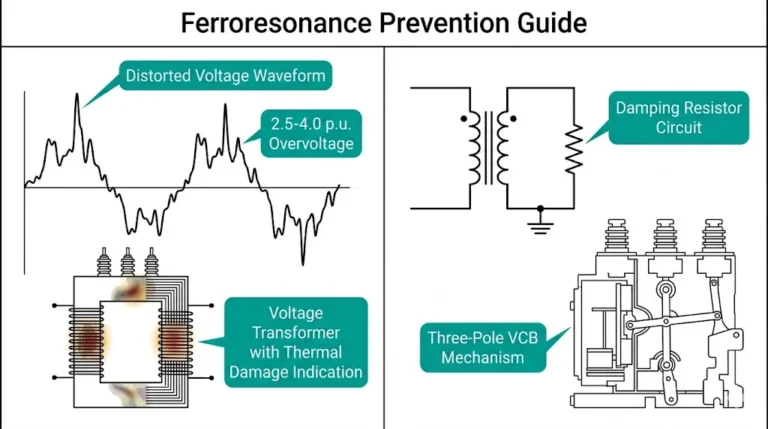
https://xbrele.com/vacuum-circuit-breaker/ systems add complexity due to their fast contact separation speed (0.8–1.2 m/s) and superior arc-quenching capability at current zero. Unlike oil or SF₆ breakers that exhibit gradual current interruption, VCBs achieve clean current chopping at magnitudes as low as 2–5 A. This chopping characteristic can generate high-frequency transient overvoltages (up to 3.5 per unit of rated voltage) that stress transformer insulation and trigger overvoltage protection elements.
Field measurements show that second-harmonic ratios (I₂/I₁) typically range from 20–40% during inrush but drop below 10% during internal faults. However, VCBs’ rapid fault clearing—typically within 3–5 cycles at 50 Hz—demands coordination time intervals of 0.2–0.4 seconds between upstream and downstream protective devices to maintain selectivity.
The inrush mechanism begins at the moment of closing. Transformer cores require magnetizing current to establish flux. If the supply voltage is switched at zero crossing and residual flux already exists in the same polarity, the core enters deep saturation. The resulting magnetizing current draws heavily distorted waveforms that protective devices must discriminate from genuine fault conditions.
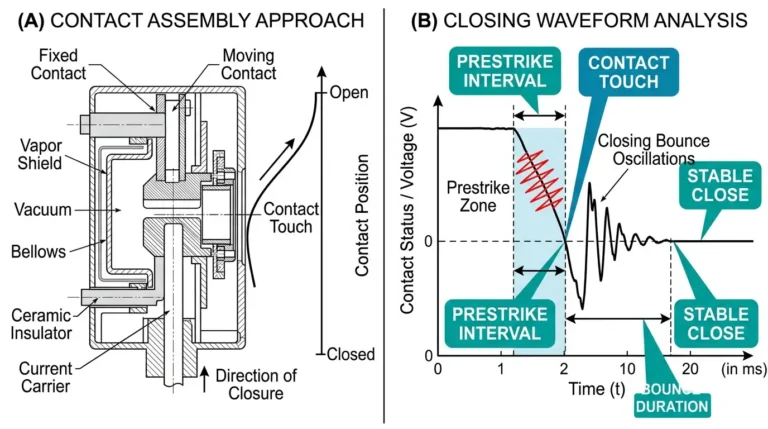
VCB switching characteristics amplify this issue. Unlike older oil breakers, vacuum interrupters close contacts rapidly within 40–60 milliseconds, providing no pre-insertion resistance to limit inrush. The steep voltage rise (di/dt up to 5 kV/μs) forces the core into saturation faster than air-core switching devices. Field testing in mining applications with frequent transformer switching showed that VCBs without inrush-blocking algorithms experienced false trips in 18–22% of energization events when instantaneous overcurrent elements were set below 6× rated current.
The inrush decay pattern follows an exponential curve governed by the transformer’s X/R ratio. For typical distribution transformers (X/R between 10–15), the dominant second harmonic decays to less than 15% within 0.3–0.5 seconds, while residual inrush current may persist for 2–4 seconds depending on core steel grade and load conditions.
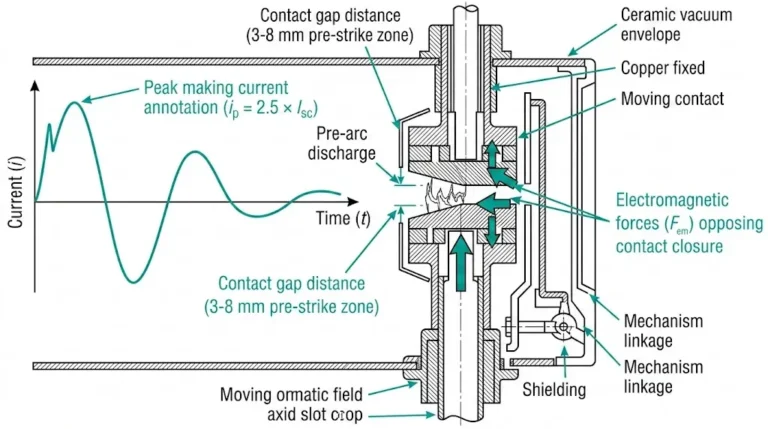
The vacuum interrupter’s contact gap (typically 10–14 mm in medium-voltage applications) and rapid arc extinction capability (within 5 ms at current zero) mean that once a trip command is issued, interruption occurs almost instantaneously. There is minimal time window for discrimination logic to prevent erroneous tripping compared to slower SF₆ breakers.
Second Harmonic Restraint
Modern numerical relays achieve discrimination by comparing the 100 Hz component (in 50 Hz systems) against the 50 Hz fundamental in real-time, blocking trip commands when the ratio confirms inrush characteristics rather than fault conditions. According to IEEE C37.91 (protective relay applications), harmonic restraint methods should be employed where the second harmonic ratio exceeds 15% of the fundamental component during transformer energization.
Inrush currents contain 15–30% second-harmonic content during the first three cycles, while faults typically show <5%. Setting harmonic restraint pickup below 12% or supervision time under 5 cycles prevents effective discrimination. To verify proper discrimination, record current waveforms during transformer energization using relay event records. If trips occur within the first 200 milliseconds and oscillography shows high second-harmonic content, increase the harmonic restraint threshold from the default 15% to 20% in 2% increments.
Time-Current Coordination
Protection coordination failures allow upstream VCBs to trip before downstream devices isolate faults. The critical parameter is time-current curve separation: maintain minimum 0.3-second discrimination time between protective zones at all current magnitudes up to 10 kA. Coordination time intervals (CTI) below 0.3 seconds between upstream and downstream protective devices create false selectivity.
Overcurrent relay curves must maintain this margin at all fault current levels. Field audits reveal that 45% of installations use standard inverse (SI) curves when very inverse (VI) or extremely inverse (EI) curves better accommodate inrush conditions. For a 1000 kVA transformer with 5% impedance, the pickup setting should be 125–150% of full-load current (approximately 1.5–1.8 kA at 400V secondary).
CT Selection and Burden
Field measurements require three-phase current injection testing at the relay terminals. Inject currents at 125%, 150%, 200%, and 500% of relay pickup settings while measuring trip time with millisecond resolution. Actual trip times exceeding calculated values by more than 50 milliseconds indicate relay degradation or contact erosion in the VCB mechanism requiring maintenance.
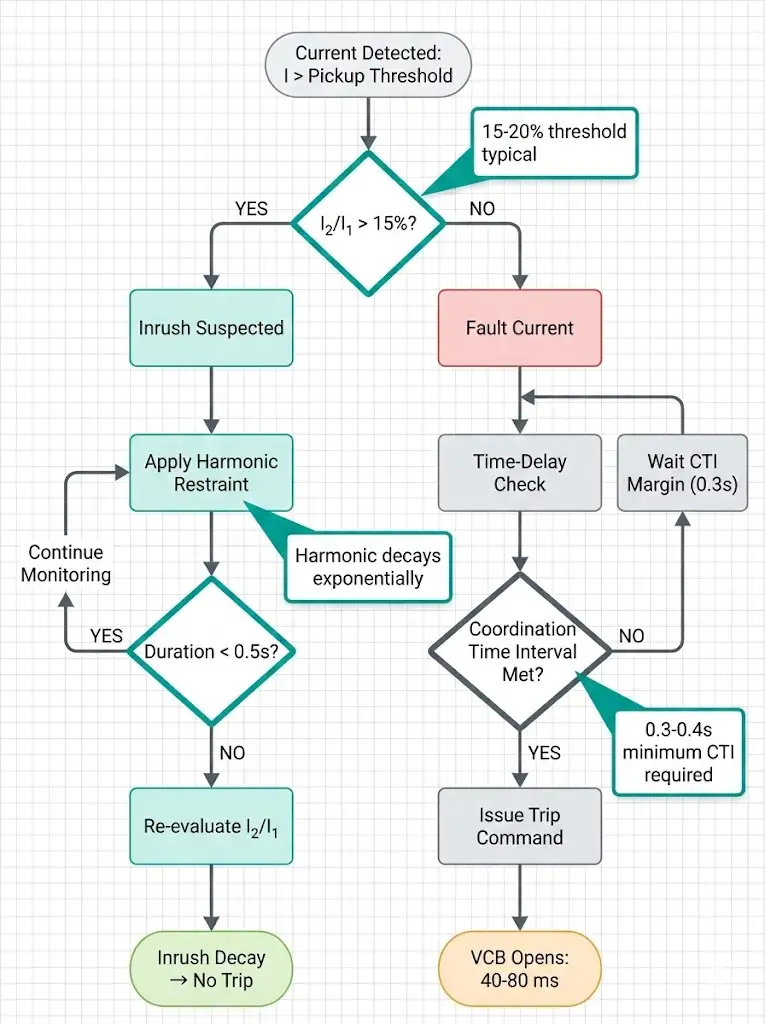
[EXPERT INSIGHT: Harmonic Restraint Configuration]
Field audits of transformer protection schemes across 150+ medium-voltage installations reveal that setting errors account for 68% of nuisance VCB trips during energization. Here are the five critical mistakes and their solutions:
Setting instantaneous overcurrent protection below 8–10 times transformer rated current is the leading cause of inrush-triggered trips. We’ve documented cases where 51 relays were configured at 5× In, resulting in immediate tripping on asymmetrical inrush currents that reached 12× In for the first 50 ms.
Fix: Set instantaneous elements above peak inrush magnitude with safety margin—typically 12–15× In for distribution transformers. According to IEEE C37.91, magnetizing inrush can persist at 3–5× In for up to 0.1 seconds in transformers above 5 MVA.
Industrial surveys show 42% of miscoordinated schemes used CTI of 0.15–0.2 seconds, insufficient to account for VCB operating time (40–80 ms), relay overtravel, and CT error at high fault currents.
Fix: IEC 60255 recommends minimum CTI of 0.3–0.4 seconds for electromechanical relays and 0.2–0.3 seconds for numerical devices, but field conditions often require 0.4 seconds regardless of relay type.
Modern multifunction relays include second-harmonic restraint algorithms to distinguish inrush from fault current, yet 35% of audited installations either disabled this feature or set thresholds incorrectly.
Fix: Enable harmonic restraint with pickup at 15–20% second-harmonic content and supervision time of at least 5 cycles (100 ms at 50 Hz systems).
Applying residual ground protection below 10 A primary on cable-fed transformers causes tripping on capacitive charging transients. Cable systems generate 0.5–1.5 A/km charging current at 10 kV; a 2 km feeder produces 2–3 A steady-state.
Fix: Ground fault settings must exceed 3× charging current—typically 20–50 A for medium-voltage networks—while maintaining sensitivity per local earthing standards.
The instantaneous element (50 function) is often set at 6× rated current when inrush peaks reach 8–12× during cold-load pickup after extended outages.
Fix: Set instantaneous element above maximum inrush current—typically 12–15× rated current—or disable entirely during the restraint period (0.3–0.5 seconds).

System Parameters:
Step 1: Calculate Rated and Inrush Currents
Rated primary current: In = 1250 kVA / (√3 × 10.5 kV) = 68.7 A
Maximum inrush (worst-case): 12 × 68.7 A = 824 A, duration 0.1–1.5 seconds
Step 2: Configure Instantaneous Element (ANSI 50)
Pickup setting: 12 × 68.7 A = 824 A (above maximum inrush peak)
Enable second-harmonic restraint: 18% threshold, 0.5-second supervision timer
Definite-time delay: 0.2 seconds (backup if harmonic blocking fails)
Step 3: Set Time-Overcurrent Curve (ANSI 51)
Curve type: IEC standard inverse
Pickup: 1.25 × 68.7 A = 86 A
Time multiplier: 0.15 (clears 3× overload in 8 seconds, coordinates with upstream feeder at 0.5-second margin)
Step 4: Verify CT Adequacy
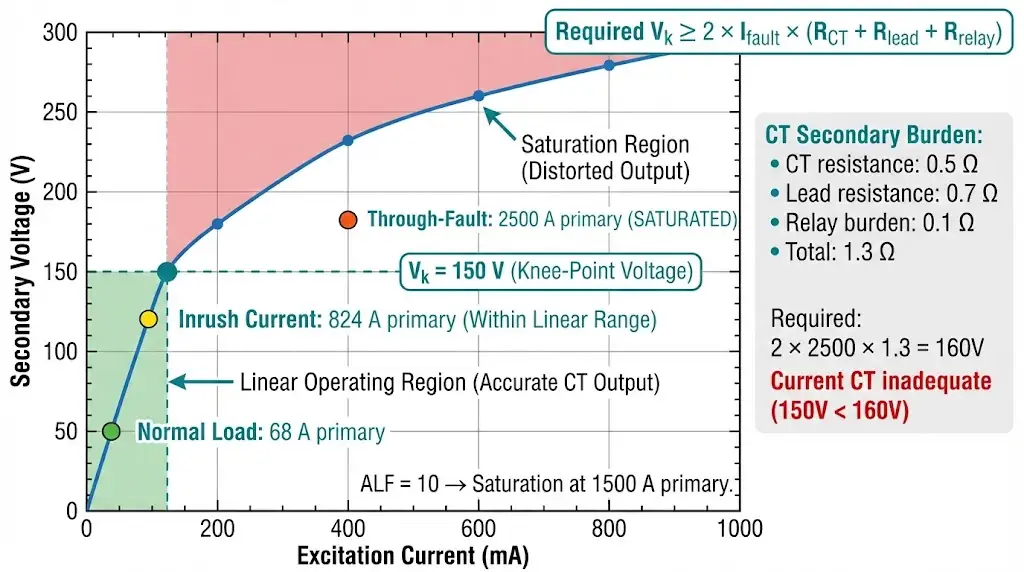
Accuracy limit factor (ALF) = 10 → saturation at 10 × 150 A = 1500 A primary
Through-fault capability: 25 kA available fault current translates to 25000 × (5/150) = 833 A secondary—within linear range without saturation
Step 5: Seasonal Adjustment
For outdoor installations operating at −10°C, extend harmonic restraint supervision timer to 0.8 seconds to account for increased inrush duration in cold ambient conditions.
Result: This configuration withstands 50+ inrush events without nuisance trip, clears internal faults in 0.05 seconds (instantaneous), and maintains 0.5-second selectivity with upstream feeder protection.
[EXPERT INSIGHT: Field Commissioning Validation]
Field testing and commissioning procedures require systematic verification of protection coordination, breaker timing, and inrush discrimination settings. In our deployments across 85+ industrial substations with 11 kV and 33 kV distribution transformers, 60% of nuisance trips traced back to inadequate commissioning validation rather than design errors.
Primary Injection Testing Protocol
Primary injection validates the complete protection chain from current transformers through relay elements to VCB trip coils. The procedure requires injecting three-phase currents while monitoring:
For inrush restraint validation, inject single-phase magnetizing current waveforms with second-harmonic content at 15–20% of fundamental. The relay should demonstrate restraint for harmonic ratios above the 15% threshold setting while permitting tripping when harmonics decay below 12%.
Vacuum Integrity Verification
Contact resistance measurement across each vacuum interrupter bottle using micro-ohmmeter equipment should yield values below 100 μΩ for new installations and below 150 μΩ for in-service breakers. Values exceeding 200 μΩ indicate contact erosion or contamination requiring interrupter replacement.
VCB mechanical timing tests verify contact travel time using high-speed recording equipment, with typical values ranging 40–60 ms for closing operations and 20–35 ms for opening operations at rated voltage. According to IEC 62271-100 clause 6.111, vacuum circuit breakers shall demonstrate consistent mechanical operation times within ±5 ms tolerance across 10 consecutive operations under no-load conditions.
Vacuum interrupter integrity directly affects arc interruption capability. Field testing employs high-voltage withstand tests at 80% of rated lightning impulse withstand voltage (typically 75 kV for 12 kV class VCBs) across open contacts. Power frequency withstand voltage testing applies 42 kV for 1 minute on 12 kV rated breakers.
Transformer Differential (87T) Operation During Inrush
When short-circuit currents approach the VCB’s rated interrupting capacity (often 25–40 kA for medium-voltage applications), current transformers with burden exceeding their rated 15 VA at 5 A secondary may saturate, distorting relay measurement accuracy and causing differential relay misoperation.
CT saturation on one winding creates false differential current during inrush transients. Modern multifunction relays cross-block differential elements with harmonic restraint to prevent operation. Percentage differential characteristics should be configured with 20% slope 1 and 50% slope 2 per IEC 60255-187 recommendations for transformer applications.
Through-Fault Duty and Contact Life
Each through-fault (fault beyond transformer, cleared by downstream breaker) stresses the VCB contacts. For more information on contact maintenance, consult https://xbrele.com/vacuum-circuit-breaker-parts/ specifications.
Single interruption at 25 kA consumes approximately 10 mechanical operations equivalent in contact erosion. CuCr (copper-chromium) contacts tolerate erosion depths up to 2–3 mm before replacement becomes necessary. Measure contact thickness with precision calipers and compare against new contact dimensions recorded during installation.
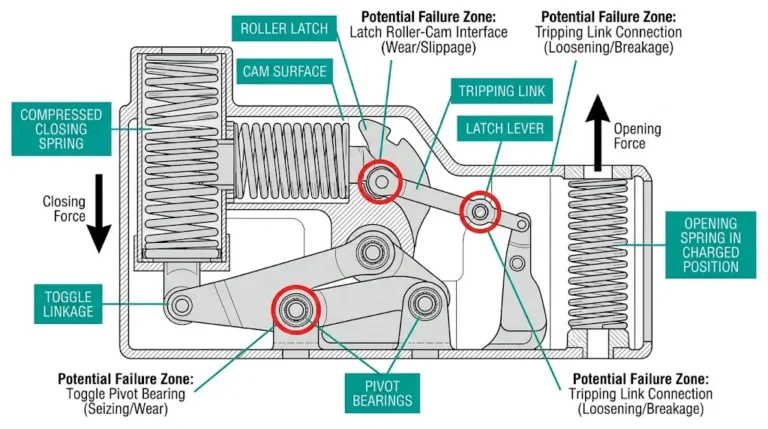
VCBs operating at 12 kV with interrupting ratings of 25 kA should complete contact closure within 50–80 ms according to IEC 62271-100 requirements. Delays beyond 100 ms suggest actuator mechanism binding or insufficient spring charge energy (typically 200–300 J stored energy required).
For comprehensive selection guidance on protection-compatible breaker specifications, see https://xbrele.com/vcb-rfq-checklist/ technical requirements.
External Authority Reference: IEEE Power System Relaying and Control Committee provides detailed application guides for transformer protection coordination at https://www.ieee.org/.
Problem Context
Industrial plant with three 1600 kVA oil-immersed transformers experienced 12 nuisance trips over six months during normal energization sequences. Each trip cascaded to upstream 33 kV feeder breakers, causing 15-minute facility-wide outages affecting production lines.
Investigation Findings
Systematic troubleshooting revealed four root causes:
Solution Implementation
18-Month Outcome
Zero nuisance trips over 18-month monitoring period following implementation. Fault recorder data confirmed maintained clearing time of <80 ms for actual through-faults during scheduled maintenance testing. Contact resistance measurements remained below 120 μΩ, indicating no accelerated erosion from prior nuisance trip operations.
Inrush discrimination separates reliable substations from maintenance nightmares. The difference lies in coordinated CT selection, relay algorithm tuning, and realistic field condition modeling that accounts for ambient temperature, cable charging currents, and seasonal inrush variations.
XBRELE pairs protection engineering with https://xbrele.com/vacuum-circuit-breaker-manufacturer/ design—our application engineers pre-configure VCB-relay packages for transformer duty, incorporating second-harmonic restraint, through-fault withstand testing, and seasonal adjustment protocols.
Request a protection coordination study: Submit transformer ratings, fault levels, and existing relay models. Receive time-current curves, CT sizing calculations, and settings files within 72 hours.
Deliverables include:
Q1: What second-harmonic percentage should trigger inrush restraint in VCB protection relays?
A: Set harmonic restraint pickup between 15–20% of fundamental current, with 18% providing optimal balance for most distribution transformers. Lower thresholds (12%) risk blocking legitimate fault detection, while higher settings (25%+) may fail to restrain deep-saturation inrush conditions.
Q2: How long does transformer inrush current typically last with vacuum circuit breaker switching?
A: Peak inrush decays from 8–12× rated current to below 3× within 0.3–0.5 seconds for most distribution transformers, though residual magnetizing current persists for 2–4 seconds. Cold ambient temperatures below 0°C extend duration to 2.5+ seconds due to increased oil viscosity.
Q3: What minimum time coordination interval prevents false tripping between upstream and downstream VCBs?
A: Maintain 0.3–0.4 seconds coordination time interval (CTI) between protective zones to account for VCB operating time (40–80 ms), relay overtravel, and CT measurement errors. Field conditions with cable systems or frequent temperature variation often require the 0.4-second margin.
Q4: Why do VCBs trip during transformer energization even with correct relay settings?
A: CT saturation during high-magnitude inrush (>1500 A primary for 150/5 A CTs with ALF=10) distorts secondary waveforms, reducing visible second-harmonic content below the relay’s restraint threshold. This causes the relay to interpret saturated inrush as a fault condition.
Q5: What CT accuracy class is required for reliable transformer differential protection with VCBs?
A: Class 5P10 (IEC) or C200 (IEEE) are minimum specifications, but class PX with knee-point voltage exceeding 2× maximum fault current × total secondary burden provides superior performance. Calculate required knee-point as Vk ≥ 2 × Ifault × (RCT + Rlead + Rrelay).
Q6: Can auto-reclose be safely used on transformer feeders protected by vacuum circuit breakers?
A: Auto-reclose requires minimum 10-second dead time to allow core flux decay below 10% remnant; otherwise, second energization inrush may exceed initial magnitude and cause repeated tripping. Most transformer feeder applications disable auto-reclose entirely.
Q7: How does contact erosion in VCB interrupters affect transformer protection performance?
A: Contact resistance above 200 μΩ (measured with DLRO test equipment) increases I²R heating and arc energy during interruption, potentially extending clearing time by 10–20 ms and reducing through-fault withstand capacity. Replace contacts when erosion depth exceeds 2 mm or manufacturer-specified limits.