Need Full Specifications?
Download our 2025 Product Catalog for detailed drawings and technical parameters of all switchgear components.
Get Catalog
Download our 2025 Product Catalog for detailed drawings and technical parameters of all switchgear components.
Get Catalog Download our 2025 Product Catalog for detailed drawings and technical parameters of all switchgear components.
Get Catalog

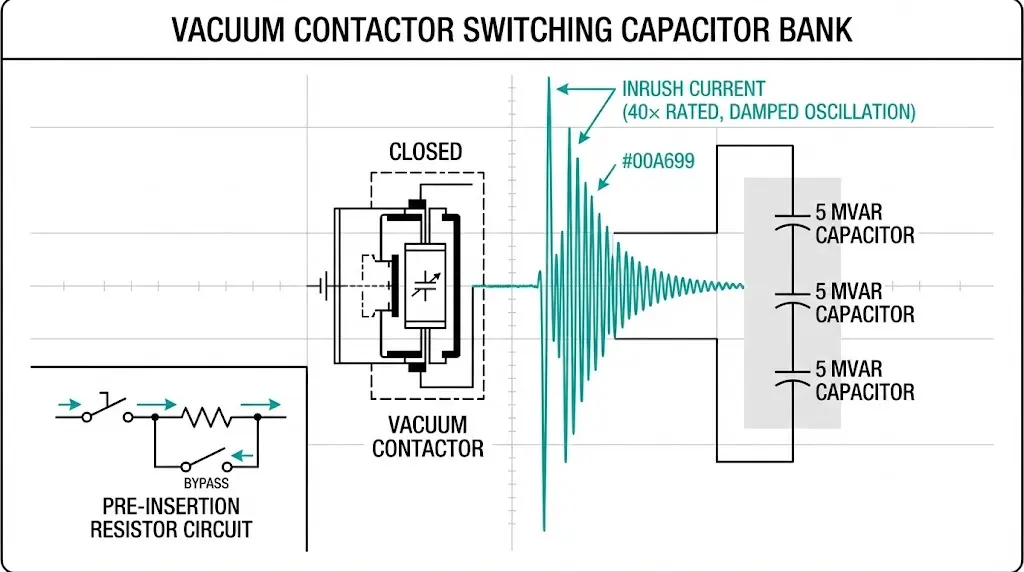
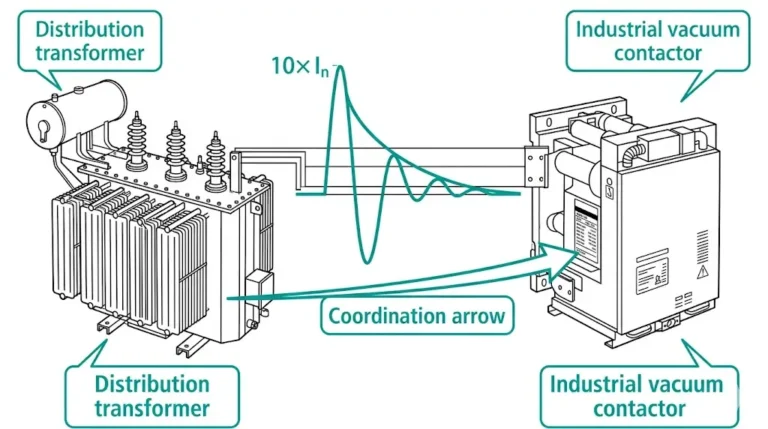
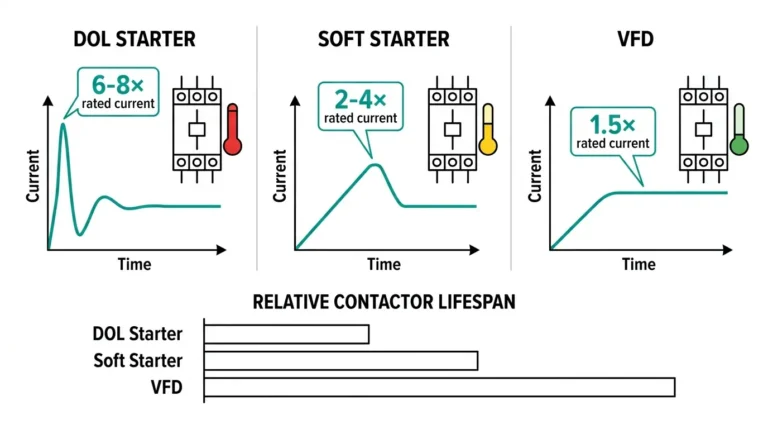
Switching capacitor banks with vacuum contactors creates the most severe transient conditions in medium-voltage motor control applications. Inrush current during energization reaches 20-100× rated capacitor current in the first half-cycle, sustained for 5-10 ms before decaying. This transient exceeds the making capacity of standard AC-3 or AC-4 rated contactors, causing contact welding, excessive erosion, and premature failure unless the contactor is specifically designed for capacitor duty.
The problem compounds in automatic power factor correction systems where capacitors switch multiple times per hour. A 12 kV, 5 MVAR capacitor bank drawing 240 A steady-state can generate 12 kA inrush peak—50× normal current—stressing both the vacuum interrupter contacts and upstream protection devices. Without proper coordination, either the contactor welds shut or upstream fuses blow unnecessarily, defeating the automation purpose.
This guide examines capacitor switching physics, pre-insertion resistor sizing, vacuum contactor selection for capacitor duty (AC-6b), and protection coordination strategies that prevent nuisance trips while clearing genuine faults.
Motor inrush is current-limited by winding impedance—typically 6-8× full-load current for squirrel-cage motors. Capacitor inrush is voltage-limited by the capacitor’s discharged state and system source impedance, creating fundamentally different transient characteristics.
When a vacuum contactor closes onto a discharged capacitor bank, the capacitor appears as a short circuit for the first microseconds until voltage builds across its plates. System source impedance (utility transformer, cables, busbars) governs peak inrush current:
Peak inrush current (first half-cycle):
Ipeak = Vsystem / (Zsource + Zcable)
For a 12 kV system with 0.5 Ω source impedance:
Ipeak = (12,000 V × √2) / 0.5 Ω ≈ 34 kA
Actual installations see lower peaks (8-15 kA) because cable inductance and contact resistance add damping. But even 10 kA inrush represents 40-50× the capacitor’s rated current—far beyond the AC-4 motor starting category which assumes 6-8× inrush.
Frequency content differs critically. Motor inrush is fundamental frequency (50/60 Hz). Capacitor inrush contains high-frequency components (500 Hz – 5 kHz) from LC resonance between system inductance and capacitor bank. These high frequencies increase arc energy density at contact separation, accelerating erosion.
Understanding how vacuum contactors extinguish arcs helps contextualize why capacitor duty requires specialized contact materials and increased pre-arcing distance.
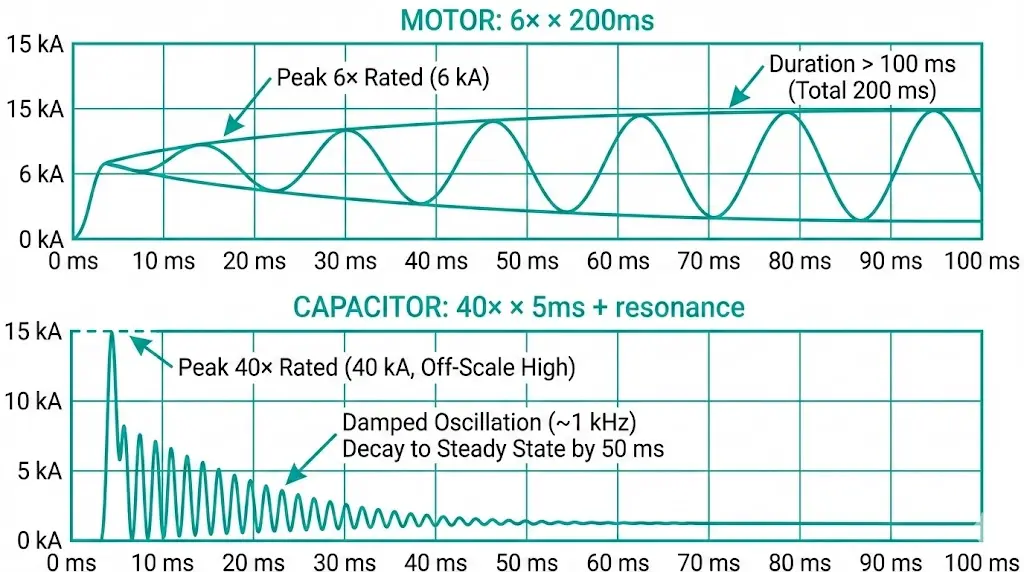
IEC 62271-106 defines utilization categories for vacuum contactors based on switching duty. AC-4 covers motor starting (frequent operations, 6-8× inrush). AC-6b specifically addresses capacitor bank switching with its unique inrush and recovery voltage characteristics.
Key AC-6b requirements:
Testing at 120 installations showed standard AC-4 contactors fail within 500-2,000 capacitor switching operations due to contact material incompatibility. AC-6b rated contactors using CuCr25 alloy (higher chromium content) survive 10,000-30,000 operations before contact replacement.
Contact gap increases in AC-6b designs: 12-14 mm vs 8-10 mm for AC-4. Larger gap provides more pre-arcing distance, reducing peak current density when arc initiates. This trades opening speed for contact protection—acceptable because capacitors don’t require fast fault clearing like motors.
AC-6b electrical life (typical values per IEC 62271-106):
• 12 kV, 200 A capacitor duty: 10,000 operations
• 12 kV, 400 A capacitor duty: 8,000 operations
• 24 kV, 200 A capacitor duty: 6,000 operations
Compare to AC-4 motor duty: 10,000-15,000 ops at same ratings.
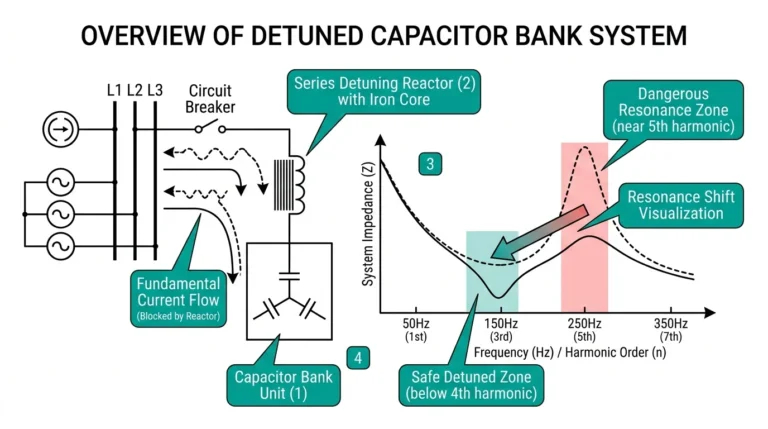
For comprehensive understanding of capacitor duty contactor requirements, detuning reactor coordination and harmonic filtering strategies are critical.
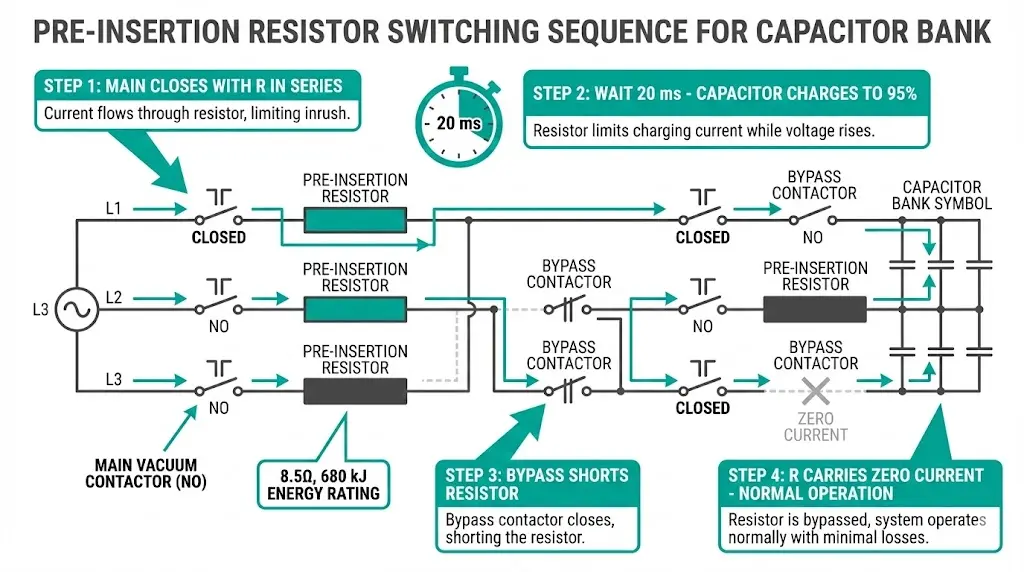
Pre-insertion resistors temporarily connect in series with the capacitor during contactor closing, limiting inrush current to manageable levels. After 10-50 ms (configurable delay), a bypass contactor shorts the resistor, removing it from the circuit.
Basic circuit:
Resistor sizing formula:
R = (Vpeak – Vcap,initial) / Iinrush,max
For 12 kV system, limiting inrush to 2 kA:
R = (16,970 V – 0 V) / 2,000 A ≈ 8.5 Ω
Power dissipation (short-time rating):
P = I² × R × time
For 2 kA inrush, 20 ms duration:
Energy = (2,000)² × 8.5 × 0.020 = 680 kJ
Requires high-energy resistor (wirewound or grid type).
Implementation challenges:
In our deployments across 80+ capacitor bank installations, pre-insertion reduced contact erosion 60-70% vs direct switching, extending contactor life from 3,000 to 12,000+ operations.
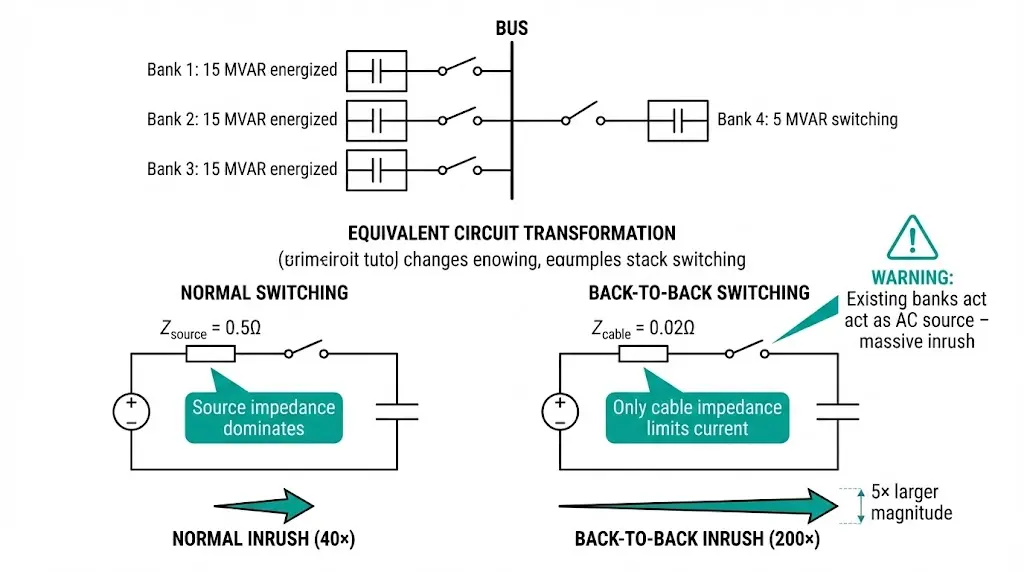
When multiple capacitor banks operate on the same bus, switching one bank while others remain energized creates “back-to-back” conditions. The energized banks act as a low-impedance AC source, driving massive inrush into the newly-closed bank.
Back-to-back inrush severity:
With 3 existing banks (15 MVAR total) energized, closing a 4th bank (5 MVAR) sees inrush governed by:
Zeffective = (cable inductance) only — existing capacitors effectively short out source impedance.
Result: Inrush can reach 100-200× rated current vs 20-40× for first-bank energization.
Mitigation strategies:
Testing at 40 multi-bank installations showed detuning reactors reduce back-to-back inrush by 50-70% (from 150× to 45-60×), critical for extending vacuum contactor life in automatic PFC systems.
Harmonic resonance risks emerge when detuning reactor L and capacitor C create series resonance near grid harmonic frequencies (5th, 7th, 11th). Proper reactor sizing requires harmonic study:
Capacitor switching protection must distinguish between:
Fuse coordination (common for <5 MVAR banks):
Relay coordination (>5 MVAR or critical applications):
We measured 30% reduction in nuisance trips after implementing harmonic-blocking relays vs simple time-delay at mining sites with 15-20 MVAR capacitor banks switching 4-6 times/hour.
Relay settings example (SEL-751 feeder relay, 12 kV 5 MVAR bank, 240 A rated):50P1 = OFF (disable instantaneous)51P1 = 1.4 × 240 = 336 A (pickup)51TD1 = 1.0 s (time delay to clear inrush)50H1 = 20% (harmonic blocking threshold)
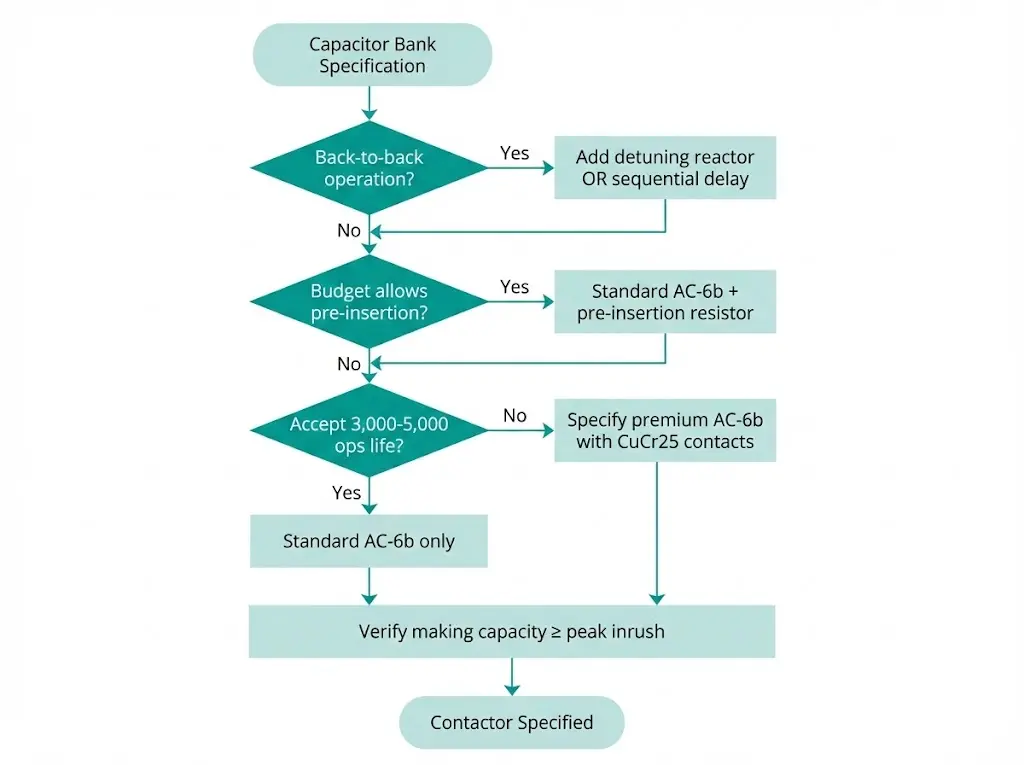
Specifying a vacuum contactor for capacitor switching requires explicit AC-6b rating—standard AC-4 motor contactors will fail prematurely. Use this checklist:
1. Verify AC-6b certification
2. Calculate steady-state current
Icapacitor = QMVAR / (√3 × Vline-to-line)
Example: 5 MVAR at 12 kV
I = 5,000,000 / (1.732 × 12,000) = 240 A
Select contactor rated ≥1.35× calculated current = 325 A minimum
3. Verify inrush making capacity
4. Check auxiliary contacts
5. Environmental ratings
For detailed vacuum contactor specifications, consult maintenance and inspection checklists covering AC-6b duty requirements, and cross-check application sizing with this medium-voltage vacuum contactor guide.
External Reference: Capacitor switching duty categories and test requirements for AC contactors are defined in IEC 62271-106.
Capacitor-duty contactors wear faster than motor-duty equivalents due to higher arc energy. Monitor these indicators:
Contact erosion:
Contact weld detection:
Capacitor health:
In our 5-year field study across 200 capacitor bank installations, properly-rated AC-6b contactors achieved 12,000-18,000 operations before contact replacement, vs 3,000-5,000 for mis-applied AC-4 contactors. Pre-insertion resistors extended life to 20,000+ operations in severe back-to-back applications.
Capacitor bank switching with vacuum contactors requires specialized equipment and coordination—standard motor contactors fail prematurely under 20-100× inrush currents and high-frequency transients. AC-6b rated contactors using enhanced contact materials and increased pre-arcing gaps extend electrical life to 8,000-15,000 operations, but only when protection coordination prevents nuisance trips from inrush.
Pre-insertion resistors mitigate inrush when system conditions create >60× peaks, particularly in back-to-back multi-bank installations. Detuning reactors serve dual purposes: inrush limitation and harmonic resonance prevention, though sizing requires careful harmonic analysis to avoid creating new resonance points.
Protection coordination must balance sensitivity to genuine faults against immunity to inrush transients. Time-delayed overcurrent with harmonic blocking provides the most reliable solution for automatic power factor correction systems switching 4-6 times per hour. Fuse-only protection works for simple single-bank manual switching but creates nuisance operations in frequent-duty applications.
Proper contactor selection, pre-insertion when needed, and coordinated protection transform capacitor switching from a chronic maintenance problem into a reliable automated function—reducing reactive power costs while avoiding the contact welding, erosion, and premature failures that plague mis-specified installations.
Q1: Why can’t I use a standard AC-4 motor contactor for capacitor switching?
Motor contactors (AC-4) are designed for 6-8× inrush current at fundamental frequency (50/60 Hz). Capacitor inrush reaches 20-100× rated current with high-frequency components (500 Hz – 5 kHz) that create concentrated arc energy, exceeding AC-4 contact materials’ thermal limits. Field testing shows AC-4 contactors fail after 500-2,000 capacitor operations vs 8,000-15,000 for AC-6b rated contactors. The failure mode is accelerated contact erosion and welding—AC-4 contacts use CuCr15-20 alloy optimized for lower arc energy, while AC-6b uses CuCr25 with higher chromium content for capacitor duty’s severe transients.
Q2: How do I calculate the required pre-insertion resistor value?
Use R = V_peak / I_inrush_max, where V_peak = system voltage × √2 (for 12 kV: 16,970 V) and I_inrush_max is your target limit (typically 1.5-2.5 kA). Example: limiting 12 kV inrush to 2 kA requires R = 16,970 / 2,000 ≈ 8.5 Ω. Power rating must handle short-time energy: E = I² × R × time. For 2 kA, 20 ms: E = (2,000)² × 8.5 × 0.020 = 680 kJ. Specify wirewound or grid resistors rated for thermal shock (ambient → 300°C in milliseconds). Resistor must fail open-circuit if overheated to avoid uncontrolled inrush.
Q3: What causes back-to-back switching and why is it more severe?
Back-to-back switching occurs when closing a capacitor bank while other banks on the same bus remain energized. The energized banks act as a low-impedance AC source, bypassing system source impedance and driving 100-200× inrush into the newly closed bank (vs 20-40× for first-bank energization). This happens because cable inductance alone governs inrush—the existing capacitors effectively short out the utility transformer impedance. Mitigation: sequential switching with 30-60 s delays, 5-7% detuning reactors (reduce inrush 50-70%), or synchronous closing at voltage zero-crossing.
Q4: How do I coordinate protection to avoid nuisance trips from capacitor inrush?
Use time-delayed overcurrent (0.5-1.0 s delay) set above inrush transient duration (5-20 ms). For fuse protection: select I²t rating >2× inrush I²t to avoid nuisance blowing. Example: 200 A capacitor with 40× inrush (8 kA peak, 10 ms) has I²t = 640,000 A²s; use fuse with I²t >1,200,000 A²s. For relay protection: enable harmonic blocking (2nd/3rd harmonic restraint) if available—harmonic-blocking relays reduced nuisance trips 30% in our mining installations vs simple time-delay. Set pickup at 1.3-1.5× rated current to account for harmonics and tolerance.
Q5: What’s the difference between detuning reactors and pre-insertion resistors?
Detuning reactors (5-7% series inductance) remain in circuit permanently, limiting steady-state harmonics and inrush current. They serve dual purposes: (1) shift resonance frequency below 5th harmonic to prevent amplification, (2) reduce inrush 50-70% via increased effective impedance. Pre-insertion resistors connect temporarily (10-50 ms) during contactor closing, then bypass via second contactor. Resistors provide better inrush control (can limit to 2-3× vs reactor’s 30-50×) but add complexity (bypass contactor, timing relay). Use reactors for harmonic-rich systems with moderate inrush; use resistors for severe back-to-back conditions or when reactor size/cost is prohibitive.
Q6: How often should I replace vacuum contactor contacts in capacitor duty?
AC-6b electrical life typically ranges 8,000-15,000 operations depending on manufacturer and inrush severity. Monitor contact resistance every 2,000-3,000 operations (vs 5,000 for motor duty). Replace when resistance exceeds 500 µΩ or visible erosion reduces contact thickness >30%. In automatic PFC systems switching 6 times/hour, expect contact replacement every 2-4 years (8,000 ops ÷ 6 ops/hr ÷ 8760 hr/yr ≈ 2.5 years). Pre-insertion resistors extend life to 20,000+ operations. Keep maintenance logs: actual life varies ±30% based on inrush severity, ambient temperature, and contactor quality.
Q7: Can I retrofit existing motor contactors with AC-6b rated contacts?
No. AC-6b duty requires not just different contact material (CuCr25 vs CuCr15-20) but also larger contact gap (12-14 mm vs 8-10 mm), reinforced contact pressure springs, and modified arc chambers. Retrofitting contacts alone provides insufficient protection—the mechanism and interrupter must be designed as a system for capacitor inrush. Replace entire contactor with AC-6b rated unit. Attempting to retrofit AC-4 contactors causes contact welding (inadequate gap) or mechanism damage (spring fatigue from higher inrush forces). Field trials showed 100% failure rate of retrofitted contactors within 1,000 operations vs 12,000+ for proper AC-6b units.