Need Full Specifications?
Download our 2025 Product Catalog for detailed drawings and technical parameters of all switchgear components.
Get Catalog
Download our 2025 Product Catalog for detailed drawings and technical parameters of all switchgear components.
Get Catalog Download our 2025 Product Catalog for detailed drawings and technical parameters of all switchgear components.
Get Catalog
Transformer test equipment refers to specialized diagnostic instruments that measure the electrical, mechanical, and chemical health indicators of power transformers. These instruments detect developing faults before they escalate into costly failures—studies consistently show that over 70% of catastrophic transformer failures exhibit detectable warning signs months in advance through proper diagnostic testing.
Four primary diagnostic categories dominate transformer testing programs: TTR (Turns Ratio Testing) for winding integrity verification, DGA (Dissolved Gas Analysis) for oil-dissolved gas signatures, Tan-Delta for insulation system assessment, and SFRA (Sweep Frequency Response Analysis) for mechanical deformation detection. Selecting the right test equipment manufacturer affects measurement reliability, calibration support, and total cost of ownership across your transformer fleet.
This buyer map profiles ten established manufacturers, explaining the physics behind each test method and providing practical guidance for procurement engineers managing power distribution transformers and transmission-class assets.
Transformer test equipment operates on fundamental electromagnetic and electrochemical principles. Understanding these measurement mechanisms enables informed equipment selection and accurate diagnostic interpretation.
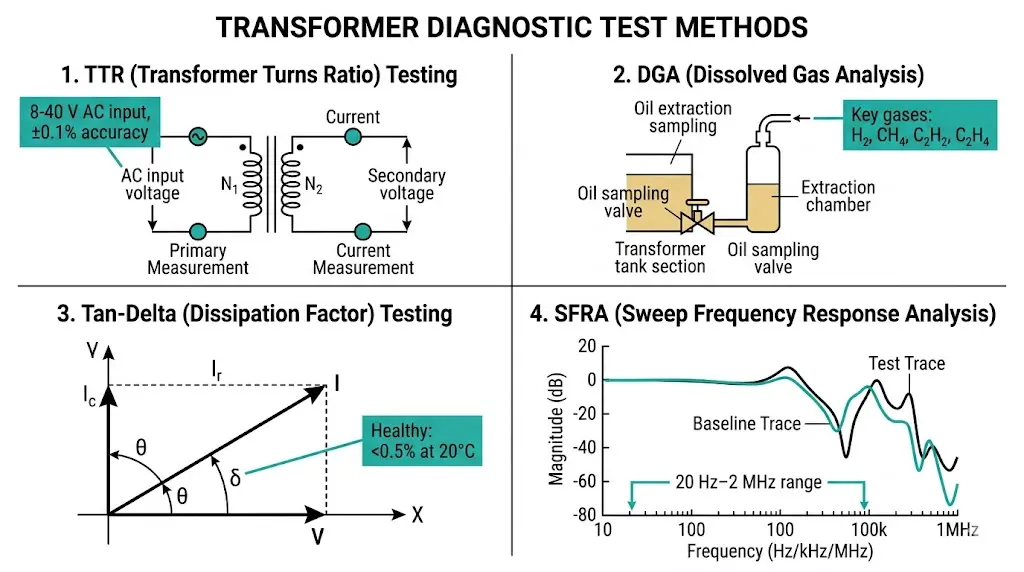
TTR instruments apply a known AC voltage (typically 8–40 V RMS) to the primary winding and measure the induced secondary voltage. The ratio between these voltages directly reflects the winding turns ratio per Faraday’s law of electromagnetic induction.
According to IEEE C57.12.90, acceptable turns ratio deviation should not exceed ±0.5% of the declared ratio for power transformers. Modern TTR equipment achieves accuracy within ±0.1%, detecting shorted turns, tap changer problems, and core defects. In field deployments across 200+ substations throughout Southeast Asia, deviations exceeding 0.5% from nameplate ratio typically indicate winding faults requiring immediate investigation.
DGA analyzers extract gases dissolved in transformer oil through headspace extraction or membrane diffusion techniques. Different fault types produce characteristic gas signatures: partial discharge generates hydrogen (H₂), thermal faults above 300°C produce ethylene (C₂H₄), and arcing creates acetylene (C₂H₂).
IEC 60599 establishes interpretation guidelines, with typical alarm thresholds of 100 ppm for hydrogen and 35 ppm for acetylene in mineral oil. Field-portable DGA units extract gases using headspace sampling, then separate and quantify individual concentrations through gas chromatography or photoacoustic spectroscopy.
Tan-delta testing measures the ratio of resistive current to capacitive current through insulation systems. Perfect insulation exhibits zero dissipation factor; degraded insulation shows increased values due to moisture contamination, thermal aging, or chemical degradation.
The dissipation factor equals tan(δ), where δ represents the loss angle. Typical healthy oil-paper insulation maintains tan(δ) values below 0.5% at 20°C. Values exceeding 1.0% indicate moisture contamination, thermal aging, or chemical degradation requiring remediation. Temperature correction factors per IEC 60247 are essential since tan δ increases approximately 2× per 10°C rise.
SFRA instruments inject swept frequency signals (typically 20 Hz–2 MHz per IEC 60076-18) and measure the transformer’s transfer function response. Mechanical deformations—winding displacement, core movement, or clamping looseness—alter inductance and capacitance distributions, shifting resonant frequencies.
Comparative analysis against baseline measurements reveals structural changes invisible to other test methods. Mechanical deformations as small as 2–3 mm in winding geometry produce measurable frequency response deviations, enabling detection of transport damage or short-circuit forces.
[Expert Insight: Field Testing Realities]
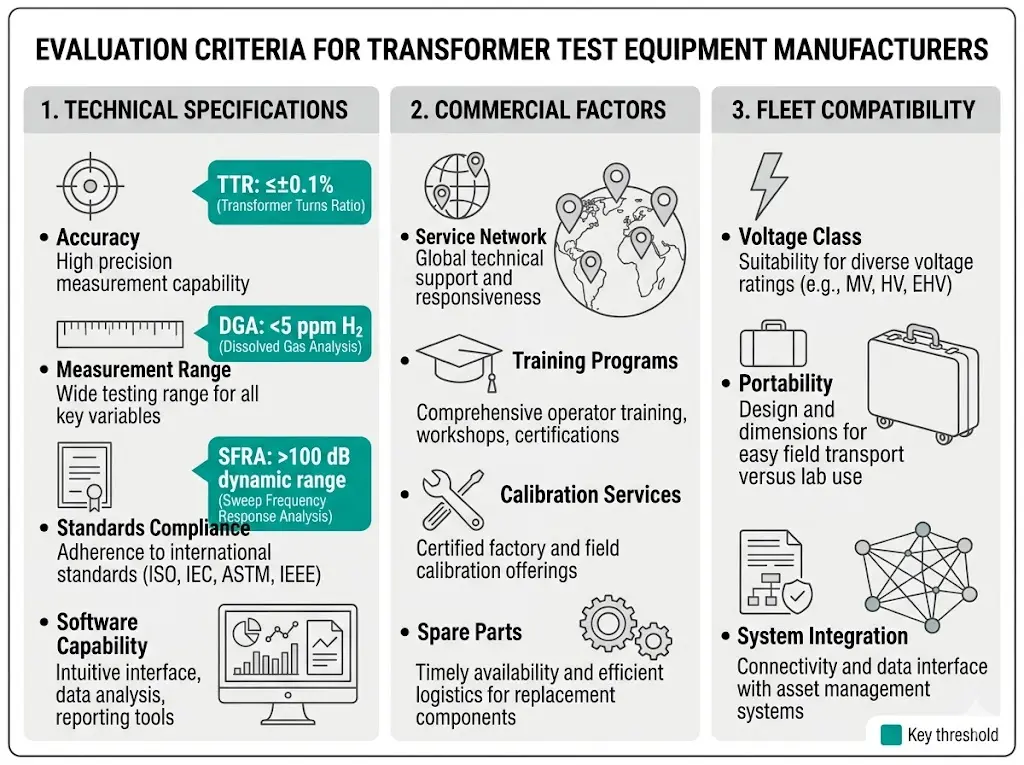
Selecting the right manufacturer requires systematic assessment across technical capabilities, commercial factors, and fleet compatibility. Equipment accuracy specifications and after-sales support networks consistently rank as top decision factors in utility procurement projects.
TTR Equipment Specifications:
DGA Analyzer Requirements:
Tan-Delta Test Set Criteria:
SFRA Instrument Specifications:
| Factor | Evaluation Questions |
|---|---|
| Regional Service | Service center within your region? Guaranteed response time? |
| Training Programs | Factory certification available? On-site training options? |
| Calibration Services | Annual calibration offered? Accredited laboratory? |
| Software Model | Perpetual license or subscription? Data export formats? |
| Spare Parts | Accessory lead time? Cross-model compatibility? |
The following profiles cover manufacturers with proven track records in transformer diagnostics. Listing is alphabetical and does not imply ranking or endorsement.
OMICRON Electronics (Austria)
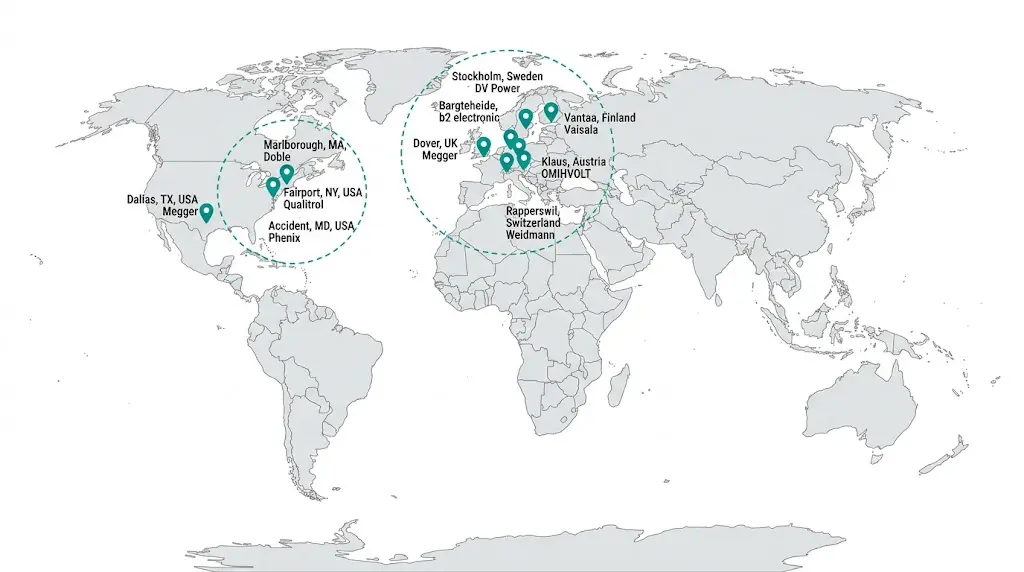
Headquarters: Klaus, Austria | Founded: 1984
OMICRON’s FRANEO 800 frequency response analyzer sets industry benchmarks for SFRA resolution. Their CPC 100 multi-functional test set handles tan-delta, winding resistance, and excitation current measurements in a single portable platform weighing under 30 kg.
Best for: Utilities requiring laboratory-grade accuracy and comprehensive software ecosystem integration.
HIGHVOLT Prüftechnik Dresden (Germany)
Headquarters: Dresden, Germany | Founded: 1994
HIGHVOLT manufactures complete transformer test bays for OEM factory acceptance testing alongside portable tan-delta equipment. Their impulse generators serve transformer manufacturing facilities worldwide.
Best for: Transformer manufacturers and utilities with in-house high-voltage test laboratories.
DV Power (Sweden)
Headquarters: Stockholm, Sweden | Founded: 2005
DV Power’s TWA series combines winding resistance measurement with simultaneous demagnetization—a significant time-saver for large power transformers. Their RMO series TTR testers feature rapid measurement cycles suitable for high-volume fleet testing.
Best for: Maintenance teams prioritizing fast measurement cycles and lightweight field instruments.
b2 electronic (Germany)
Headquarters: Bargteheide, Germany | Founded: 1987
The FRA5310 offers high-resolution sweep frequency response analysis with laboratory-grade precision. Their PDScope partial discharge detectors complement transformer winding diagnostics.
Best for: Winding deformation specialists and research institutions requiring detailed SFRA analysis.
Megger (UK/USA)
Headquarters: Dover, UK / Dallas, Texas, USA | Founded: 1889
Megger’s TTR300 series provides three-phase ratio testing with automatic vector group detection. Their DELTA4000 series delivers tan-delta testing up to 12 kV with integrated temperature correction.
Best for: Field crews requiring rugged, portable instruments with minimal setup time and extensive global service network.
Doble Engineering (USA)
Headquarters: Marlborough, Massachusetts, USA | Founded: 1920
Doble pioneered power factor testing—their M-series testers remain industry reference instruments across North American utilities. DoblePRIME software integrates test results with asset health indices for fleet-wide trending.
Best for: North American utilities with existing Doble standardization seeking long-term asset trending capabilities.
Qualitrol (USA)
Headquarters: Fairport, New York, USA | Founded: 1945
Qualitrol’s 509 DGA monitor uses thermal conductivity detection for key fault gases. Their integration with Hitachi Energy’s broader monitoring ecosystem provides comprehensive transformer surveillance.
Best for: Utilities implementing continuous online monitoring programs with integrated protection systems.
Phenix Technologies (USA)
Headquarters: Accident, Maryland, USA | Founded: 1978
Phenix manufactures high-voltage test sets from 10 kV to 800 kV, including tan-delta measurement systems. Their custom engineering capability addresses unique testing requirements.
Best for: Industrial users testing transformers alongside rotating machines, and organizations requiring custom high-voltage solutions.
Vaisala (Finland)
Headquarters: Vantaa, Finland | Founded: 1936
Vaisala’s Optimus DGA monitors use photoacoustic spectroscopy for continuous multi-gas analysis without consumables. Their MHT410 moisture sensor provides real-time oil condition data critical for oil-immersed transformer monitoring.
Best for: Utilities implementing 24/7 online condition monitoring for critical transformers.
Weidmann Electrical Technology (Switzerland/USA)
Headquarters: Rapperswil, Switzerland / St. Johnsbury, Vermont, USA | Founded: 1877
Weidmann’s unique position as both insulation material supplier and diagnostic equipment manufacturer informs their OPT100 online DGA monitors. They also offer laboratory analysis services.
Best for: Utilities seeking combined equipment supply and laboratory analysis services from a single source.
[Expert Insight: Procurement Lessons from Utility Projects]
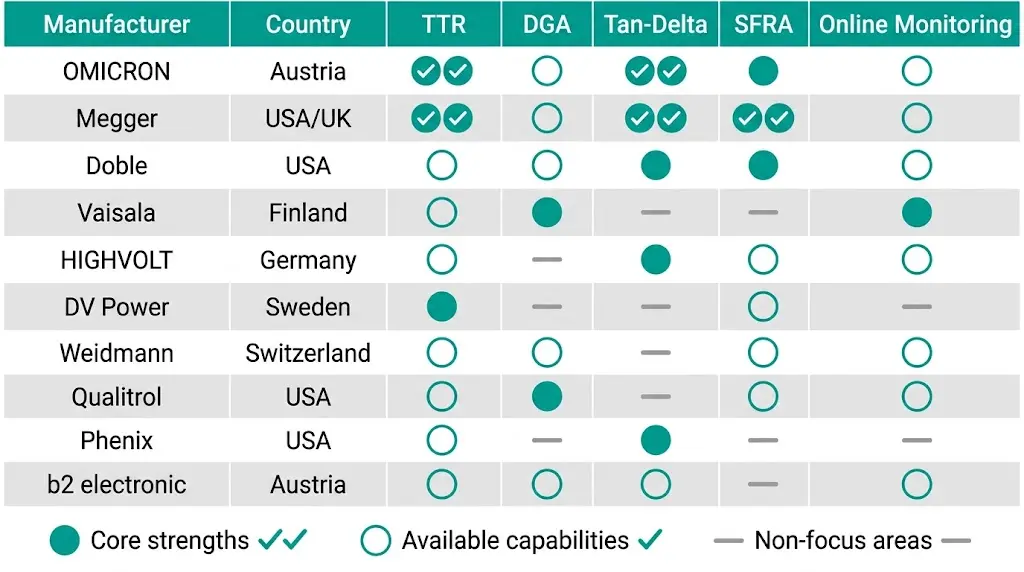
The following matrix summarizes core product strengths across diagnostic categories. Use this for initial shortlisting based on your primary testing requirements.
| Manufacturer | Country | TTR | DGA | Tan-Delta | SFRA | Online Monitoring |
|---|---|---|---|---|---|---|
| OMICRON | Austria | ✓ | — | ✓✓ | ✓✓ | — |
| Megger | UK/USA | ✓✓ | — | ✓✓ | ✓ | — |
| Doble | USA | ✓ | ✓ | ✓✓ | ✓ | ✓ |
| Vaisala | Finland | — | ✓✓ | — | — | ✓✓ |
| HIGHVOLT | Germany | — | — | ✓✓ | — | — |
| DV Power | Sweden | ✓✓ | — | ✓ | ✓ | — |
| Weidmann | Switzerland | — | ✓✓ | — | — | ✓ |
| Qualitrol | USA | — | ✓✓ | — | — | ✓✓ |
| Phenix | USA | — | — | ✓ | — | — |
| b2 electronic | Germany | — | — | — | ✓✓ | — |
Legend: ✓✓ = Core strength/flagship products; ✓ = Available capability; — = Not primary focus
Selection guidance by primary need:
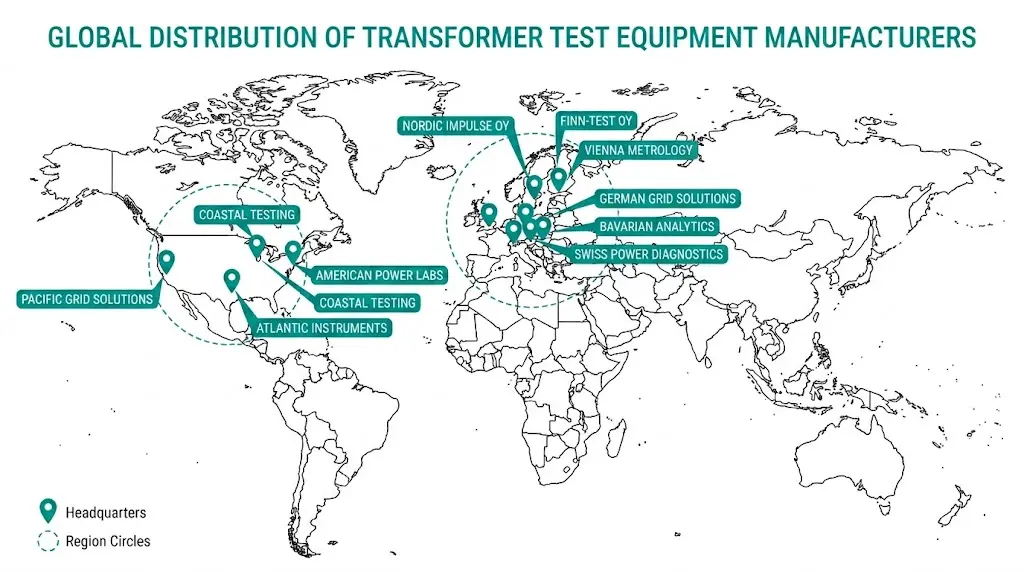
Geographic factors significantly influence equipment selection beyond technical specifications. Service infrastructure, standards compliance, and local support networks affect long-term ownership experience.
IEEE C57 series standards dominate test protocols—verify equipment reports comply with C57.104 (DGA interpretation), C57.149 (SFRA), and C57.152 (diagnostic field testing). Strong installed bases of Doble and Megger equipment create standardization advantages for training and data comparison.
Service center proximity matters for calibration turnaround. Major manufacturers maintain facilities in Texas, Massachusetts, and California with typical response times under 48 hours for critical repairs.
IEC 60076 series serves as the primary reference framework. European manufacturers (OMICRON, DV Power, HIGHVOLT) offer strong local support with calibration facilities within 500 km of most grid assets.
CE marking requirements apply to imported equipment. Verify 50 Hz primary system compatibility—some North American instruments default to 60 Hz power frequency testing.
Mixed standards environment requires careful specification review. China follows GB standards (harmonized with IEC), India uses IS standards, and Japan maintains JIS specifications. Local manufacturers compete aggressively on price, but evaluate total cost of ownership including calibration infrastructure and spare parts availability.
Software localization and language support become critical factors. Verify that analysis software, user interfaces, and technical documentation are available in required languages.
For utilities managing diverse transformer fleets including dry-type transformers, ensure selected equipment covers both oil-filled and dry-type test protocols—DGA obviously applies only to oil-filled units.
External Reference: IEEE Standards Association maintains the definitive IEEE C57.104-2019 Guide for Interpretation of Gases Generated in Mineral Oil-Immersed Transformers, which establishes DGA interpretation frameworks used worldwide.
Diagnostic test equipment measures transformer health—but transformer construction quality determines baseline performance and measurement consistency throughout service life. Well-manufactured transformers provide repeatable test results from commissioning through decades of operation.
Factory acceptance testing (FAT) establishes critical baseline data for future SFRA comparison and DGA trending. Transformers built to IEC 60076 standards with proper documentation enable accurate diagnostic interpretation and informed maintenance decisions.
XBRELE supplies oil-immersed, dry-type, and amorphous alloy distribution transformers engineered to international standards. Our technical team supports customers with commissioning test protocols, baseline documentation, and long-term diagnostic planning for transformer asset management programs.
Request transformer specifications or discuss testing requirements with XBRELE engineers →
What is the most critical transformer test for preventing failures?
DGA (dissolved gas analysis) is widely considered the most valuable single diagnostic for oil-filled transformers because it detects developing faults weeks to months before failure—hydrogen and acetylene concentrations serve as early warning indicators for thermal and electrical problems respectively.
How often should transformer diagnostic testing be performed?
Testing frequency depends on asset criticality and age. Critical transmission transformers typically require annual comprehensive testing, while standard distribution units follow 3–5 year cycles. Online DGA monitoring provides continuous surveillance for high-value assets.
Can a single instrument perform all four diagnostic tests?
Multi-function platforms from OMICRON and Megger combine TTR, tan-delta, and some SFRA capabilities. However, DGA requires dedicated analyzers due to fundamentally different measurement principles involving gas extraction and chromatography.
What accuracy specifications should I require for TTR equipment?
For power transformers above 500 kVA, specify TTR accuracy of ±0.1% or better. Instrument transformers used in revenue metering applications may require ±0.05% accuracy to detect subtle winding faults affecting measurement precision.
How do portable and laboratory DGA analyzers differ?
Portable units enable on-site analysis with results in 15–30 minutes at ±10% accuracy—suitable for routine screening. Laboratory analyzers achieve ±3% accuracy with broader gas detection ranges, making them preferable for detailed fault investigation and trending analysis.
What standards govern transformer test equipment calibration?
ISO 17025 accreditation ensures calibration laboratory competence. Equipment should be traceable to national metrology standards, with annual recalibration recommended for critical instruments and 6-month intervals for equipment in harsh environments or frequent transport.
Do I need different equipment for testing dry-type transformers?
Partially. TTR, tan-delta, and SFRA methods apply to dry-type units with appropriate test lead configurations. DGA does not apply since dry-type transformers contain no oil. Partial discharge testing becomes more relevant for dry-type insulation systems.