Need Full Specifications?
Download our 2025 Product Catalog for detailed drawings and technical parameters of all switchgear components.
Get Catalog
Download our 2025 Product Catalog for detailed drawings and technical parameters of all switchgear components.
Get Catalog Download our 2025 Product Catalog for detailed drawings and technical parameters of all switchgear components.
Get Catalog
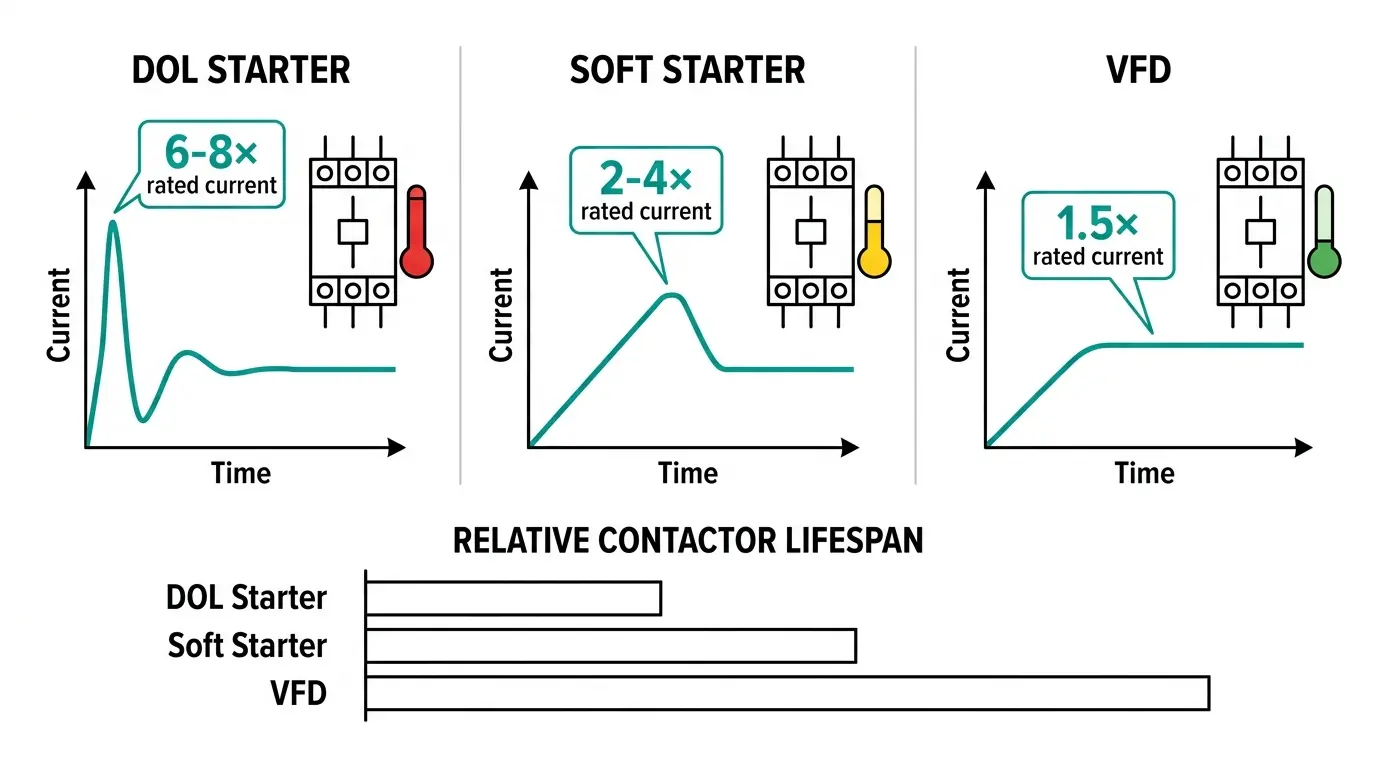
The starting method you select for a motor determines how long the contactor will last—often by a factor of 3× or more. Direct-On-Line starting subjects contactors to 6–8× full-load inrush current, while VFDs with pre-charge circuits reduce this stress to under 2×. This difference translates directly into contact erosion rates, replacement intervals, and total cost of ownership.
In field assessments across 200+ industrial installations, we’ve documented how these three starting configurations create fundamentally different duty profiles for switching devices. The physics is straightforward: higher inrush means greater electromagnetic repulsion, faster contact erosion, and shorter service life.
Direct-On-Line (DOL) starting applies full line voltage instantaneously. The contactor closes into inrush currents reaching 6–8 times full-load amperage (FLA). For a 75 kW motor rated at 140 A, contacts must handle surges exceeding 840 A during the first 100–200 milliseconds. This represents maximum electrical stress on the switching device.
Soft starters reduce inrush by controlling thyristor firing angles, ramping voltage from 30–70% over 2–30 seconds. Field measurements consistently show peak currents reduced to 2–4× FLA. The trade-off: harmonic content during ramp-up creates non-sinusoidal waveforms that affect arc extinction behavior.
Variable Frequency Drives decouple the supply-side contactor from motor starting transients entirely. DC bus capacitors absorb inrush energy, limiting contactor exposure to capacitor charging currents—typically 1.5–2× steady-state input current for 10–50 milliseconds.
The lifespan differential is substantial. Identical AC-3 contactors achieve roughly 1 million operations under VFD duty versus 300,000–500,000 in DOL service. Same contactor, same motor rating, 2–3× difference in replacement intervals.
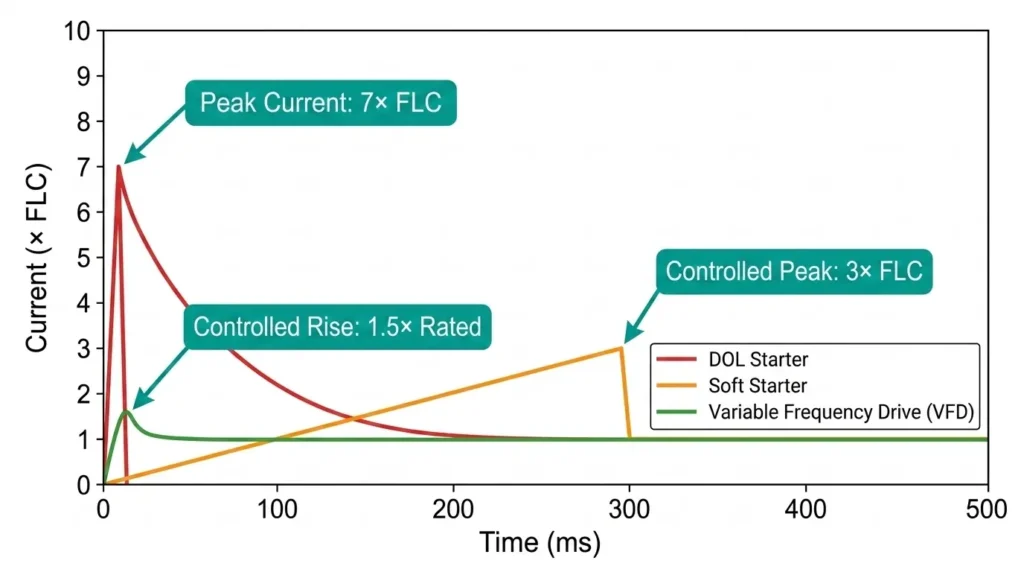
Understanding why motor starting methods affect contactor duty requires examining the forces at play during each switching event. Three mechanisms work simultaneously during high-current closure.
Electromagnetic repulsion acts to separate closed contacts. Force follows the I² relationship—a 6× inrush current generates 36 times the repulsion force compared to steady-state operation. Contact holders must resist these forces continuously to prevent micro-separation. Even momentary gaps create arcing that accelerates wear.
Contact erosion occurs with every make operation under inrush conditions. Arc plasma transfers material between contact faces at rates of 0.1–0.3 mg per operation for silver-cadmium oxide contacts at 400 A inrush. This erosion is cumulative and irreversible.
Thermal cycling from repeated high-current events causes differential expansion between contact rivets and carriers. Over thousands of cycles, this leads to contact loosening—a failure mode common in applications exceeding 30 starts per hour.
Reduced-voltage methods address all three mechanisms. Soft starters limit inrush to 200–350% FLC, reducing electromagnetic repulsion by 75–90% compared to DOL. VFDs maintain starting current at or below 100% FLC through controlled frequency acceleration, virtually eliminating inrush-related stress.
According to IEC 60947-4-1 governing contactor utilization categories, this distinction determines operating classification. DOL contactors must meet AC-3 requirements (motor starting duty). VFD input contactors often qualify for AC-1 classification (resistive/slightly inductive loads)—a less demanding category with correspondingly longer contact life expectations.
[Expert Insight: Field Observations from High-Cycle Applications]
- Cement plant crushers with DOL starting typically require contactor replacement every 6–12 months at 50+ starts per day
- Same installations converted to VFD control extend contactor intervals to 3–5 years
- Contact resistance measurements above 500 µΩ indicate replacement needed within 30 days regardless of visual appearance
- Thermal imaging during operation reveals contact degradation before electrical symptoms appear
Contactor selection errors often stem from misunderstanding utilization categories. The distinction between AC-3 and AC-4 ratings represents the difference between years of service and months of service.
AC-3 duty covers normal motor starting and stopping. The contactor makes into inrush current (6× rated) but breaks at running current (1× rated) because the motor reaches speed before disconnection. This is the standard rating for most industrial motor applications.
AC-4 duty applies to jogging, plugging, and reversing operations. The contactor both makes and breaks at inrush levels because the motor never reaches running speed. Breaking 6× current instead of 1× current accelerates contact erosion dramatically.
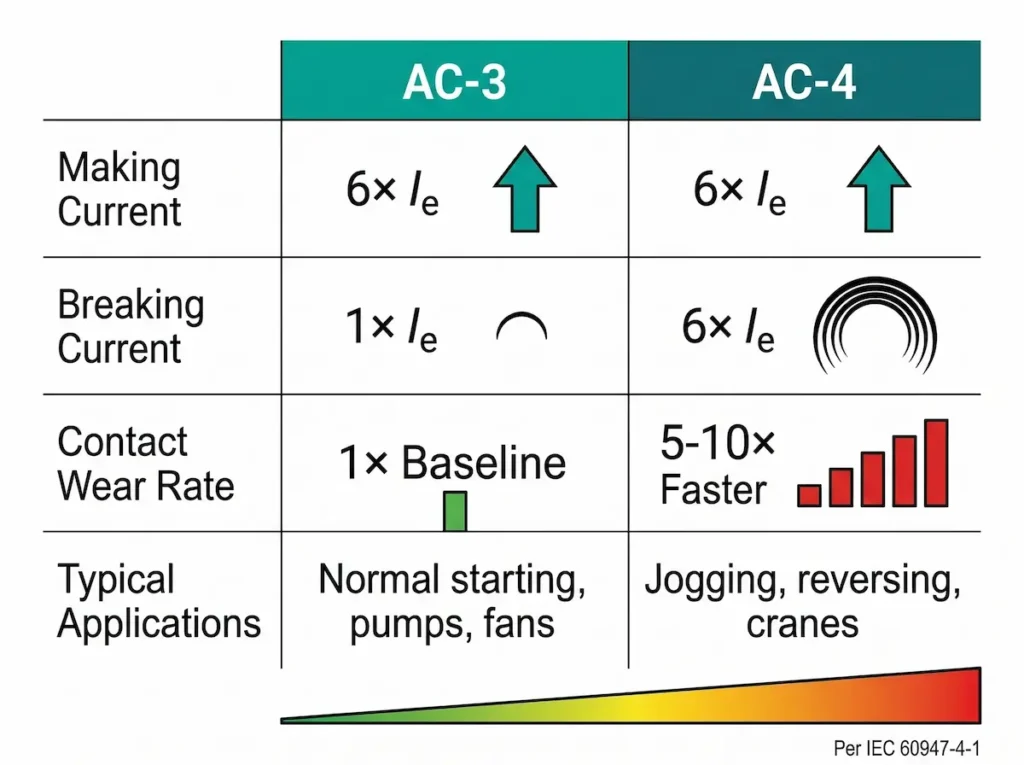
The practical impact is severe. A contactor rated 100 A in AC-3 service might carry only 60 A rating for AC-4 applications. Engineers who specify based on motor current without considering duty category end up with undersized contactors and premature failures.
Contact life under AC-4 conditions follows approximately: LAC-4 = LAC-3 × (Ibreak-AC3/Ibreak-AC4)2, where the squared relationship reflects arc energy dependence on current magnitude.
For applications involving frequent reversing—cranes, hoists, positioning systems—specify AC-4 ratings or consider VFD control that eliminates reversing contactors entirely. The upfront cost difference is trivial compared to repeated replacement labor.
Soft starter installations require multiple contactors with different duty requirements. Understanding each position’s role prevents both over-specification (unnecessary cost) and under-specification (premature failure).
Line contactors connect the motor to the soft starter during ramp-up. Despite reduced inrush from thyristor control, these contactors still make into 2–4× FLC. AC-3 rating remains appropriate. Size for full motor current plus 10% margin.
Bypass contactors short across the soft starter after the motor reaches speed. These contactors close at running current (1× FLC) under near-unity power factor conditions. AC-1 rating is acceptable here. The bypass sees the gentlest duty in the entire starting system.
A common specification error: sizing bypass contactors for motor FLC only without thermal margin. Correct practice uses 1.2–1.5× motor FLC to accommodate continuous operation heating. A 160 A motor requires at least a 200 A bypass contactor frame.
Harmonic considerations affect line contactor selection. During ramp-up, chopped thyristor waveforms contain significant 3rd, 5th, and 7th harmonic content. True RMS current exceeds fundamental current by 5–15%. Contactors must handle this additional heating without exceeding thermal limits.
For medium-voltage soft starter applications, vacuum contactors in the JCZ series provide the arc interruption capability needed for reliable harmonic-rich current switching.
[Expert Insight: Soft Starter Bypass Timing]
- Bypass should engage only after motor reaches 95%+ speed to ensure minimal current transient
- Premature bypass engagement (below 90% speed) subjects bypass contactor to AC-3 equivalent duty
- Adjustable bypass delay settings on modern soft starters allow optimization for specific motor/load combinations
- Failed bypass contactors often indicate incorrect timing parameters rather than contactor defects
VFD installations present unique contactor selection challenges that differ fundamentally from direct motor starting applications. The critical factor: contactors switch capacitor charging current, not motor inrush.
When the main contactor closes, it charges the VFD’s DC bus capacitor bank. Without pre-charge circuits, this creates inrush peaks of 10–20× drive rated input current for 5–20 milliseconds. Despite the brief duration, this spike can weld contacts on undersized switching devices.
Quality VFDs incorporate pre-charge circuits using current-limiting resistors. These reduce capacitor charging inrush to 2–5 A regardless of drive size, transforming contactor duty from severe to minimal. With effective pre-charge, input contactors operate at near-AC-1 conditions.
Field reality check: many drives under 30 kW omit pre-charge or use undersized circuits that fail within 2–3 years. Verify pre-charge presence and rating before assuming light-duty contactor requirements. Request pre-charge circuit specifications during VFD procurement.
Some applications require contactors between VFD output and motor—multi-motor configurations, bypass schemes, emergency transfer arrangements. These contactors face different challenges.
PWM switching frequency (2–16 kHz) doesn’t directly affect contact wear. However, output contactors must handle regenerative current if the motor is spinning during switching. A coasting motor acts as a generator, driving current back through closing contacts.
For installations requiring frequent VFD-to-bypass transfer, high-performance vacuum contactors provide superior arc interruption compared to air-break alternatives, particularly at medium voltage levels.
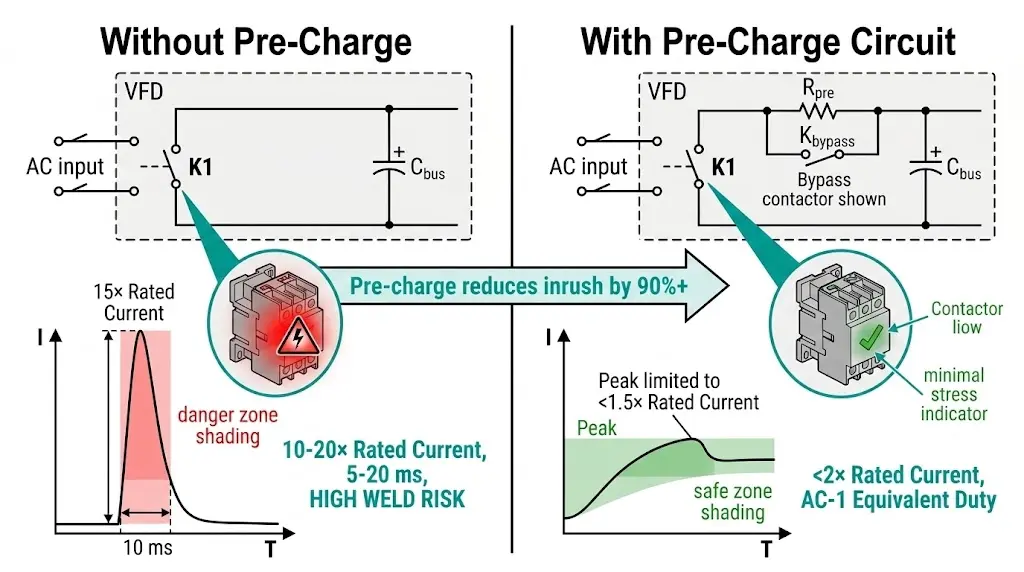
Abstract comparisons mean little without numbers. The following data derives from manufacturer endurance testing combined with field replacement records across diverse industrial applications.
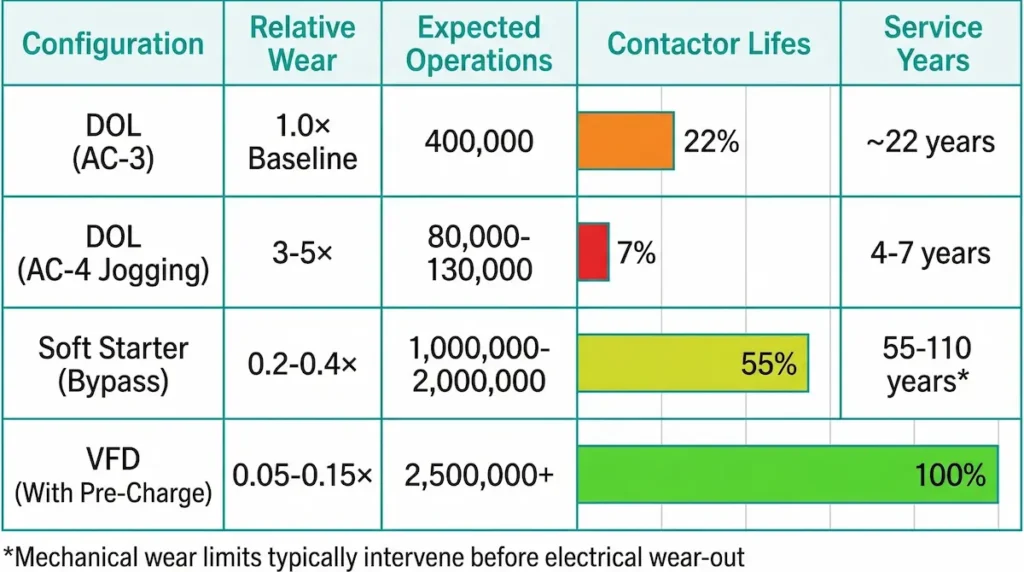
| Starting Method | Relative Wear | Expected Operations | Years at 50 Starts/Day |
|---|---|---|---|
| DOL (AC-3) | 1.0× baseline | 400,000 | ~22 |
| DOL (AC-4 jogging) | 3–5× | 80,000–130,000 | 4–7 |
| Soft starter (bypass) | 0.2–0.4× | 1,000,000–2,000,000 | 55–110* |
| VFD (with pre-charge) | 0.05–0.15× | 2,500,000+ | 130+* |
*Mechanical wear limits typically intervene before electrical wear-out in light-duty applications
The 6–20× lifespan advantage for VFD configurations explains why lifecycle cost analyses often favor drives even when energy savings alone don’t justify the investment. Reduced maintenance labor, fewer unplanned outages, and extended replacement intervals compound over a 15–20 year motor service life.
For high-cycle applications exceeding 100 starts daily, the comparison becomes even more favorable to reduced-voltage methods. At 200 starts/day, DOL contactors under AC-4 duty may require replacement every 12–18 months. The same application with VFD control extends intervals to 5+ years.
Matching starting method to application requirements prevents both over-engineering (wasted capital) and under-engineering (premature failures and production losses).
High-cycle applications (>100 starts/day): Batch mixers, packaging lines, test stands. Avoid DOL unless AC-4 rated contactors are specified with appropriate derating. Soft starters or VFDs extend both motor mechanical life and contactor electrical life. For demanding applications, CKG series vacuum contactors deliver 1 million+ operations at full AC-4 rating.
Jogging and reversing duty: Cranes, hoists, positioning systems. AC-4 category is mandatory—never use AC-3 ratings regardless of current magnitude. VFDs with vector control eliminate reversing contactors entirely, removing a common failure point.
Constant-speed pumps and fans (<10 starts/day): DOL with standard AC-3 contactors is economical and appropriate. The low cycle count allows contact life to reach mechanical wear limits rather than electrical wear limits.
Variable-flow pumps and fans: VFDs provide both energy savings (15–40% typical for variable-torque loads) and contactor life extension. Payback typically occurs within 2–4 years on energy alone.
Capacitor switching: Power factor correction capacitors and VFD input filter capacitors create inrush currents of 100–200× for microseconds. Standard AC-3 contactors may weld on first operation. Specify AC-6b rated devices or dedicated capacitor switching contactors.
Motor starting applications with high cycle rates, frequent reversing, or medium-voltage requirements benefit from vacuum arc interruption technology. Vacuum contactors maintain consistent contact resistance and arc extinction capability across hundreds of thousands of operations where air-break contactors would require multiple replacements.
XBRELE’s vacuum contactor range spans 7.2–12 kV applications with electrical endurance exceeding 1 million operations at full AC-4 rating. For complete motor control center solutions including contactors, protection devices, and switching components, explore our switchgear parts catalog.
Contact our application engineering team at XBRELE to discuss contactor selection for your specific motor starting requirements.
Q: How much does motor starting method affect contactor replacement intervals?
A: Starting method typically creates a 2–5× difference in contactor lifespan under equivalent switching frequencies. VFD-fed motors with proper pre-charge circuits may extend contactor life by 6–20× compared to DOL starting in high-cycle applications.
Q: Can I use an AC-3 rated contactor for crane jogging applications?
A: No. Jogging operations break current at locked-rotor levels (6× FLC) rather than running current, requiring AC-4 rated contactors. Using AC-3 ratings for jogging duty typically results in contact welding or erosion failure within months.
Q: Why do some VFD input contactors weld shut during first energization?
A: DC bus capacitor charging creates brief but extreme inrush currents (10–20× rated) in drives without effective pre-charge circuits. This exceeds the making capacity of undersized contactors, fusing contacts together. Verify pre-charge specifications before selecting input contactors.
Q: What contact resistance indicates a contactor needs replacement?
A: New contacts typically measure 50–200 µΩ. Contact resistance exceeding 500 µΩ warrants investigation; above 1,000 µΩ indicates replacement is needed regardless of visual condition or operation count.
Q: Do soft starters eliminate contactor wear completely?
A: No, but they reduce it substantially. Bypass contactors see minimal stress (AC-1 equivalent duty), while line contactors still experience 2–4× FLC inrush—reduced from DOL’s 6–8× but not eliminated. Overall contactor life typically extends 2–4× compared to DOL starting.
Q: How does PWM switching frequency from a VFD affect output-side contactors?
A: High-frequency PWM switching (2–16 kHz) doesn’t directly cause contact wear. However, output contactors must handle regenerative current from spinning motors during switching events, and they should be rated for inverter duty to manage voltage transients.
Q: What contactor rating is required for power factor correction capacitor switching?
A: AC-6b category contactors designed specifically for capacitor switching are required. Capacitor inrush reaches 100–200× rated current for microseconds, exceeding the making capacity of standard AC-3 motor contactors and causing immediate contact welding.
Authority reference: For standard definitions and test context, see IEC 62271-106 publication page.