Request a Quote for High-Voltage Components&Equipment

Tell us your requirements — rated voltage, model, quantity, and destination — and our XBR Electric team will prepare a detailed quotation within 24 hours.
Contact Form Demo
Feature illustration of an epoxy contact box showing insulated terminals, sealing, and key components

Epoxy Contact Box Basics: The Complete Practical Guide for Beginners (2025)

Last updated: 2025-12-21
Reading time: ~10–12 minutes
Audience: maintenance technicians, panel builders, electrical students, procurement engineers
Scope: LV–MV “fundamentals + selection + installation + inspection + troubleshooting”
Safety note: Educational guide only. For real work, follow site safety rules, applicable electrical codes, and the manufacturer datasheet.


Key Takeaways

  • Epoxy contact boxes protect live terminals by combining rigid dielectric insulation and environmental shielding.
  • Field failures are most often caused by loose connectionsheat riseseal aging, or mechanical stress cracks—not “epoxy weakness.”
  • “Waterproof” depends on sealing design + cable entry + installation quality, not epoxy material alone.
  • Correct installation comes down to flat mountingproper torquestrain relief, and routine inspection.
  • If you share your voltage/current/environment and cable entry requirements, XBRELE can help shortlist a suitable solution (see CTA at the end).

Introduction to Epoxy Contact Boxes

Understanding epoxy contact box basics helps you make safer and more reliable electrical connections—especially in distribution equipment, industrial systems, and MV switchgear assemblies. In simple terms, an epoxy contact box is an insulating enclosure designed to house and protect terminals/contacts, reducing risk from moisture, dust, accidental touch, and contamination-driven faults.

If you’re building or sourcing MV assemblies, epoxy insulation components are often part of a wider system of switchgear parts and interlocks—see XBRELE’s overview of High-Voltage Switchgear Components & Safety Interlocks.

Accessibility & Inclusive Guidance

This guide uses plain language first and explains technical terms as you go.

  • Beginner path: read How to ChooseInstallationCommon Mistakes, and FAQs.
  • Technician path: add Failure Modes & Diagnostics and the Troubleshooting table.

Safety & Compliance

  • De-energize first: apply Lockout/Tagout (LOTO) whenever possible.
  • Verify absence of voltage: use proper test equipment and procedures.
  • Follow codes and site rules: comply with applicable electrical codes and facility requirements.
  • Use the datasheet: torque values, conductor ranges, spacing, and sealing steps must follow manufacturer documentation.

For a practical baseline of LOTO expectations (general industry), refer to OSHA’s standard: 29 CFR 1910.147 (Lockout/Tagout).


Terminology

  • Contact box: insulating enclosure protecting terminals/contacts
  • Creepage distance: surface distance along insulation between energized parts (important in MV)
  • Clearance: air distance between energized parts
  • IP rating: dust/water ingress protection—depends on sealing design and installation
  • Dielectric: insulating property resisting electrical conduction

What Is an Epoxy Contact Box?

An epoxy contact box is a rigid enclosure made primarily from epoxy resin. Inside the enclosure are conductive components such as:

  • terminal studs / bolts / threaded inserts
  • busbar interfaces
  • cable lug connection points
  • contact assemblies (design dependent)

Epoxy may fully encapsulate conductors (cast-in) or form a sealed insulating housing around terminals—improving electrical isolation and environmental protection.
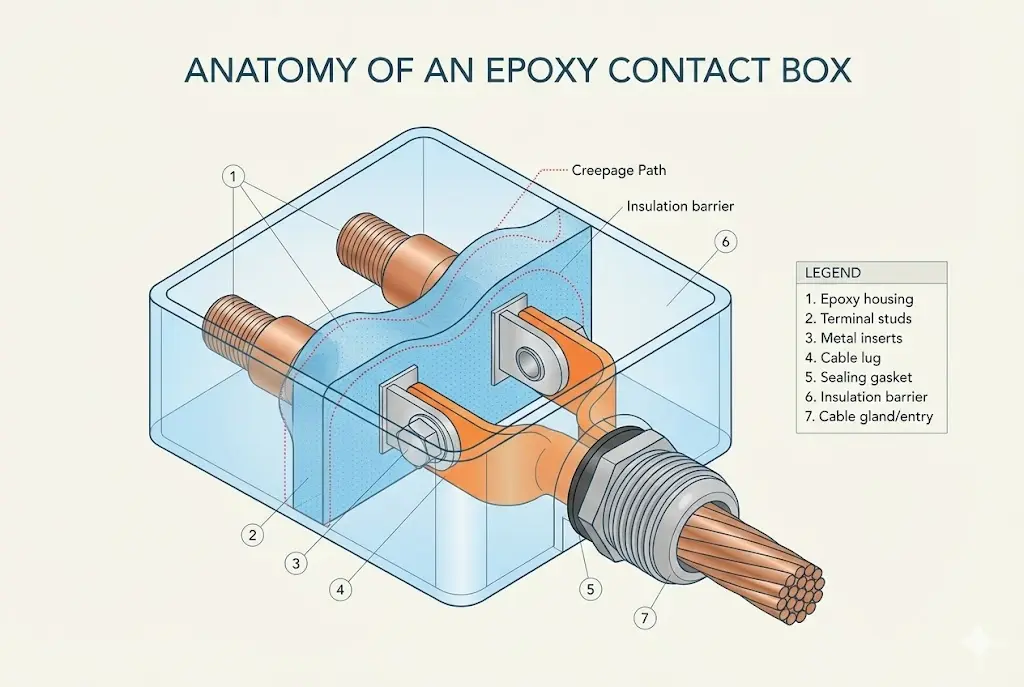
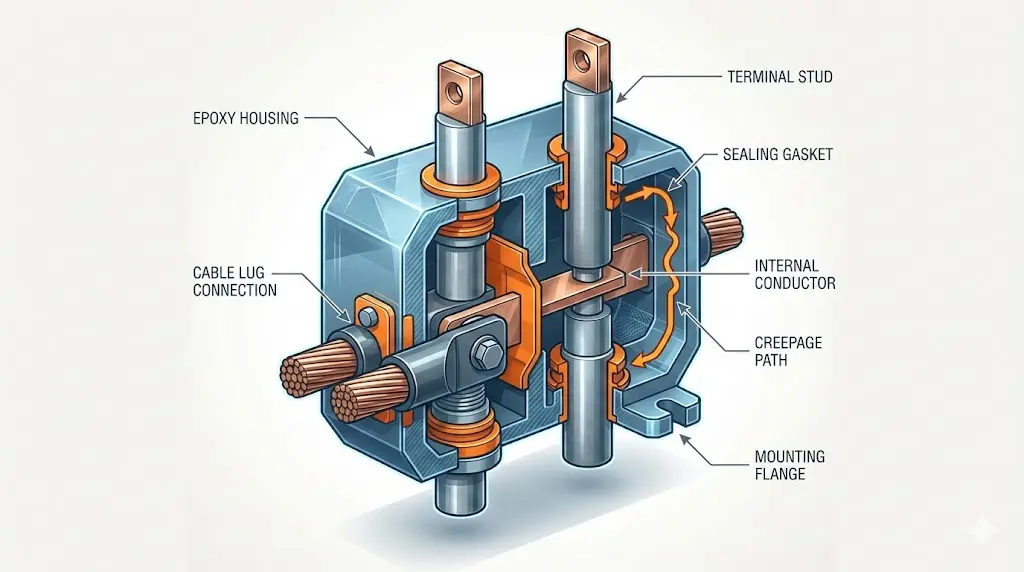
Epoxy contact box anatomy diagram showing resin housing, terminal studs, gasket sealing, and cable entry points

Why Epoxy Is Used in Contact Boxes

Epoxy resin is widely used because it can provide:

  • Strong dielectric insulation for electrical safety
  • Mechanical rigidity for stable mounting and impact resistance
  • Dimensional stability under thermal stress
  • Environmental resistance (formulation-dependent) to moisture, dust, oils/chemicals
  • Aging resistance when properly designed and installed

Materials & Manufacturing Basics

Not all epoxy contact boxes are “the same epoxy.” Performance is influenced by resin formulation and manufacturing process:

  • Resin formulation: epoxy systems can be tuned for insulation strength, mechanical toughness, heat resistance, and moisture resistance. Some include flame-retardant additives when required by project specs.
  • Manufacturing methods (common):
    • Casting / molding: forms the housing geometry (walls, ribs, mounting points).
    • Insert molding (cast-in metal inserts): terminals or threaded inserts are integrated into the epoxy body for stable positioning.
    • Potting / encapsulation: fills voids around terminals/contacts to reduce moisture paths and improve insulation integrity.
  • Why it matters: poor process control can introduce voids/bubbles, weak interfaces around inserts, or inconsistent sealing surfaces—these issues can reduce long-term reliability.

If you’re mapping epoxy contact boxes within an overall OEM insulation supply chain, you can also reference XBRELE’s manufacturing scope as a Switchgear Component Manufacturer.
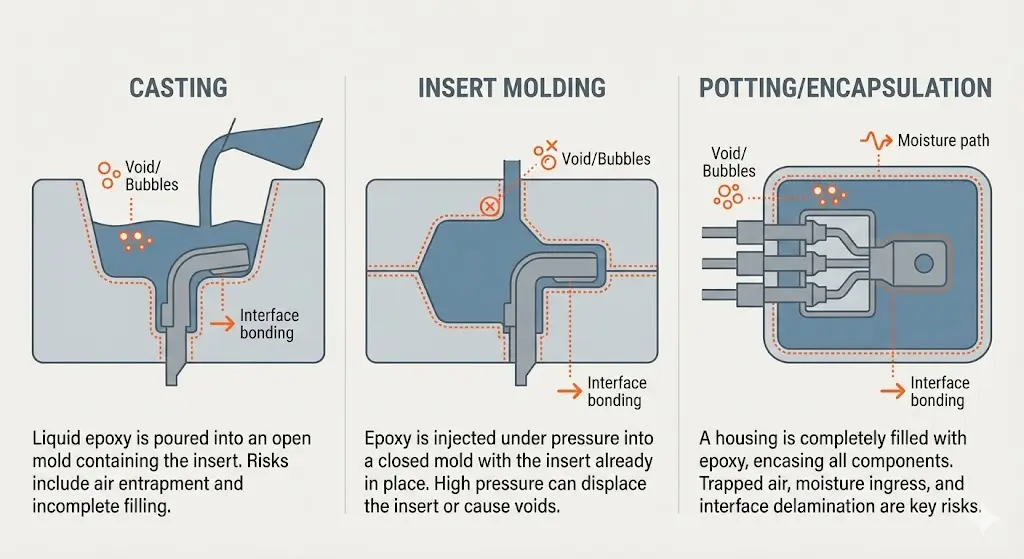
Infographic showing epoxy contact box manufacturing methods: casting, insert molding, and potting, with notes on voids, sealing paths, and reliability

Key Components of an Epoxy Contact Box

1) Epoxy Resin Housing

The molded/cast outer body provides the primary insulation and mechanical structure. Good designs prioritize:

  • adequate creepage and clearance
  • reinforced ribs and stress-relief geometry
  • smooth/rounded edges to reduce electrical stress points
  • mounting points that resist cracking under normal torque

2) Electrical Contacts and Terminals

These conductive parts carry current. Reliability depends heavily on:

  • correct conductor size and lug fit
  • clean mating surfaces
  • correct torque and vibration control

Most common field issue: loose terminal connections → higher resistance → overheating.

3) Insulation & Sealing Features

Depending on the use case:

  • gaskets / O-rings
  • cable glands / sealed feedthroughs
  • potting/encapsulation at interfaces
  • structure that blocks water paths

How Epoxy Contact Boxes Work

Electrical Isolation Explained

Epoxy acts as a dielectric barrier between live conductors and the outside environment. This reduces:

  • accidental touch risk (shock protection)
  • contamination-triggered short circuits
  • insulation instability in compact layouts

Protection Against Environmental Factors

With appropriate sealing and design, epoxy contact boxes can help resist:

  • moisture/humidity
  • dust and conductive particles
  • industrial contaminants (formulation-dependent)
  • vibration and mechanical stress
  • thermal cycling

Types of Epoxy Contact Boxes

Indoor Epoxy Contact Boxes

Common in panels and indoor switchboards:

  • compact designs
  • moderate sealing requirements
  • easier access for wiring/inspection (model-dependent)

Outdoor and Industrial-Grade Boxes

Designed for exposure:

  • improved sealing and cable entry protection
  • stronger mechanical structure / thicker walls
  • better performance under temperature swings and moisture exposure

Flame-Retardant Variants

Some epoxy formulations include flame-retardant additives to meet project safety requirements.


Applications of Epoxy Contact Boxes

Power Distribution Systems

Used in switchgear, distribution panels, and transformer connection areas to protect terminal interfaces.

Industrial Machinery

Protects connection points exposed to vibration, dust, oil mist, and frequent maintenance.

Renewable Energy Installations

Common in solar/wind systems to protect outdoor terminals and reduce weather-related degradation.


Advantages of Epoxy Contact Boxes

Durability and Longevity

Epoxy housings can offer long service life due to rigidity and stable insulation geometry (when installed correctly).

Electrical Safety Benefits

By insulating live terminals and supporting reliable spacing, epoxy boxes help reduce shock and short-circuit risk.


Key Ratings & Specs to Check

You don’t need to memorize numbers—just confirm these items in the datasheet:

Spec / RequirementWhat to confirmWhy it matters
Voltage classLV/MV suitability; insulation design intentWrong class risks tracking/breakdown
Creepage & clearance (MV)Geometry is designed for your voltage environmentPrevents surface tracking/flashover
Current rating / conductor rangeTerminal size matches conductor + lugAvoids overheating and loose fit
Temperature range / heat riseAmbient + load heating marginHeat accelerates insulation aging
Sealing approachgasket / gland / potting designDetermines moisture and dust resistance
IP requirement (if specified)Rated level + proper installation steps“Material” alone doesn’t give IP
Flame-retardant requirementIf project/spec demands itSafety and compliance
Mounting methodpanel/bracket, orientation limitsAvoids stress cracks and misfit
Serviceabilitycan you inspect/retorque terminals?Reduces downtime and repeat failures

If your project references IP codes, IEC has a concise explanation of IP ratings and what they do (and do not) guarantee: IEC IP ratings (IEC 60529).


Indoor vs Outdoor: Quick Decision Tree

Use this quick logic before choosing a model:

  1. Is the box exposed to rain, wash-down, or condensation?
  • Yes → choose outdoor/industrial grade with robust sealing and proper cable entry (gasket + glands; potting where needed).
  • No → indoor grade may be sufficient (still confirm dust/vibration).
  1. Is there conductive dust, chemical mist, oil fog, or heavy pollution?
  • Yes → prioritize sealing + contamination control; consider industrial grade and more protected terminal interfaces.
  1. Is the site high vibration (machines, vehicles, frequent door slams)?
  • Yes → prioritize strain relief, stable mounting, and terminal designs that resist loosening (and tighten to torque spec).
  1. Is this MV insulation-critical (metal-enclosed switchgear assemblies)?
  • Yes → confirm your assembly requirements align with applicable MV switchgear standards (for example IEC 62271-200 for metal-enclosed switchgear assemblies): IEC 62271-200 (overview).
Decision tree flowchart to select indoor vs outdoor epoxy contact box based on condensation, dust, vibration, and MV insulation criticality

Installation and Maintenance Basics

Step-by-Step Installation Mini HowTo

  1. Verify ratings & accessories
    Confirm voltage/current/environment, and ensure gaskets/glands/hardware are present.
  2. Inspect the housing
    Check for chips/cracks, damaged sealing surfaces, or bent inserts.
  3. Prepare mounting surface
    Mount on a flat, stable surface. Uneven surfaces create stress and cracks over time.
  4. Install cable entry correctly
    Use the correct gland/feedthrough. Seat properly; avoid cutting/rolling the gasket. Keep sealing surfaces clean.
  5. Terminate conductors properly
    Use correct lug type and conductor size. Ensure clean mating surfaces and full contact.
  6. Torque to datasheet specification
  • Terminal hardware: too loose = overheating; too tight = damage.
  • Mounting fasteners: avoid overtightening epoxy mounting points.
  1. Add strain relief
    Ensure cables do not pull or vibrate at the terminal interface. Respect bend radius.
  2. Final check
    Confirm spacing, covers, seals, and grounding/earthing per system design.
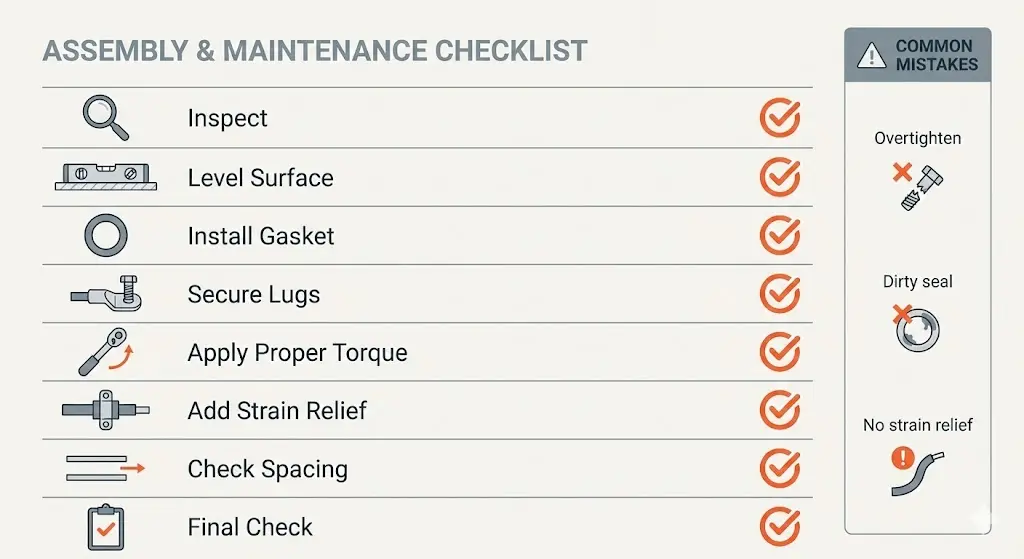
Checklist-style infographic for epoxy contact box installation: inspect housing, prepare surface, seal cable entry, terminate lugs, torque, strain relief, final inspection

Routine Inspection Tips

  • Visual: cracks, tracking marks, carbonization, discoloration
  • Heat clues: browning, odor, softened insulation near terminals
  • Connection stability: looseness, vibration wear, misaligned lugs
  • Seal health: gasket hardening, compression set, gland looseness
  • Outdoor moisture: condensation signs, corrosion at terminals

Inspection frequency (rule of thumb):

  • stable indoor: every 6–12 months
  • harsh outdoor/industrial: every 3–6 months and after severe weather/outage events

If You Don’t Have Advanced Tools

  • No thermal camera? Look for discoloration, odor, and insulation softening near terminals (only when safe and permitted).
  • No ingress test? Inspect gasket compression, cable gland tightness, and likely water paths.
  • Limited downtime? Prioritize high-current terminals, retorque checks (per procedure), and crack inspection.

Failure Modes & Diagnostics (Field-Practical)

1) Overheating from Loose Connections (Most Common)

Symptoms: discoloration near terminal, smell, softened insulation, hot spots
Root cause: high contact resistance from poor torque, wrong lug, contamination, vibration
Action: de-energize → inspect lug fit → clean mating surfaces → torque per datasheet → confirm conductor sizing

2) Surface Tracking / Creepage Issues

Symptoms: branch-like marks, carbon tracking, occasional discharge noise (severe cases)
Root cause: contamination + moisture + insufficient creepage distance or poor surface condition
Action: clean/replace affected parts → improve sealing/contamination control → confirm suitability for MV environment

3) Seal Aging / Water Ingress

Symptoms: corrosion, condensation, moisture residue
Root cause: gasket aging, poor cable entry sealing, installation errors
Action: replace gasket/glands → correct cable entry → improve moisture management

4) Mechanical Stress Cracks

Symptoms: micro-cracks around mounting holes or corners
Root cause: overtightening, uneven mounting surface, impact
Action: replace if insulation integrity is compromised → correct mounting flatness → torque discipline


Troubleshooting Table (Quick Reference)

SymptomLikely causeQuick checkCorrective action
Terminal discoloration / hot smellloose joint / wrong lug / undersized conductorinspect lug seating; check tightness; signs of heatingde-energize, clean, re-terminate, torque to spec, verify conductor size
Intermittent faults in humid weathermoisture ingress / poor sealinggasket condition, gland seating, water pathreplace gasket/gland, improve entry sealing, consider higher grade
Tracking marks on surfacecontamination + moisture + MV stressinspect for carbon paths and depositsclean/replace, improve sealing/cleanliness, verify creepage/clearance design
Hairline cracks near mountingovertightening / uneven mountingcheck mounting surface flatness and torquereplace if needed, correct mounting, use proper torque/washer strategy
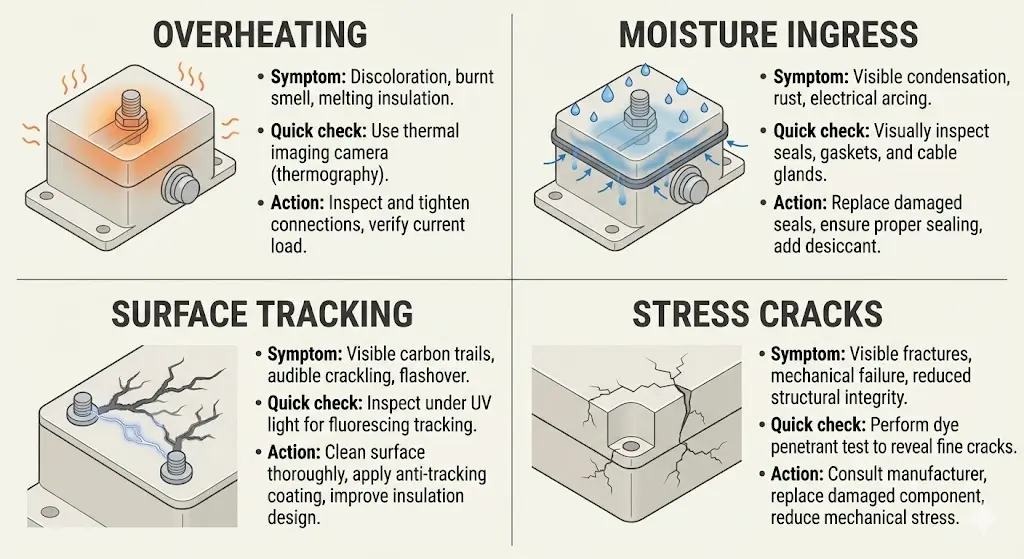
Infographic showing common epoxy contact box failures: overheated terminal, moisture ingress, surface tracking, stress cracks, with quick checks and corrective actions

Mini Case Examples (Typical Scenarios)

Case 1: Outdoor cabinet with condensation and corrosion

A site reported corrosion near terminal hardware after seasonal temperature swings. Inspection showed gasket compression was uneven and cable glands were not fully seated. After replacing gaskets/glands and re-installing with clean sealing surfaces, moisture signs reduced significantly.

Lesson: outdoor performance is often decided by cable entry + gasket installation quality.

Case 2: Factory vibration causing overheating at terminals

In a high-vibration environment, a box showed discoloration near one terminal. The lug was slightly loose, increasing contact resistance. After correcting strain relief, re-terminating, and torquing to spec, temperature rise symptoms stopped.

Lesson: many “epoxy problems” are actually connection + vibration control problems.


Common Mistakes to Avoid

  • using indoor-rated boxes outdoors
  • assuming “epoxy = waterproof” without confirming sealing/IP requirements
  • ignoring temperature rise for high current applications
  • loose terminals or wrong lug/conductor sizing
  • overtightening mounting screws (stress cracks)
  • skipping strain relief so cables pull terminals loose
  • pinched gaskets or dirty sealing surfaces
  • ignoring grounding/earthing requirements

FAQs About Epoxy Contact Box Basics

1) Are epoxy contact boxes waterproof?

Some designs are water-resistant, but performance depends on sealing design, cable entry, gasket condition, and installation quality. Always verify the datasheet/IP requirement for your application.

2) Can epoxy contact boxes handle high voltage?

Yes—many models are used in MV equipment, but suitability depends on insulation design (creepage/clearance) and correct installation.

3) Are epoxy contact boxes better than plastic ones?

In harsh environments or higher electrical stress, epoxy often offers better rigidity and insulation stability. For light-duty indoor use, engineered plastics may also be appropriate if rated correctly.

4) Do epoxy contact boxes require maintenance?

Usually minimal, but periodic inspection is recommended—especially for loose connections, cracks, and seal aging.

5) Can epoxy contact boxes be used outdoors?

Yes, but only if the model is designed for outdoor service and installed with correct sealing and cable entry practices.

6) Are epoxy contact boxes fire-resistant?

Some are flame-retardant, but you must confirm the exact epoxy formulation and project compliance requirements.


Conclusion and Final Thoughts

Epoxy contact boxes are widely used because they combine strong insulationrigid protection, and long-term stability for critical terminal interfaces. Most failures can be avoided by choosing the right type for the environment and applying disciplined installation practices: flat mounting, correct torque, strain relief, and routine inspection.

If you’re building a complete insulation BOM for switchgear, you may also find it helpful to explore related epoxy insulation products like Indoor Epoxy Post Insulators & Capacitive Sensors, and download reference materials from the XBRELE Resources hub.


Next Step: Get the Right Model Quickly

If you want a fast recommendation, send XBRELE the following:

  • voltage class (LV/MV), system type
  • operating current and conductor size
  • indoor/outdoor + contamination type (dust/chemical mist/vibration)
  • cable entry method (gland/feedthrough), sealing/IP target
  • mounting method and quantity/lead time

👉 Contact XBRELE here: https://xbrele.com/contact/

Hannah Zhu marketing director of XBRELE
Hannah

Hannah is the Administrator and Technical Content Coordinator at XBRELE. She oversees website structure, product documentation, and blog content across MV/HV switchgear, vacuum breakers, contactors, interrupters, and transformers. Her focus is delivering clear, reliable, and engineer-friendly information to support global customers in making confident technical and procurement decisions.

Articles: 60