Benötigen Sie die vollständigen Spezifikationen?
Laden Sie unseren Produktkatalog 2025 herunter, um detaillierte Zeichnungen und technische Parameter aller Schaltanlagenkomponenten zu erhalten.
Katalog anfordern
Laden Sie unseren Produktkatalog 2025 herunter, um detaillierte Zeichnungen und technische Parameter aller Schaltanlagenkomponenten zu erhalten.
Katalog anfordern Laden Sie unseren Produktkatalog 2025 herunter, um detaillierte Zeichnungen und technische Parameter aller Schaltanlagenkomponenten zu erhalten.
Katalog anfordern
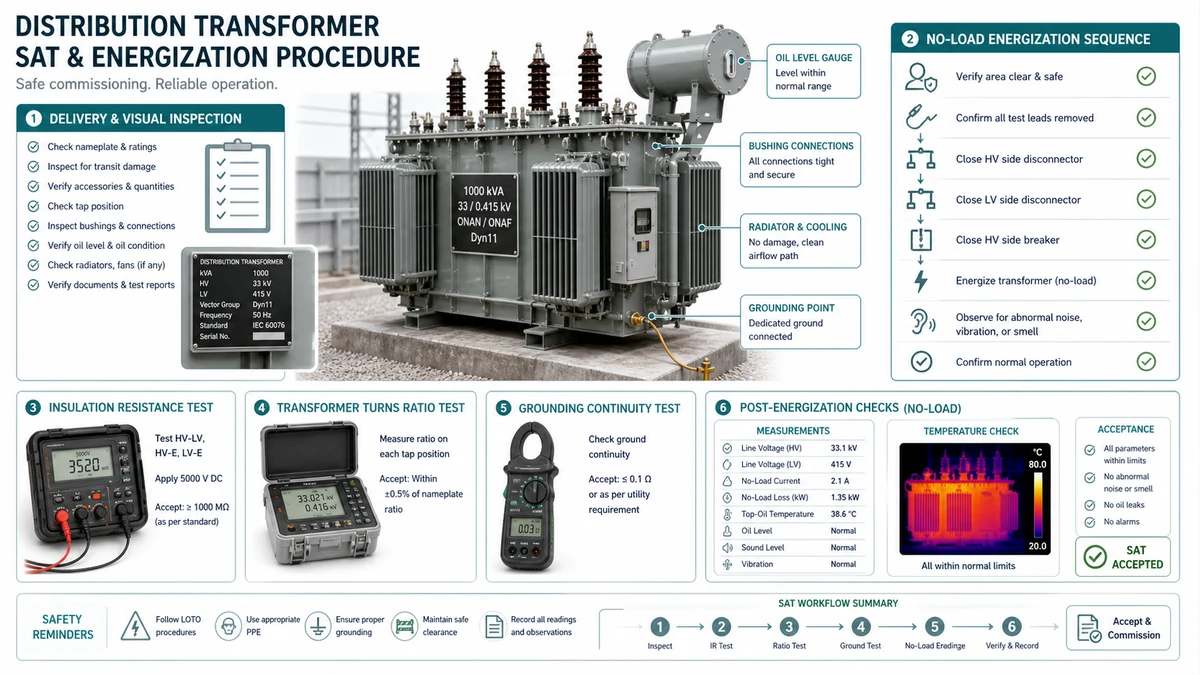
A Verfahren zur Inbetriebnahme des Verteilungstransformators SAT legt die strukturierte Abfolge der Abnahmeprüfungen vor Ort und der Umschaltvorgänge fest, die vor der Inbetriebnahme eines neuen Transformators erforderlich sind. Bei korrekter Durchführung wird dadurch sichergestellt, dass das Gerät den Transport unbeschadet überstanden hat, gemäß den Spezifikationen installiert wurde und bei den transienten Strömen beim ersten Einschalten nicht ausfällt.
Dieser Leitfaden deckt den gesamten Arbeitsablauf von der Anlieferungsprüfung bis zur Abnahme nach der Inbetriebnahme ab und enthält vor Ort einsetzbare Checklisten, Abnahmetabellen sowie einen Rahmen für die Fehlerbehebung. Er gilt für einphasige und dreiphasige Verteilungstransformatoren mit einer Nennleistung von 25 kVA bis etwa 2.500 kVA bei Primärspannungen bis einschließlich 36 kV. Geräte mit Laststufenschaltern (OLTC) erfordern zusätzliche Inbetriebnahmeschritte, die über die hier dargestellten hinausgehen.
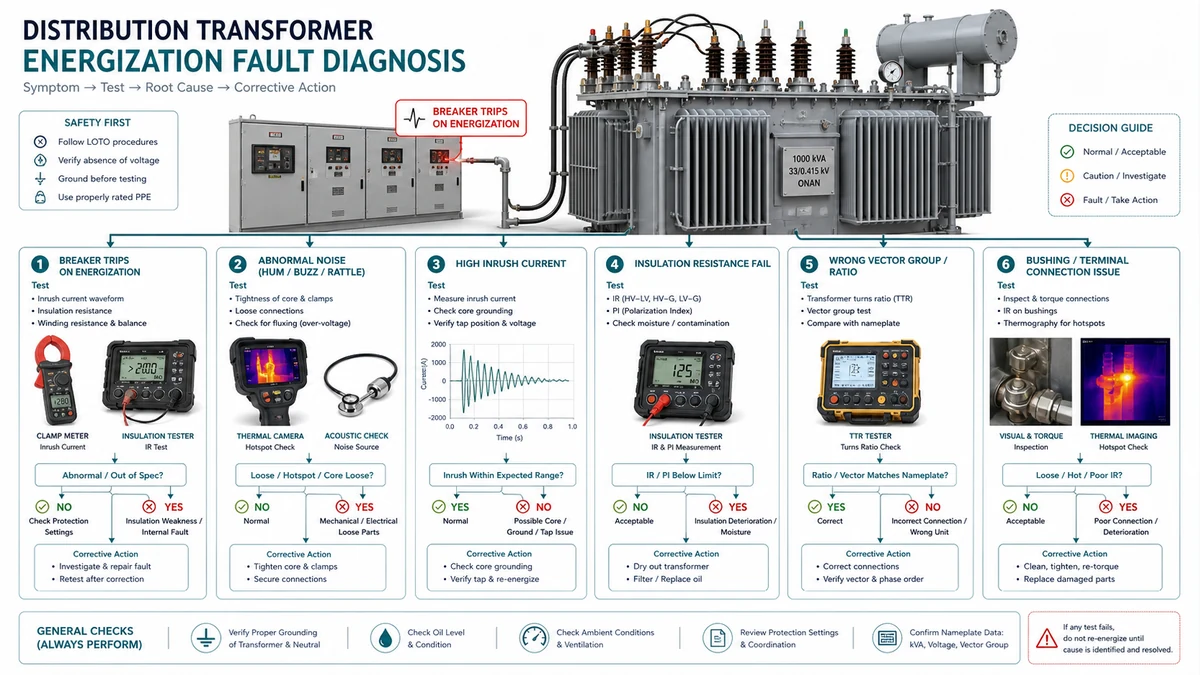
Bevor sie sich mit dem gesamten Verfahren befassen, können die Einsatzleiter diese Tabelle nutzen, um alle Anomalien zu bewerten, die während oder unmittelbar nach der Einschaltung auftreten.
| Symptom | Erster Test | Wahrscheinliche Grundursache | Nächste Aktion |
|---|---|---|---|
| Das Differentialrelais löst bei Erregung aus | CT-Polarität und Einstellung der Relais-Vektorgruppe prüfen | Vertauschte CT-Verdrahtung oder falsche Kompensation der Vektorgruppe | Strom abschalten; CT-Leitungen vertauschen oder Relaiseinstellung korrigieren; vor dem Wiedereinschalten durch Einspritzen erneut prüfen |
| Der Einschaltstrom klingt nicht innerhalb von 2 Sekunden ab | Messung des Erregungsstroms im Vergleich zur werkseitigen Referenzlinie | Teilweise Kernsättigung oder beginnender Windungsfehler | Strom abschalten; Erregungsstrom mit Werksangaben vergleichen; DGA durchführen |
| Spannungsunsymmetrie in der LV-Phase >2% im Leerlauf | TTR in allen drei Phasen erneut messen | Anschlussfehler an der Wicklung oder Fehler im offenen Dreieck | Strom abschalten; Klemmenanschlüsse und Übersetzungsverhältnis erneut überprüfen |
| Deutlich hörbares Klopfen oder Knacken beim Einschalten | Auf die Position achten; bei ölgefüllten Motoren eine DGA durchführen | Lose Kernbleche oder interne Lichtbogenbildung | Sofort die Stromversorgung unterbrechen; DGA vor jedem weiteren Versuch |
| Die Öltemperatur steigt im Leerlauf rapide an | Funktion des Kühlsystems prüfen; Leerlaufverlustwert überprüfen | Kühlungsausfall oder Kurzschluss in den Wicklungen | Strom abschalten; Lüfter und Pumpen des Kühlers überprüfen; Leerlaufverlust mit dem Werkswert vergleichen |
| Buchholz-Alarm innerhalb von 30 Minuten nach Einschalten | Relais-Gasprobe entnehmen; Dräger-Röhrchen-Analyse | Ein beginnender thermischer Riss, der Gas erzeugt | Strom abschalten; Gaszusammensetzung analysieren; erst wieder einschalten, wenn die Fehlerquelle ermittelt wurde |
| IR-Messwert unter 500 MOhm (Hochspannung zu Masse) | Erneut messen, auf 20 °C korrigiert; PI überprüfen | Feuchtigkeitseintritt in den Wicklungs- oder Durchführungsrevolver | Inbetriebnahme verschieben; Ölprobe zur Bestimmung des Wassergehalts entnehmen; bei Bestätigung Trocknung durchführen |
| Phasenunsymmetrie des Wicklungswiderstands >2% | Das Anzugsmoment der Klemmen erneut überprüfen; bei stabilisiertem Strom erneut messen | Lose Verbindung oder Kontaktwiderstand des Stufenschalters | Anschlüsse nachziehen; Kontakte des Stufenschalters prüfen; erneut prüfen |
| Instrument oder Quelle | Zweck im SAT | Annahmevermerk |
|---|---|---|
| Isolationswiderstandsprüfer (5.000 V DC für Hochspannung; 1.000 V DC für Niederspannung) | Messung der Infrarotstrahlung und des Polarisationsindex | IEEE-Norm 43; IEC 60076-1 |
| Ohmmeter für niedrige Widerstände / Mikroohmmeter | Wicklungswiderstand und Kontaktwiderstand | OEM-Werksprüfbericht; IEC 60076-1 |
| Brücke zur Bestimmung des Übersetzungsverhältnisses (TTR) eines Transformators oder automatischer Übersetzungsverhältnismesser | Übersetzungsverhältnis in allen Schaltstellungen | IEEE C57.12.90; Projektspezifikation |
| True-RMS-Multimeter | Spannung, Hilfsspannung und Durchgang der Auslösespule | OEM-Handbuch; Projekt-Schaltpläne |
| Stromzange (True-RMS) | Laststrom, Sekundärausgang des Stromwandlers, Neutralstrom | Koordinationsstudie; Projektspezifikation |
| Netzqualitätsanalysator | THD, Leistungsfaktor, Oberschwingungsanteil | IEC 61000-Reihe; Projektspezifikation |
| Wärmebildkamera | Heißstellen an Buchsen, Laschen und Tankoberflächen | NETA MTS; OEM-Handbuch |
| Prüfgerät für die Sekundärstromeinspeisung | Überprüfung der Relais-Anzugsspannung, der Steilheit und der Einschaltstromsperre | Relais-Einstellungsdatei; Spezifikation des Schutzingenieurs |
| Durchgangswiderstandsprüfer | Kontaktwiderstand des Stufenschalters | OEM-Handbuch für den Stufenschalter |
| Kit zur Analyse gelöster Gase (DGA) oder Laborservice | Gas-Ausgangswerte vor und nach der Stromzufuhr | IEC 60599; CIGRE-Richtlinien |
| Karl-Fischer-Feuchtemessgerät | Feuchtigkeitsgehalt des Öls | IEC 60814; OEM-Spezifikation |
| OEM-Werksprüfzertifikat | Grundwiderstand der Wicklung, TTR, Verluste | Von einem OEM unterzeichneter Prüfbericht |
| Projektspezifikation und Einliniendiagramm | Spannungsklasse, Vektorgruppe, Schutzeinstellungen | Verantwortlicher Projektingenieur |
Für IEEE-Normen zur Prüfverfahren für Transformatoren gilt die IEEE C57-Normensammlung für Transformatoren ist die wichtigste externe Referenz für die in diesem Verfahren verwendeten Akzeptanzkriterien.
Schäden oder fehlerhafte Konfigurationen, die erst nach der Installation eines Transformators entdeckt werden, sind deutlich kostspieliger zu beheben als Probleme, die bereits bei der Lieferung festgestellt werden. Gliedern Sie die Prüfung in zwei Phasen: eine Überprüfung der Unterlagen vor der Ankunft und eine systematische physische Begutachtung bei der Annahme.
| Dokument | Was ist zu überprüfen? | Rote Flagge |
|---|---|---|
| Bestellschein vs. Typenschild-Datenblatt | Nennleistung in kVA, Primär-/Sekundärspannung, Anschlussgruppe, Schaltbereich | Jede Abweichung löst eine Sperre aus |
| Werksprüfbericht (Routineprüfungen) | Leerlaufverlust, Lastverlust, Impedanz, TTR innerhalb von ±0,5% der Spezifikation | Fehlende Meldung oder Werte außerhalb der Toleranz |
| Versand- und Packliste | Anzahl der Buchsen, Schaltgriff, Dichtungen, Ölfass (falls trocken versandt) | Nach der Einschaltung festgestelltes fehlendes Zubehör |
| Isolationsklasse und Höhenklasse | Überprüfen Sie die Nennleistung für die Standorthöhe; oberhalb von 1.000 m gilt eine Leistungsreduzierung. | Für Standorte in großer Höhe geltende Standardbewertung |
Anzeigen für Stoß und Neigung: Lesen Sie vor dem Entladen den Stossaufzeichner ab. Eine ausgelöste Anzeige erfordert eine Sperrung und eine technische Überprüfung vor der Wiedereinschaltung.
Strukturelle Integrität und Dichtheit: Überprüfen Sie den Tank und die Kühler auf Beulen oder Schweißnahtrisse, untersuchen Sie die Buchsen auf Absplitterungen oder Risse und kontrollieren Sie die Farbe des Silikagels im Entlüftungsbehälter – rosa oder weiß deutet auf das Eindringen von Feuchtigkeit während des Transports hin.
| Zustand | Verfügung |
|---|---|
| Keine ausgelösten Warnanzeigen, keine strukturellen Schäden, Öl klar, Druck positiv | Akzeptieren; mit der Installation und dem SAT fortfahren |
| Anzeige ausgelöst, keine sichtbaren Schäden | Zurückstellen; technische Überprüfung vor dem SAT erforderlich |
| Rissige Buchse(n) | Aussortieren oder reparieren; nicht unter Spannung setzen |
| Null oder negativer Stickstoffdruck | Moment; vor dem Einfüllen des Öls muss eine Feuchtigkeitsprüfung durchgeführt werden |
| Öl milchig oder schwarz | Warten; vor der Einschaltung ist eine Laboranalyse erforderlich |
| Das Typenschild stimmt nicht mit der Bestellung überein | Zurückstellen; vor der Installation ist eine Klärung durch den Hersteller erforderlich |
| Leichte optische Mängel (Oberflächenkratzer, Lackabsplitterungen bis zur Grundierung) | Annehmen mit dokumentiertem Vermerk; vor dem Einsatz im Freien reparieren |
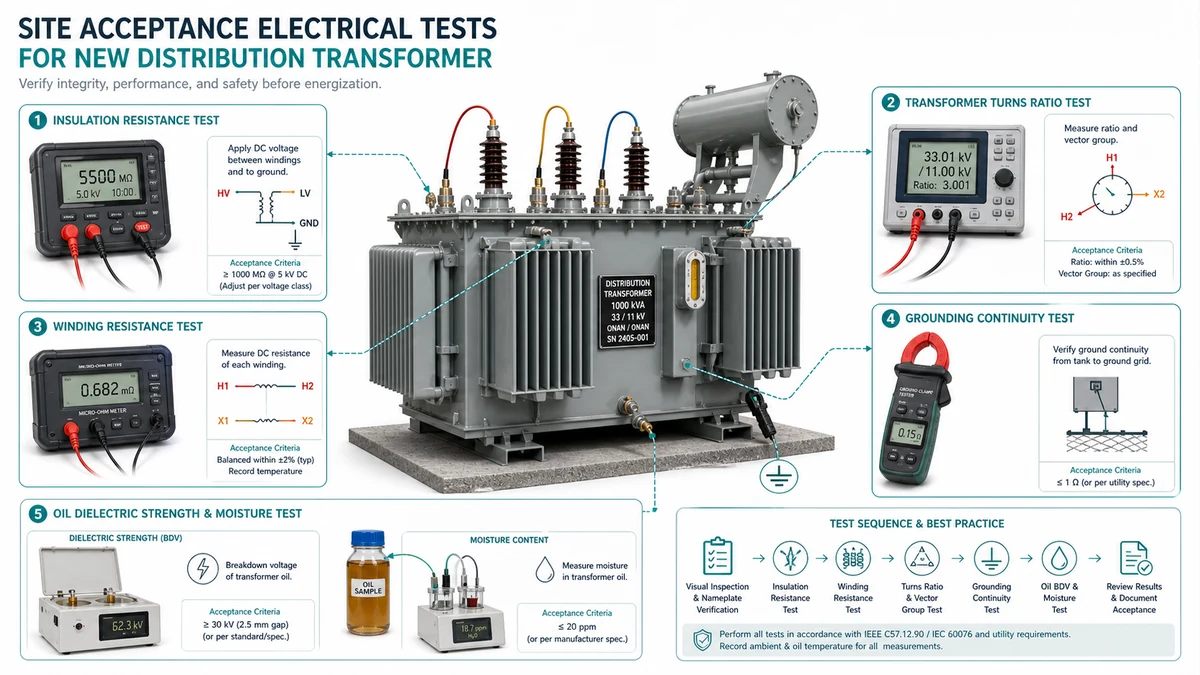
Diese drei elektrischen Prüfungen dienen dazu, den Ausgangszustand des Geräts bei Erhalt festzustellen. Werden sie vor der Inbetriebnahme durchgeführt, lassen sich damit Werksfehler, Transportschäden und das Eindringen von Feuchtigkeit erkennen, die bei einer reinen Sichtprüfung übersehen würden.
Empfohlene Testreihenfolge:
1. Zuerst der Wicklungswiderstand – erzeugt keine Restladung
| Test | Parameter | Minimum Akzeptabel | Warnzone | Ablehnungskriterium | Abhilfemaßnahmen |
|---|---|---|---|---|---|
| IR | IR60 Hochspannung gegen Erde (korrigiert auf 20 °C) | >=1.000 MOhm | 500–999 MOhm | <500 MOhm | Feuchtigkeit untersuchen; Ölprobe entnehmen; bei Bestätigung austrocknen lassen |
| IR | IR60 Niederspannung gegen Erde (korrigiert auf 20 °C) | >=100 MOhm | 50–99 MOhm | <50 MOhm | Buchsenoberflächen, Zustand der Entlüftung und Ölstand prüfen |
| PI | Hochspannungs- oder Niederspannungswicklung | >=2,0 | 1.5-1.99 | <1,5 | Inbetriebnahme verschieben; Prüfung der dielektrischen Eigenschaften des Öls und des Feuchtigkeitsgehalts |
| IR | Wicklungs-Wicklungs-Übergang von Hochspannung zu Niederspannung (korrigiert auf 20 °C) | >=1.000 MOhm | 500–999 MOhm | <500 MOhm | Auf Ölverschmutzung oder eine Verschiebung der Wicklung prüfen |
| TTR | Abweichung vom Nennverhältnis | <=0,51 TP3T am Hauptabzweig | 0.5-1.0% | >1,01 TP3T an jedem Wasserhahn | Position des Wasserhahns überprüfen; bei Bestätigung an den Hersteller zurücksenden |
| TTR | Ausgleich des Phasen-zu-Phasen-Verhältnisses (3-phasige Geräte) | <=0,51 TP3T-Spread | 0.5-0.8% | >0,81 TP3T-Spread | Verdacht auf Kurzschluss in den Wicklungen; DGA-Analyse der Ölprobe durchführen |
| Wicklungswiderstand | Phasenausgleich, Hochspannungswicklung | <=1,01 TP3T-Abweichung zwischen den Phasen | 1.0-2.0% | >2.0% | Anschlüsse prüfen; nachziehen; Kontakte des Stufenschalters überprüfen |
| Wicklungswiderstand | Phasenausgleich, Niederspannungswicklung | <=1,01 TP3T-Abweichung zwischen den Phasen | 1.0-2.0% | >2.0% | Die Anschlüsse der Niederspannungs-Sammelschienen überprüfen; auf gebrochene Litzen prüfen |
| Wicklungswiderstand | im Vergleich zum Werksprüfprotokoll (temperaturkorrigiert) | <=2,01 TP3T-Abweichung | 2.0-5.0% | >5.0% | Kontaktwiderstand oder lose interne Verbindung prüfen |
Bevor mit der Schaltsequenz fortgefahren wird, müssen alle Schutzrelais, Steuerkreise und Hilfssysteme zunächst einzeln und anschließend als integrierter Regelkreis überprüft werden. Das Überspringen dieser Phase ist die häufigste Ursache für eine ausgebliebene oder fehlerhafte Auslösung während der Erstinbetriebnahme.
| Posten prüfen | Verfahren | Akzeptanzkriterium |
|---|---|---|
| Polarität und Übersetzungsverhältnis des Relais-Stromwandlers | Sekundäre oder primäre Einspeisung an der Nennentnahmestelle | CT-Verhältnis innerhalb von ±0,51 TP3T; Polarität an der Relaisklemme bestätigt |
| Phasenüberstromauslösung (51) | Sekundärstromeinspeisung | Arbeitet bei einem festgelegten Aufnahmepunkt von ±5% |
| Erdschlusserkennung (51N/50N) | Injektion über eine neutrale CT | Arbeitet bei eingestellter Verstärkung; kein Betrieb unter 0,9-facher Verstärkung |
| Einschaltstrombegrenzung (Unterdrückung der 2. Harmonischen) | Zweite Oberschwingung von >=15% des Grundstroms anlegen | Relais-Begrenzungen; Schwellenwert entspricht dem Einstellungsblatt |
| Momentanelement (50) | Hochstrominjektion bei 1,05-fach und 0,95-fach des Sollwerts | Oben wirkt es; unten dämpft es |
| Durchgangsprüfung des Auslösekontakts | Multimeter an normalerweise offenen Kontakten | <1 Ohm im geschlossenen Zustand; im stromlosen Zustand im offenen Zustand |
| Posten prüfen | Verfahren | Akzeptanzkriterium |
|---|---|---|
| Gleitcharakteristik | Zweikanal-Einspritzung an Arbeits- und Halte-Spule | Grenzwert innerhalb von ±51 TP3T gemäß Datenblatt der Relaiskurve |
| Einstellung der Vektorgruppenkompensation | Überprüfen Sie, ob die Softwareeinstellungen des Relais mit den Angaben auf dem Typenschild übereinstimmen (Dyn11, Yyn0 usw.). | Einstellungen; bestätigt in der Relaisdatei und auf der abgestempelten Zeichnung |
| Nullsequenz-Sperrung (Hochspannungsseite) | Nullstrom an die Hochspannungsanschlüsse einspeisen | Das Relais funktioniert nicht |
| Kompensation von CT-Fehlanpassungen | Korrekturfaktoren für den Wasserhahn berechnen und eingeben | Differenz-Leckstrom <5% des Nennwerts bei symmetrischer Lastzuführung |
| Stabilität bei Durchgangsfehler | Einspeisung des Nenn-Durchgangsstroms im Bereich der Steigung 1 | Keine Auslösung; Strom liegt unterhalb des Schwellenwerts |
| Posten prüfen | Verfahren | Akzeptanzkriterium |
|---|---|---|
| WTI-Kalibrierung | Strom in die Wärmebildheizung bei Nennstrom und 125%-Nennstrom einspeisen | Messwert innerhalb von ±3 °C des berechneten Hotspots |
| OTI-Kalibrierung | Die Glühbirne in ein Bad mit kontrollierter Temperatur von 75 °C und 100 °C eintauchen | Messwert innerhalb von ±2 °C an jedem Punkt |
| Buchholz-Alarmschwimmer | Über das Prüfventil Luft in das Relaisgehäuse einleiten | Der Alarmkontakt schließt, bevor der Auslöse-Schwimmer anspricht |
| Buchholz-Ausflug-Festwagen | Schnelle Ölzufuhr mittels Handpumpe oder Kippversuch | Der Auslöser schließt; keine mechanische Blockierung |
| Gleichstrom-Hilfsversorgung | Spannungsmesser an den Relaisklemmen | innerhalb von -10% / +5% der Nenn-Hilfsspannung |
| Durchgangsprüfung der Auslösespule | Messung des Widerstands der Messspule im Vergleich zu den Herstellerangaben | Innerhalb von ±151 TP3T des auf dem Typenschild angegebenen Spulenwiderstands |
| SCADA/RTU-Signalzuordnung | Jeden fest verdrahteten Status und jeden analogen Messpunkt anhand der Messpunktliste überprüfen | Alle Punkte stimmen überein; keine vertauschten oder umgekehrten Signale |
Situation: Während eines SAT-Einschaltvorgangs an einem Verteilungstransformator in einem 33/11-kV-Umspannwerk ergab eine Sekundär-Einspeisungsprüfung, dass die Schwelle für die Einschaltstromunterdrückung auf die zweite Harmonische von 20% eingestellt war. Allerdings wies diese Firmware-Charge eine dokumentierte Abweichung auf: Die Oberschwingungsblockierung griff erst ab 22% ein, und das Einsatzteam hatte das Einstellungsblatt der vorherigen Firmware verwendet.
Messdaten: Das Einspeisen eines Grundstroms mit einem Anteil der zweiten Harmonischen von 18% – wie er typischerweise bei der Einspeisung eines leicht belasteten Verteilungstransformators auftritt – führte eher zu einer Relaisauslösung als zu einer Dämpfung.
Sobald jedes SAT-Testergebnis in eine dokumentierte Entscheidung über „bestanden“ oder „nicht bestanden“ umgewandelt wurde, kann das Team mit der Umschaltsequenz fortfahren. Eine einzige ungelöste Abweichung – sei es ein Wicklungswiderstand über der Toleranzgrenze, ein IR unter dem Mindestwert oder ein fehlerhafter Messwert des Windungsverhältnisses – reicht als Grund aus, die Einschaltung zu unterbrechen.
Prüfung des physischen Zustands und der Installation
– [ ] Die Angaben auf dem Typenschild des Transformators stimmen mit den Konstruktionszeichnungen der Zuleitung überein (kVA, Spannung, Vektorgruppe, Impedanz)
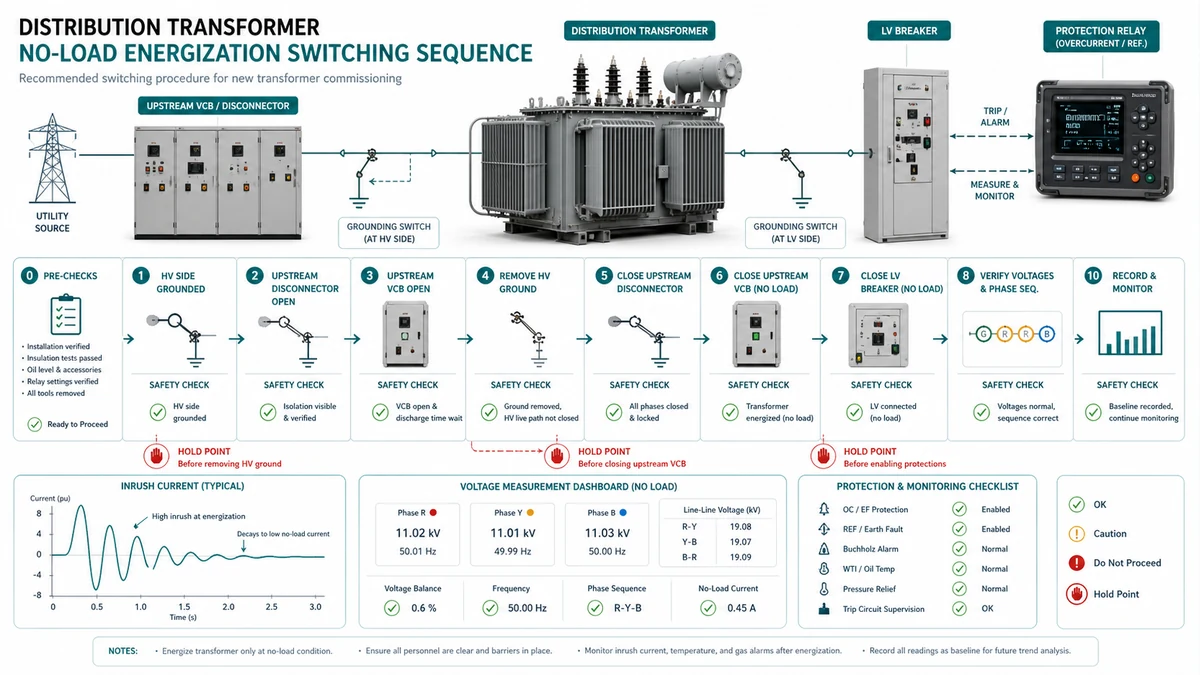
Sobald der Transformator während der Leerlauf-Beobachtungsphase die Spannung ohne Auslösung oder Alarm aufrechterhalten hat, geht die Abnahmephase in die Überprüfung der Lastleistung über.
| Parameter | Messverfahren | Bestehenskriterium | Prüfen, ob |
|---|---|---|---|
| Ausgangsspannung (pro Phase) | True-RMS-Spannungsmesser an den Sekundäranschlüssen | Innerhalb von ±2,51 TP3T des tap-angepassten Nennwerts | Jede Phase weicht um >2,51 TP3T ab |
| Spannungsausgleich (dreiphasig) | Unterschiede bei % über die verschiedenen Phasen hinweg | <=1,01 TP3T Phase-zu-Phase | Ungleichgewicht >1,5% |
| Laststrom (pro Phase) | Stromzange an der Sekundärzuleitung | <=Nenn-Sekundärstrom für die angeschlossene Last | Jede Phase >105% der erwarteten Entnahme |
| Stromunsymmetrie | Berechnet anhand der Messwerte aus drei Phasen | <=10% gemäß NEMA MG-1-Richtlinie | Unwucht >10% |
| Neutralstrom (Sternschaltung im Sekundärkreis) | Strommesszange am Neutralleiter | <=10% des Nennstroms bei Volllast unter symmetrischer Last | Nullstrom >20% des FLA |
| Leistungsfaktor | Leistungsanalysator auf der Primär- oder Sekundärseite | Innerhalb von 0,05 des Auslegungs-PF bei Prüflast | PF weicht um >0,05 vom Ausgangswert ab |
| THD (Spannung) | Messgerät für die Netzqualität | <=5% Gesamtklirrfaktor | THD >8% |
| Messpunkt | Werkzeug | Bestehenskriterium | Flaggenstatus |
|---|---|---|---|
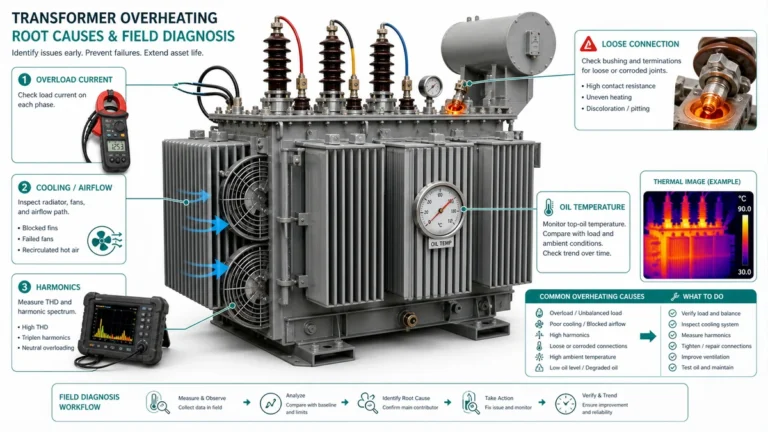
| Temperatur des Oberöls | Zeigerthermometer oder RTD | <=Nennwert auf dem Typenschild: maximaler Ölstandanstieg über Umgebungstemperatur | >10 °C über dem erwarteten Anstieg bei Testlast |
| Tankoberfläche | Wärmebildkamera | Gleichmäßiger Farbverlauf von unten nach oben | Jeder lokale Hotspot, der mehr als 15 °C über der angrenzenden Tankoberfläche liegt |
| Primäranschlussklemmen | Wärmebildkamera | <=10 °C über der Leitertemperatur bei gleichem Strom | Jede Anschlussklemme, deren Temperatur bei gleicher Belastung mehr als 20 °C über der des Leiters liegt |
| Sekundäre Buchsenverbindungen | Wärmebildkamera | <=10 °C über der Leitertemperatur | Jede Buchse, deren Temperatur mehr als 20 °C über der des Leiters liegt |
| Kühlrippen oder Kühler | Wärmebildkamera | Gleichmäßige Lamellentemperatur innerhalb von ±5 °C von Reihe zu Reihe | Kaltflossen in einer Reihe (blockierte oder gestörte Kühlung) |
| Intervall | Aktion | Zweck |
|---|---|---|
| 24 Stunden nach der Einschaltung | Öltemperatur, Umgebungstemperatur, Laststrom aufzeichnen | Erstellung einer ersten thermischen Basislinie |
| 72 Stunden | Alle externen Anschlüsse auf thermische Verfärbungen überprüfen; bei Auffälligkeiten das Anzugsmoment nachziehen | Durch Temperaturwechsel können sich die Druckbefestigungen lösen |
| 7 Tage | Infrarot-Scan bei maximaler Tageslast | Erfasst thermische Anomalien, die bei Teillast während des SAT nicht sichtbar sind |
| 30 Tage | Ölprobenahme für die DGA bei Anlagen mit einer Leistung von mehr als 500 kVA | Erkennt interne Fehler im Frühstadium, die sich unter Last entwickeln |
| 30 Tage | Protokoll der Auslöseereignisse des Schutzrelais überprüfen | Bestätigt, dass keine nicht gemeldeten Betriebsvorfälle oder Beinahevorfälle vorliegen |
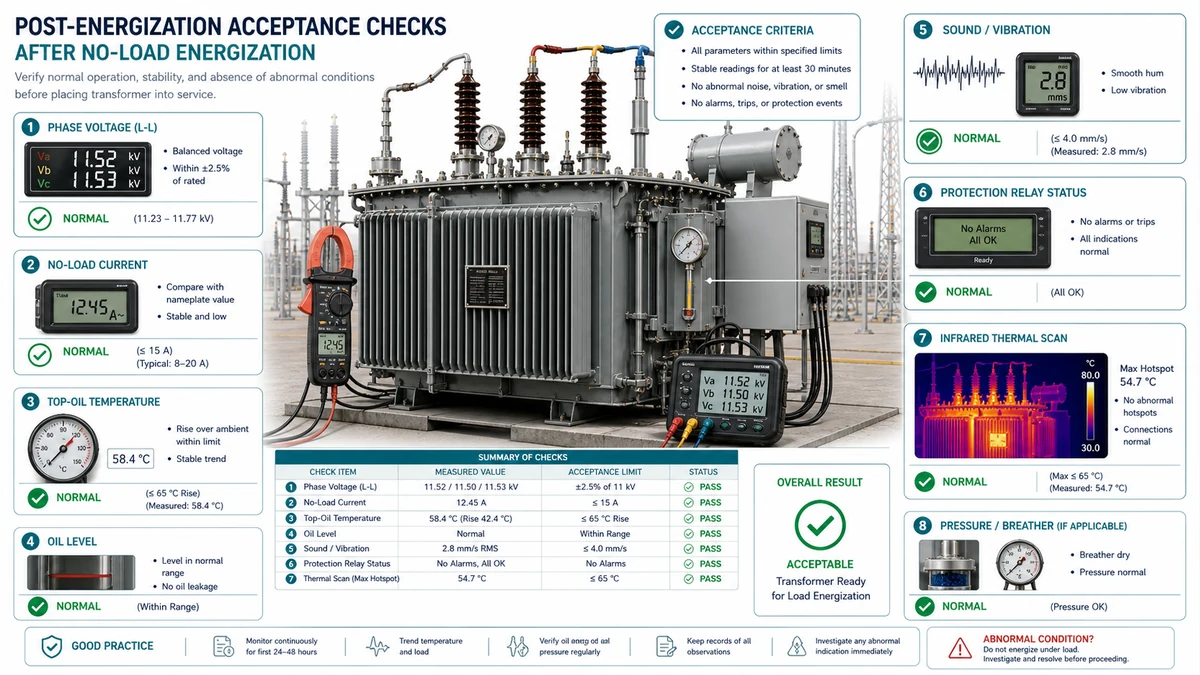
Die vor dem Versand eines Transformators getroffenen Beschaffungsentscheidungen bestimmen unmittelbar, wie reibungslos die SAT vor Ort ablaufen wird. Wenn man erst nach Ankunft der Ausrüstung vor Ort damit beginnt, die Prüfanforderungen, die Erwartungen an die Dokumentation oder die Zuständigkeiten für die Inbetriebnahme festzulegen, führt dies zu Verzögerungen, Kostenstritten und Lücken in den Basisdaten, die sich niemals vollständig beheben lassen.
Die der Angebotsanfrage beigefügte technische Spezifikation ist die einzige vertraglich bindende Grundlage für die Festlegung des SAT-Umfangs. Die Mindestangaben sollten folgende Punkte umfassen:
| Zustand des Feldes | Spezifikationsparameter nach Status | Auswirkungen auf das SAT-Protokoll |
|---|---|---|
| Höhe über 1.000 m | Geländehöhe in Metern | Erforderliche Korrekturen des dielektrischen Abstands und der dielektrischen Festigkeit von Öl |
| Extreme Umgebungstemperaturen | Tägliche Tiefst- und Höchsttemperaturen | Änderung der Korrekturfaktoren für den Wicklungswiderstands-Referenzwert |
| Hohe Luftfeuchtigkeit oder Lage an der Küste | Bereich der relativen Luftfeuchtigkeit; Salznebel-Klassifizierung | Es sind strengere IR-Zulassungsschwellen erforderlich |
| Starke industrielle Umweltverschmutzung | IEC-Schutzklasse oder gleichwertig | Prüfungen auf Leckstrom bei Durchführungen gewinnen zunehmend an Bedeutung |
| Häufiger Schaltbetrieb | Geschätzte tägliche Schaltzyklen | Die Koordination der Überspannungsableiter muss während der SAT überprüft werden |
Verwenden Sie diese XBRELE-Referenzen, um die Feldentscheidung mit dem richtigen Produkt-, Test- und Beschaffungsablauf zu verbinden: XBRELE Produktseite, XBRELE Vakuum-Leistungsschalter-Programm, VCB-Rating-Leitfaden, VCB FAT/SAT Annahme-Checkliste, XBRELE Stromverteilertransformatorreihe.
Beispiel aus der Praxis: Bei einer Wartungsinspektion wurde bei einer Phase eine Abweichung von der Inbetriebnahme-Basislinie gemessen, während die beiden anderen Phasen stabil blieben. Das Team wiederholte die Messung mit verifizierten Leitungen, überprüfte das Timing und den Kontaktweg und nutzte die gemessene Abweichung, um ein Kontaktdruckproblem von einem allgemeinen Oberflächenreinigungsproblem zu unterscheiden.
Der branchenübliche Grenzwert liegt bei >=1.000 MOhm für die Hochspannungswicklung gegen Erde (korrigiert auf 20 °C) und bei >=100 MOhm für die Niederspannungswicklung gegen Erde. Der Polarisationsindex ist jedoch oft ein zuverlässigerer Zustandsindikator als der absolute IR-Wert.
Der Einschaltstrom erreicht bei den meisten Verteilungstransformatoren typischerweise Spitzenwerte im Bereich des 6- bis 12-fachen Nennstroms und klingt innerhalb von 0,1 bis 1,0 Sekunden ab. Ein Einschaltstrom, der nicht innerhalb von 2 Sekunden abklingt, ist ein Anomalie und erfordert eine Abschaltung, einen Vergleich der Erregungsstrommessung mit dem werkseitigen Referenzwert sowie eine DGA-Prüfung, bevor ein zweiter Einschaltversuch unternommen wird.
Technisch gesehen ja, aber dadurch gehen alle Referenzwerte für die elektrischen Prüfungen vor der Inbetriebnahme verloren. Ohne die werkseitigen Werte für Wicklungswiderstand und Windungsverhältnis lassen sich Abweichungen im Betrieb nicht als bereits vorhanden oder durch die Installation verursacht einstufen.
Die häufigsten Ursachen sind eine Umkehrung der CT-Polarität, eine falsche Einstellung der Vektorgruppenkompensation im Relais, ein im Verhältnis zum tatsächlichen Firmware-Verhalten zu hoch eingestellter Einschaltstrom-Blockierungsschwellenwert oder ein nicht blockierter Nullstromstrom an der Hochspannungs-Dreieckwicklung. Ein vor der Einschaltung durchgeführter Sekundäreinspeisungstest deckt all diese Fehler bereits vor dem ersten Schaltvorgang auf.
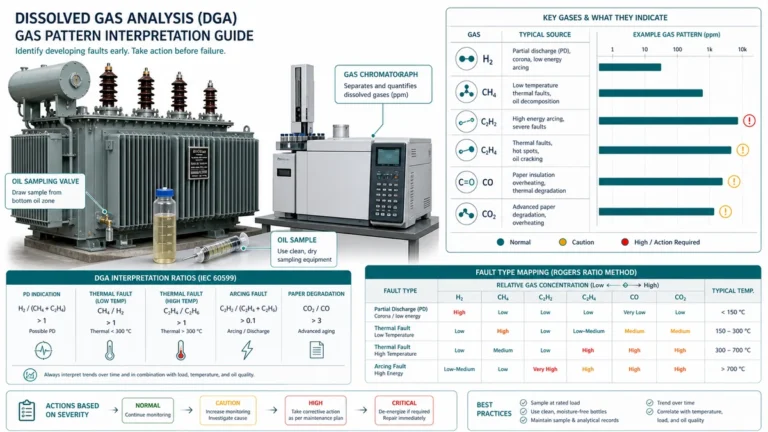
Bei Anlagen mit einer Leistung von über 500 kVA oder in Spannungsklassen über 15 kV liefert eine DGA-Messung vor der Einschaltung einen Referenzwert, der die Erkennung von sich unter Last entwickelnden Anfangsfehlern ermöglicht. Dies ist zwar nicht allgemein normativ vorgeschrieben, doch ohne diese Untersuchung lässt sich ein nach der Einschaltung auftretender Gasalarm nicht zuverlässig interpretieren – es gibt keine Möglichkeit zu bestätigen, ob das Gas bereits vor der Einschaltung vorhanden war oder durch den Einschaltvorgang selbst erzeugt wurde.