¿Necesita las especificaciones completas?
Descargue nuestro Catálogo de productos 2025 para obtener planos detallados y parámetros técnicos de todos los componentes de los equipos de conmutación.
Obtener catálogo
Descargue nuestro Catálogo de productos 2025 para obtener planos detallados y parámetros técnicos de todos los componentes de los equipos de conmutación.
Obtener catálogo Descargue nuestro Catálogo de productos 2025 para obtener planos detallados y parámetros técnicos de todos los componentes de los equipos de conmutación.
Obtener catálogo
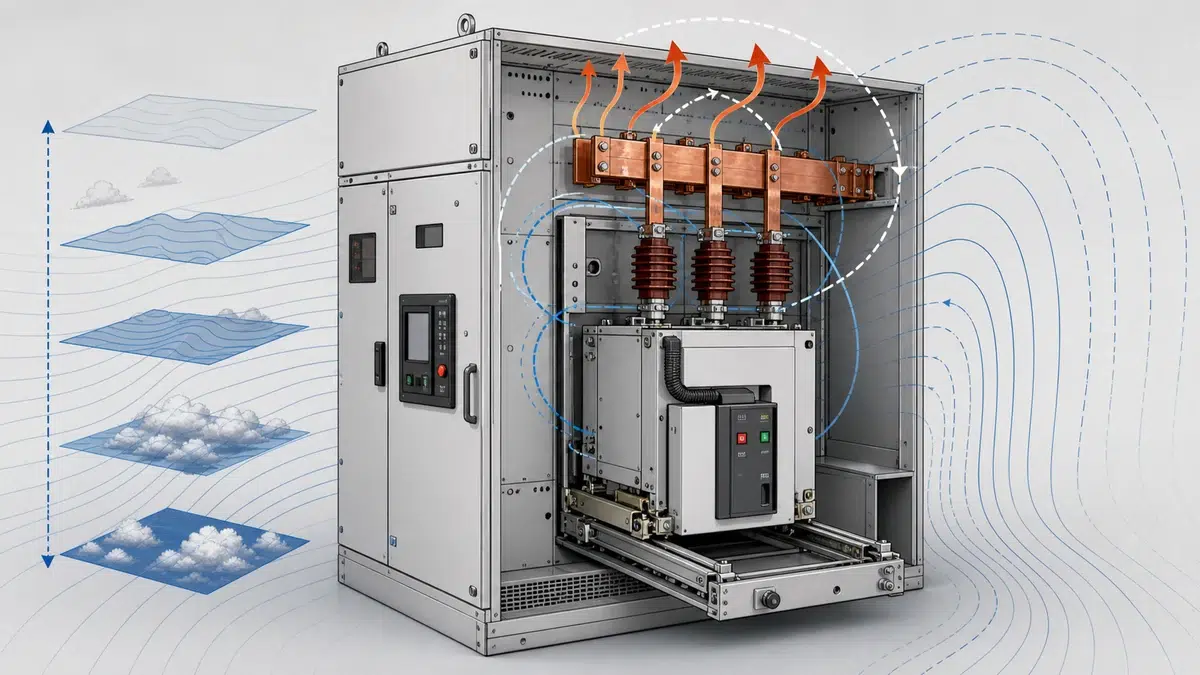
High-altitude installations introduce a set of engineering challenges that are easy to underestimate during the early design phase of a medium-voltage switchgear project. When a 12 kV indoor vacuum circuit breaker (VCB) is specified for a site located above 2,000 metres above sea level (MASL), the thinner air fundamentally changes two physical phenomena that the breaker depends on: dielectric withstand strength and convective heat dissipation. Neither effect is trivial, and ignoring the combined impact of both during equipment selection can result in insulation failures, nuisance tripping, or premature ageing of the interruption chamber. This article explains the physics behind vcb altitude derating 2000m requirements, the applicable international standards, the correction methodology engineers should apply, and the practical decisions that arise at procurement and commissioning stages.
—
At sea level, dry air at standard conditions (20 °C, 101.3 kPa) has sufficient molecular density to support the dielectric withstand voltages and current-interruption ratings that IEC standards define at reference altitude. As altitude increases, ambient pressure falls roughly in accordance with the International Standard Atmosphere model. At 2,000 MASL, atmospheric pressure is approximately 79.5 kPa—about 78% of sea-level pressure. By 3,000 MASL the value drops further to roughly 70 kPa.
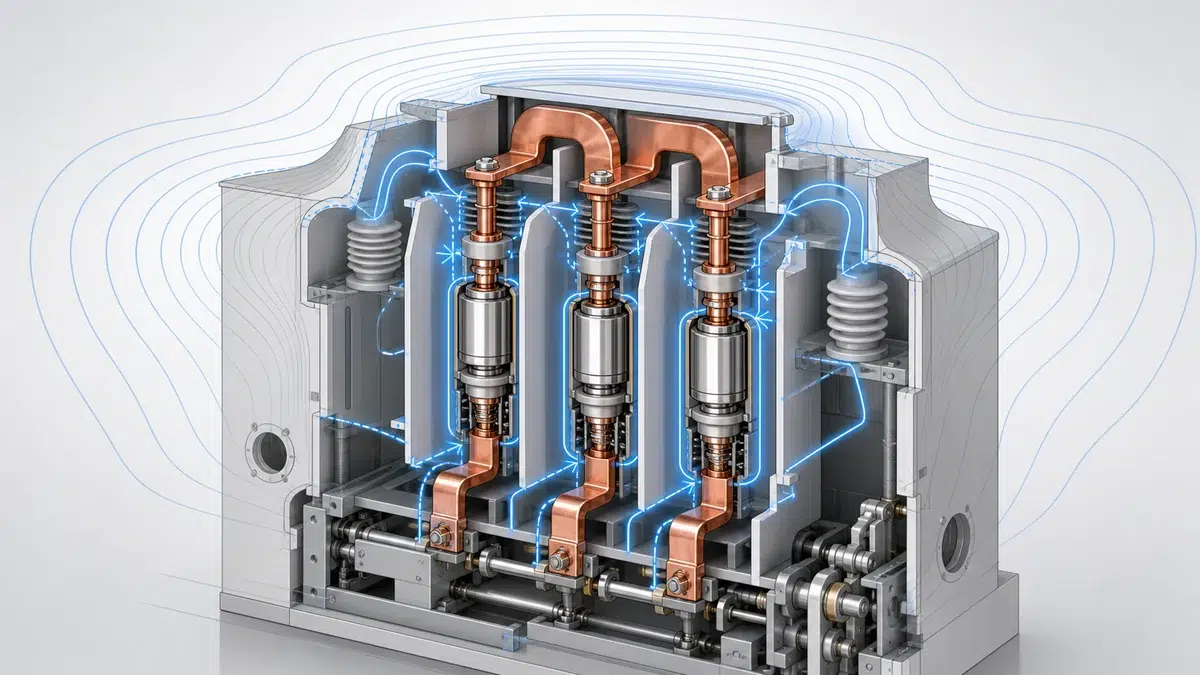
This pressure reduction matters in two separate but simultaneous ways. First, the dielectric breakdown voltage of air-gap insulation paths decreases because the mean free path of electrons lengthens, Paschen's Law predicts lower breakdown voltages, and partial discharge inception voltage falls proportionally. Phase-to-earth clearances and phase-to-phase clearances that are adequate at sea level may be marginal above 2,000 MASL if no correction is applied. Second, the cooling capacity of air depends on its density: forced-air and natural-convection cooling both transfer heat proportionally to the mass flow of air past the conductor surface. A thinner atmosphere removes less heat per unit time, raising junction and connection temperatures under identical load current.
For a 12 kV indoor VCB the vacuum interrupter itself is hermetically sealed and its internal dielectric environment is independent of altitude. However, the bus-bar connections, the insulating spacers, the operating mechanism compartment, and the external terminals of the VCB all exist in the ambient atmosphere and are therefore fully subject to altitude-related derating.
—
The governing document for medium-voltage switchgear and controlgear is IEC 62271-1, which establishes common specifications for AC switchgear and controlgear rated above 1 kV. Crucially, IEC 62271-1 adopts the altitude correction specifications contained in IEC 60071-2 (insulation co-ordination—application guide) for installations above 1,000 MASL. This means that the altitude correction framework is not a manufacturer-specific preference but rather a normative requirement embedded in the product standard itself.
IEC 60071-2 defines an altitude correction factor Ka that modifies the required withstand voltage for external insulation. The factor accounts for the reduced air density by increasing the required test voltage (or equivalently, by derating the equipment's rated withstand capability) relative to sea-level performance. The formula is structured around an exponential relationship between altitude and the correction multiplier, with the exponent depending on the discharge class (whether the gap involves a streamer, a rod-plane configuration, or a more complex electrode geometry).
For practical 12 kV switchgear engineering the takeaway from IEC 62271-1 in combination with IEC 60071-2 is straightforward: equipment tested and rated at sea level carries a de facto altitude limitation, and any deployment above the standard reference altitude requires the engineer to verify that the rated lightning impulse withstand voltage (LIWV) and the rated power-frequency withstand voltage (PFWV) remain adequate after the altitude penalty is applied. The standard reference altitude for most IEC 62271-series equipment ratings is 1,000 MASL, which means the derating problem technically begins above 1,000 m but becomes practically significant—and contractually mandatory to document—above 2,000 MASL. For witness planning and records, align the evidence with the breaker FAT/SAT verification guide.
—
**Dielectric correction**
The altitude correction factor for external insulation per IEC 60071-2 can be expressed as:
Ka = e^(m × H / 8150)
where H is the altitude in metres and m is an exponent that depends on the type of overvoltage (m = 1.0 for switching impulses, m varies for lightning impulses based on gap geometry). For a site at 3,000 MASL with m = 1.0, Ka ≈ 1.44. This means the required withstand voltage is 44% higher than the sea-level value, or equivalently, the sea-level-rated equipment has only about 69% of its rated withstand capability remaining in effective terms at that altitude.
For a 12 kV VCB with a rated LIWV of 75 kV (peak) at standard conditions, the engineer must confirm that the corrected required withstand level at site altitude does not exceed 75 kV. If it does, a higher-rated equipment class must be selected—often stepping up to the 17.5 kV or 24 kV equipment class to achieve adequate margin at altitude, even though the system operating voltage remains 12 kV.
**Thermal correction**
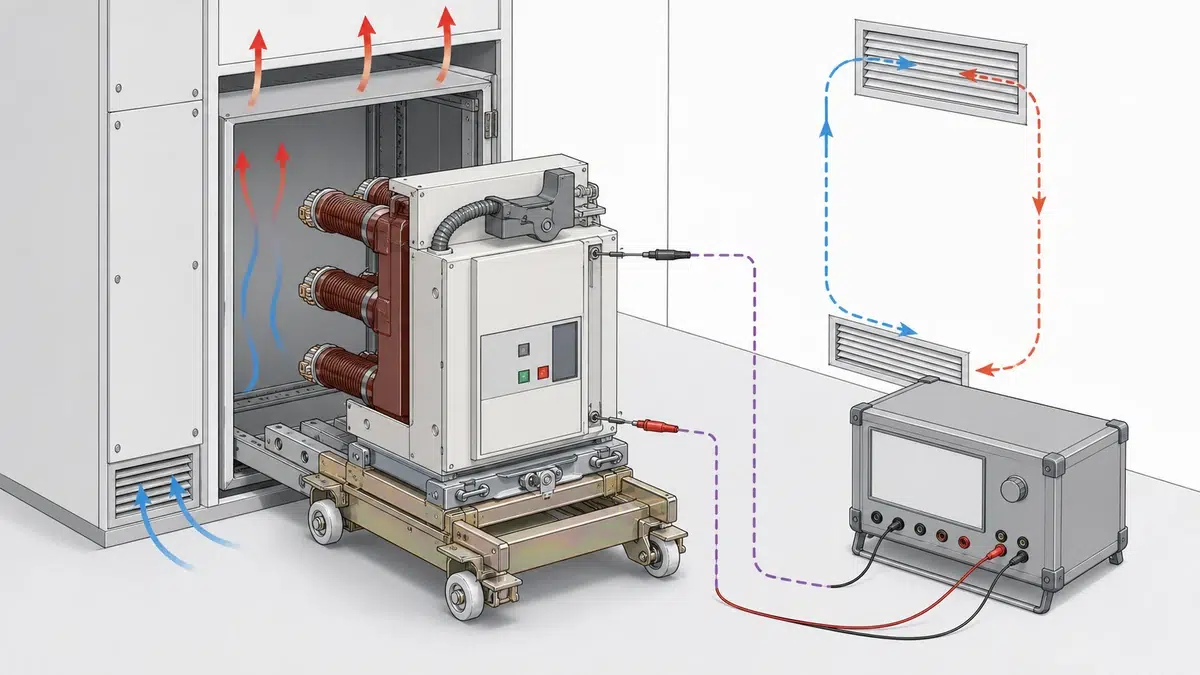
Thermal derating above 2,000 MASL results from the reduced density of ambient air reducing convective heat transfer. The continuous current rating of the VCB and its associated bus bars must be derated. While the exact correction depends on the specific thermal design of the product, a general engineering rule applied by many manufacturers is that the continuous current rating decreases by approximately 0.3% to 0.5% per 100 m above 2,000 MASL. At 4,000 MASL this can represent a derating of 6–10% on continuous current—enough to matter significantly in an industrial application running near nameplate rating. The guía de valores nominales de disyuntores de vacío helps translate the system duty into the breaker data that must be confirmed.
As Schneider Electric's technical guidance confirms, above 2,000 m the reduced dielectric strength and cooling capacity of air must both be considered, and the applicable correction depends on the specific product documentation rather than a single universal rule. This underscores a critical procurement principle: different product ranges within the same manufacturer's portfolio may carry different derating tables, and project engineers must use the published ratings for the specific intended equipment rather than applying a single generic factor across all products.
—
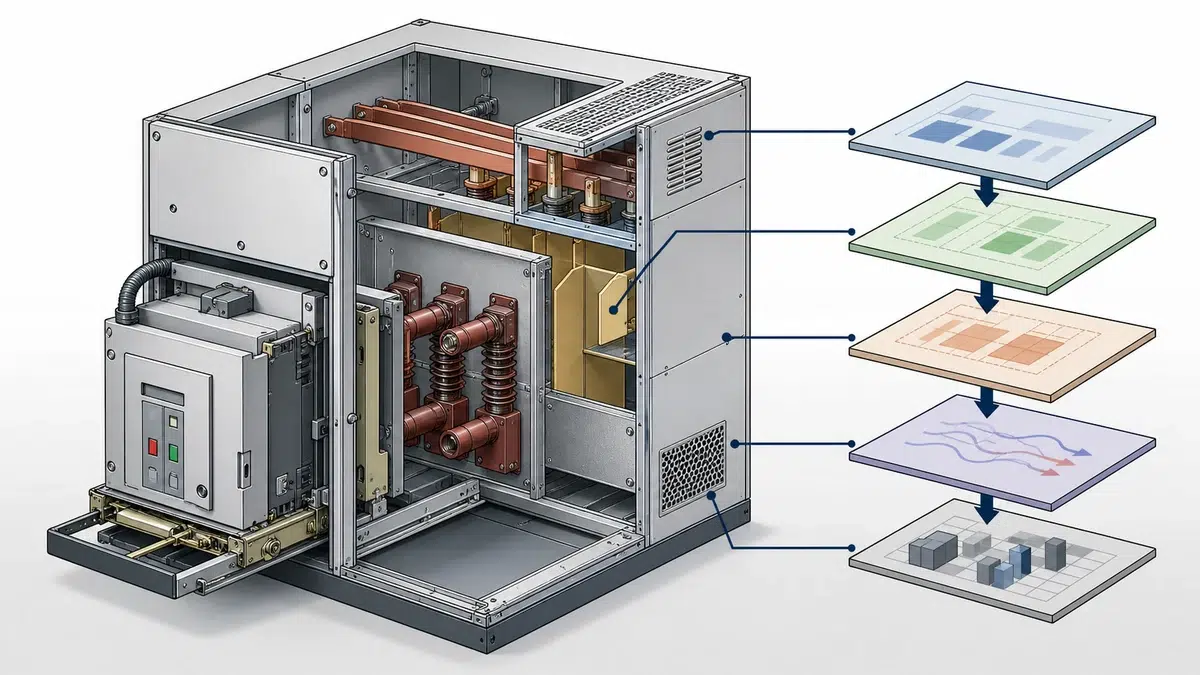
The IEC 62271-1 framework sets the minimum normative requirements, but it deliberately leaves room for manufacturers to publish product-specific derating tables that reflect the actual thermal and dielectric design of each switchgear range. This is not a gap in the standard; it is an intentional recognition that a dry-type air-insulated switchgear panel, a gas-insulated compact switchgear unit, and a vacuum circuit breaker in a metal-clad enclosure each have different electrode geometries, different insulation systems, and different cooling paths that respond differently to altitude.
For the procurement engineer specifying a 12 kV indoor VCB for a high-altitude site, the following steps represent best practice aligned with both IEC 62271-1 and manufacturer guidance:
1. **Define the site altitude precisely.** Use topographic survey data or GPS-corrected elevation rather than approximate regional figures. A difference of 300 m can change the correction factor meaningfully.
2. **Obtain the product-specific altitude derating table from the manufacturer's published documentation.** Do not rely on a generic factor from a different product range even from the same manufacturer. Schneider's product guidance for the PowerPact B-Frame breaker, for example, demonstrates that altitude derating values vary by product range, reinforcing that only the intended equipment's published ratings are applicable.
3. **Apply both dielectric and thermal corrections simultaneously.** The more conservative of the two requirements governs equipment class selection; in most 12 kV applications above 3,000 MASL, the dielectric correction drives the decision.
4. **Document the corrected ratings in the project specification and equipment data sheet.** This protects all parties during factory acceptance testing (FAT) and site acceptance testing (SAT), and it establishes the basis for any future maintenance or replacement decisions.
5. **Consider requesting special high-altitude type testing or extended-altitude certification from the manufacturer** when the site altitude exceeds 4,000 MASL, where standard correction extrapolation may no longer be conservative.
—
Beyond equipment selection, the physical installation and commissioning of a 12 kV indoor VCB at altitude introduces additional practical requirements that the project team must plan for. Review the Gama de disyuntores de vacío XBRELE as a practical starting point for matching the required breaker format to the application.
**Creepage distance review.** External insulation surfaces—bushings, insulators, and insulated operating rods—must be checked against the increased required creepage distance. IEC 60815 classifies pollution severity, and at high altitude the reduced air density amplifies the risk of surface tracking, particularly where industrial or desert pollution is also present. Specify extended creepage distance or hydrophobic silicone rubber insulation for particularly challenging sites.
**Vacuum integrity and SF₆-free design advantages.** One underappreciated benefit of VCB technology in high-altitude applications is that the interruption medium—vacuum—is entirely independent of ambient atmospheric conditions. The contact gap operates in a near-perfect vacuum inside the interrupter bottle, so the arc-quenching capability is not diminished by altitude. This stands in contrast to air-blast or minimum-oil circuit breakers, which are far more severely affected. The altitude penalty for VCBs is therefore confined to external insulation and thermal management rather than interruption performance—a significant engineering advantage.
**Operating mechanism performance.** The stored-energy spring mechanism of a VCB depends on mechanical springs rather than pneumatic or hydraulic pressure, which means it is inherently altitude-independent in its energy source. However, motor-charged mechanisms draw their motor performance from ambient air cooling; the motor winding insulation should be reviewed for temperature rise at altitude if the site also has a high ambient temperature. Many high-altitude sites in equatorial or semi-arid regions combine elevation with high ambient temperature, creating a compound derating condition that must be evaluated holistically. Use the VCB close/trip fault checklist to separate control-circuit, coil, interlock, and mechanism causes after a failed operation.
**Maintenance planning.** At altitude, any maintenance task that involves electrical testing—particularly high-potential (hi-pot) testing of insulation—must use altitude-corrected test voltages. Applying sea-level AC withstand test voltages to equipment at high altitude stresses the insulation beyond its design limit and may cause damage that is not immediately visible but accelerates ageing. Maintenance procedures must therefore specify corrected test voltages as a project deliverable, not as an afterthought.
—
VCB altitude derating above 2,000 MASL refers to the mandatory reduction in dielectric withstand ratings and continuous current ratings that must be applied to medium-voltage vacuum circuit breakers deployed at high elevations. It matters because IEC 62271-1, in conjunction with IEC 60071-2, requires that external insulation performance be corrected for reduced air density above the standard reference altitude, and because reduced air density also limits convective cooling, which constrains the safe continuous current the equipment can carry. Failing to apply these corrections risks insulation flashover, accelerated thermal ageing, or both.
IEC 62271-1 is the primary IEC standard governing common specifications for AC switchgear and controlgear rated above 1 kV. It explicitly adopts the altitude correction specifications from IEC 60071-2 for installations above 1,000 MASL. This means altitude correction is not a voluntary manufacturer practice but a normative requirement of the product standard itself. For 12 kV VCB procurement, compliance with IEC 62271-1 requires the engineer to apply, document, and verify the altitude-corrected withstand ratings appropriate to the installation site.
Dielectric derating addresses the reduction in the breakdown voltage of external insulation gaps caused by lower air density at altitude: fewer air molecules per unit volume mean electrons travel further between collisions, lowering the voltage at which breakdown occurs across air-path insulation. Thermal derating addresses the reduced ability of ambient air to carry heat away from current-carrying conductors and components: the same reduction in air density that lowers breakdown voltage also reduces the mass flow of air in natural and forced convection, increasing equilibrium temperatures under load. Both effects occur simultaneously at high altitude and must be evaluated independently, with the more restrictive result governing equipment selection.
The correct method is to begin with precise site altitude data, then obtain the product-specific altitude derating table published by the intended manufacturer for the exact VCB model under consideration. Generic correction factors from other product ranges or other manufacturers should not be substituted. The dielectric correction per IEC 60071-2 is applied to determine whether the standard 12 kV equipment LIWV and PFWV remain adequate at site conditions, or whether a higher insulation-class equipment (such as a 17.5 kV or 24 kV rated VCB) must be selected for a 12 kV system. The thermal correction is applied separately to confirm continuous current adequacy. Both corrected ratings are documented in the project equipment data sheet.
The vacuum interrupter itself is hermetically sealed and operates in an internal vacuum that is maintained independently of ambient atmospheric pressure. Therefore, the arc-quenching and current-interruption capability of the VCB is not degraded by altitude. This is a key advantage of VCB technology over air-blast or oil circuit breakers, whose interruption performance is directly tied to the properties of the ambient atmosphere. The altitude-related derating for VCBs is therefore entirely concentrated in the external insulation system (bushings, spacers, terminals, and clearances) and in the thermal management of current-carrying parts—not in the interruption mechanism itself.