Need Full Specifications?
Download our 2025 Product Catalog for detailed drawings and technical parameters of all switchgear components.
Get Catalog
Download our 2025 Product Catalog for detailed drawings and technical parameters of all switchgear components.
Get Catalog Download our 2025 Product Catalog for detailed drawings and technical parameters of all switchgear components.
Get Catalog
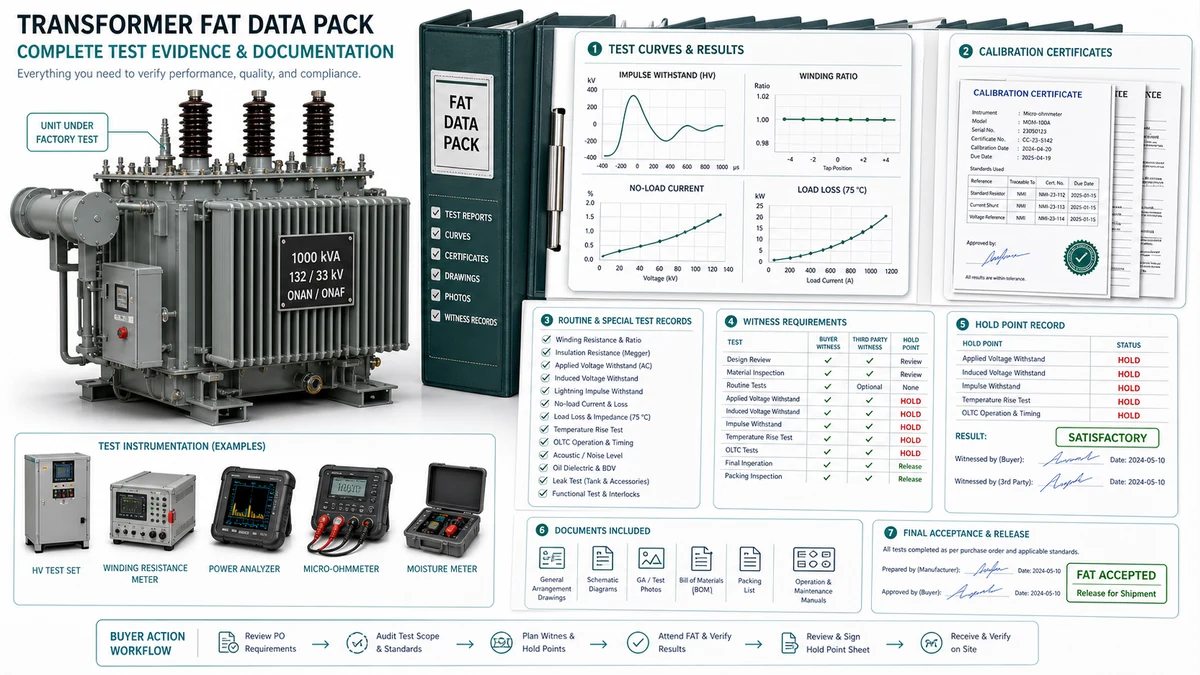
A transformer FAT data pack is the complete set of test records, measurement curves, calibration certificates, and witnessed sign-off documents that a manufacturer compiles during the factory acceptance test (FAT) of a power transformer before shipment. It serves as the primary technical evidence that the unit as built meets the contractual specification, the applicable standard (typically IEC 60076 or IEEE C57 series), and any project-specific deviations agreed in advance.
Snippet answer: A transformer FAT data pack is a bound or digital dossier containing routine and type-test results, measured performance curves, material and component certificates, and witness signatures confirming that the transformer passed all contractual acceptance criteria before leaving the factory.
Use this troubleshooting chart before signing any witness release. It converts document gaps into a first test, likely cause, and next action so the buyer can issue a corrective action request while the transformer is still at the factory.
| Symptom | First test | Likely root cause / likely cause | Next action |
|---|---|---|---|
| Data pack has pass/fail pages but no measured curves | Compare the index against the routine test record list | Factory exported summary pages instead of raw measurement data | Request original curve files, signed PDF exports, and instrument serial numbers before release |
| Calibration certificates expired before FAT date | Check every instrument ID against the certificate validity period | Test equipment was not under an accredited ISO/IEC 17025 calibration cycle | Put shipment on hold and require retest or written engineering justification |
| Serial numbers differ between certificates and nameplate | Trace serial number, drawing number, and transformer rating on each page | Sister-unit paperwork or uncontrolled document reuse | Reject the affected document and require corrected unit-specific records |
| PD, SFRA, or temperature-rise records are missing | Review the project specification and agreed FAT procedure | Contract scope was reduced during execution or the test was not performed | Escalate as a contractual non-conformance and define retest or deviation approval |
| Witness sign-off sheet is unsigned or backdated | Compare attendance record, raw test timestamps, and signatory list | Desk review was presented as witnessed testing | Require a revised witness record and buyer-approved corrective action note |
| Oil/DGA baseline is absent before shipment | Check oil certificate, heat-run sample timing, and DGA report date | Fill oil was accepted without a commissioning baseline | Request DGA baseline and retain it with the maintenance record package |
A compliant transformer FAT data pack must contain documents from five distinct categories. Absence of any category is a non-conformance against IEC 60076-1 Clause 10 or the equivalent IEEE C57.12.00 acceptance requirements.
1. Routine test results with measured curves
2. Type test certificates or design-proven equivalents
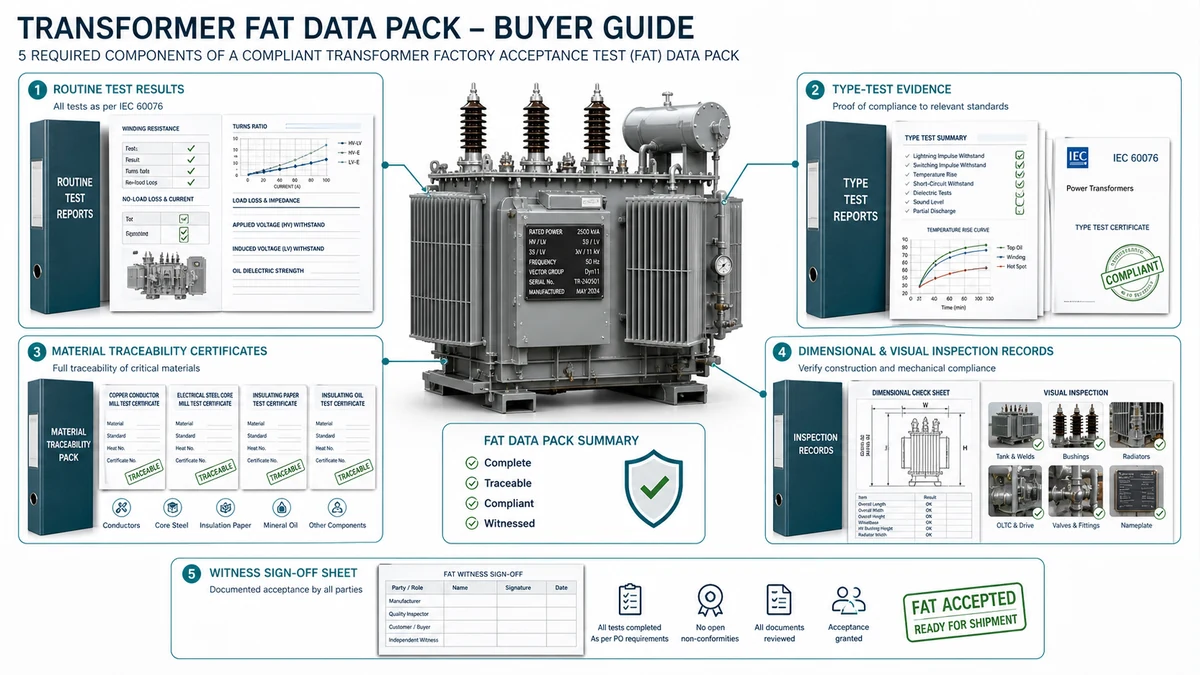
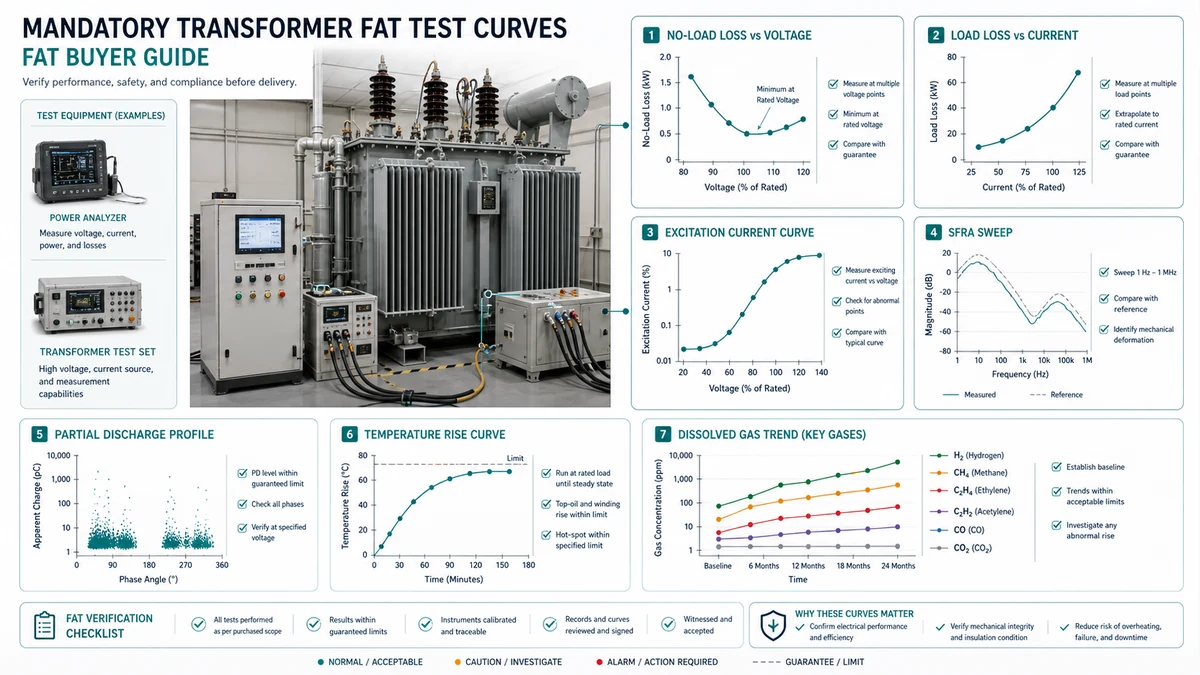
Raw pass/fail stamps confirm the unit met a threshold on a single day; calibrated curves let you detect drift, compare units across a fleet, and establish a baseline for condition monitoring.
| Curve | Test Standard | Minimum Data Points | Pass/Fail Criterion | Risk if Missing |
|---|---|---|---|---|
| No-load loss vs. voltage | IEC 60076-1 / IEEE C57.12.00 | 7 voltage steps, 90%–112% rated | Within ±10% of guaranteed value | Cannot detect overexcitation risk or core defects |
| Load loss vs. current | IEC 60076-1 / IEEE C57.12.00 | 5 current steps, 25%–100% rated | Within agreed tolerance, no anomalous non-linearity | Stray loss hot spots hidden; harmonic derating impossible |
| Impedance vs. frequency | IEC 60076-1 | Full curve at rated frequency; tap-by-tap if OLTC fitted | Within ±7.5% of declared value (±10% for multi-winding) | No baseline for detecting winding deformation after transport |
| Excitation current vs. voltage | IEC 60076-1 | Same steps as no-load loss curve | Smooth, monotonically increasing; no inflection below 100% V | Partial core faults masked |
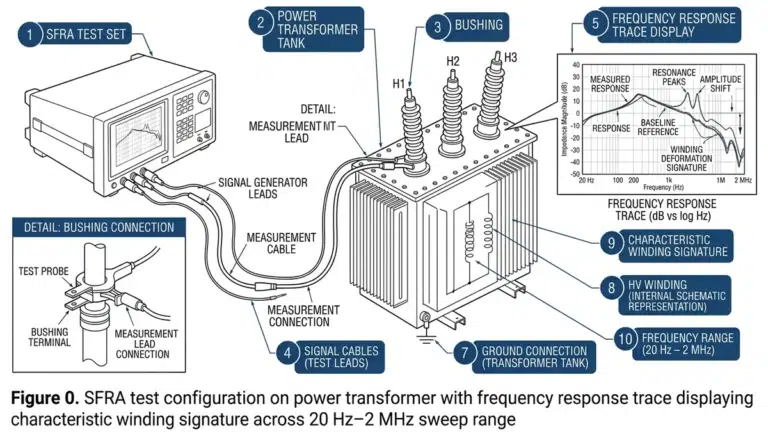
| SFRA baseline | IEC 60076-18 / CIGRE TB 342 | Full sweep, 20 Hz–2 MHz; three-phase set | Phase symmetry; reference for post-transport comparison | Transport deformation undetectable without factory baseline |
| Temperature rise curves | IEC 60076-2 / IEEE C57.12.91 | Logged every 15 min to thermal equilibrium; 100% and 110% load | Hot-spot rise ≤ declared limit (typically 78 K for ONAN Class A) | Thermal model for SCADA cannot be validated |
| Dissolved gas vs. time (heat-run) | IEC 60599 | Two oil samples minimum: start and end of heat-run | H₂ incremental rise < 10 ppm; no acetylene detectable | Latent insulation weakness undetected until in-service failure |
| Dielectric loss (tan-delta) vs. voltage | IEC 60250 / IEC 60270 | 0.2 U, 0.5 U, 1.0 U, 1.5 U steps | Tan-delta < 0.5% at rated voltage; no upward slope with voltage | Borderline wet insulation accepted without challenge |
| Partial discharge vs. voltage | IEC 60076-3 | Continuous record during induced voltage test at 1.5 U and 1.1 U | PD ≤ 300 pC at 1.5 U; ≤ 100 pC for generator step-up (verify specification) | Cavities that will discharge in service remain undetected |
| Short-circuit withstand oscillograms | IEC 60076-5 (if type-tested) | Current and voltage waveforms, all three phases; pre- and post-test FRA overlay | No sustained FRA distortion post-test; impedance unchanged within 1% | Structural adequacy for fault duty unconfirmed |
Using this table during pack review: Cross-reference every row against the data pack index before signing the witness attendance record. Confirm load loss is corrected to 75 °C (IEC) or 85 °C (IEEE) reference temperature, and that impedance values state the tap position measured. Retain the SFRA sweep, PD profile, and DGA result alongside commissioning records; they have no fleet intelligence value if they cannot be retrieved five years later.
Test reports record raw measured values; certificates carry a declaration of conformity against a named standard or contractual limit. Both must be present — a routine test report showing winding resistance is not a substitute for an IEC 60076-1 declaration of conformity.
| # | Certificate | Governing Standard | Minimum Content | Reject If |
|---|---|---|---|---|
| 1 | Declaration of Conformity | IEC 60076 series | Unit serial number, rated parameters, standards applied, authorized signatory | Serial number absent or mismatched |
| 2 | Dielectric Type Test Certificate | IEC 60076-3 | Applied voltage levels, waveform, duration, pass/fail outcome, laboratory ID | Date predates current unit build; issued for a sister unit |
| 3 | Temperature Rise Test Certificate | IEC 60076-2 | Cooling class, rated losses used, ambient, top-oil and winding gradient vs. limits | Results reported at reduced load; ambient correction not applied |
| 4 | Short-Circuit Withstand Certificate | IEC 60076-5 | Impedance before and after, pre- and post-test FRA comparison, mechanical inspection | FRA comparison absent; calculation only when tested withstand was specified |
| 5 | Insulation System Certificate | IEC 60076-1 / thermal class standard | Insulation class, thermal index, compatibility with specified medium | Generic class certificate not tied to this unit’s insulation materials |
| 6 | Oil Quality Certificate | IEC 60296 / ASTM D3487 | Batch number, BDV, moisture (ppm), tan-delta at 90 °C, acidity | No traceability to the specific drum or fill quantity |
| 7 | Calibration Certificates for Test Equipment | ISO/IEC 17025 | Instrument ID, calibration date, expiry, accredited laboratory stamp | Calibration expired before the FAT date; in-house only without accreditation |
| 8 | Material Traceability Certificates | EN 10204 Type 3.1 or 3.2 | Heat/lot number, chemical composition, mechanical properties, inspector signature | Type 2.2 substituted when 3.1 was contractually required |
| 9 | Painting and Coating Inspection Certificate | ISO 12944 / project spec | Surface prep grade, DFT readings per zone, holiday test result | DFT recorded as single average rather than per-zone minimum values |
| 10 | Nameplate Accuracy Certificate | IEC 60076-1 Annex A | Nameplate data matches factory drawings and test results | Issued before final test results were available |
Special certificates triggered by project scope: Seismic qualification (IEEE 693), fire resistance (stating fluid type — ester certificates do not apply to mineral oil units), ATEX/IECEx certificates (any post-certification modification invalidates unless re-endorsed), and noise level certificates (IEC 60076-10 — a design-stage prediction is not a certificate).
When a certificate is missing: Issue a formal document deviation notice, place a conditional hold on acceptance, and set a 5-business-day response deadline for reissuance (10–15 days if laboratory retesting is required). Verify the corrected certificate independently and document the resolution in the data pack cover letter with the revision date of each replaced document.
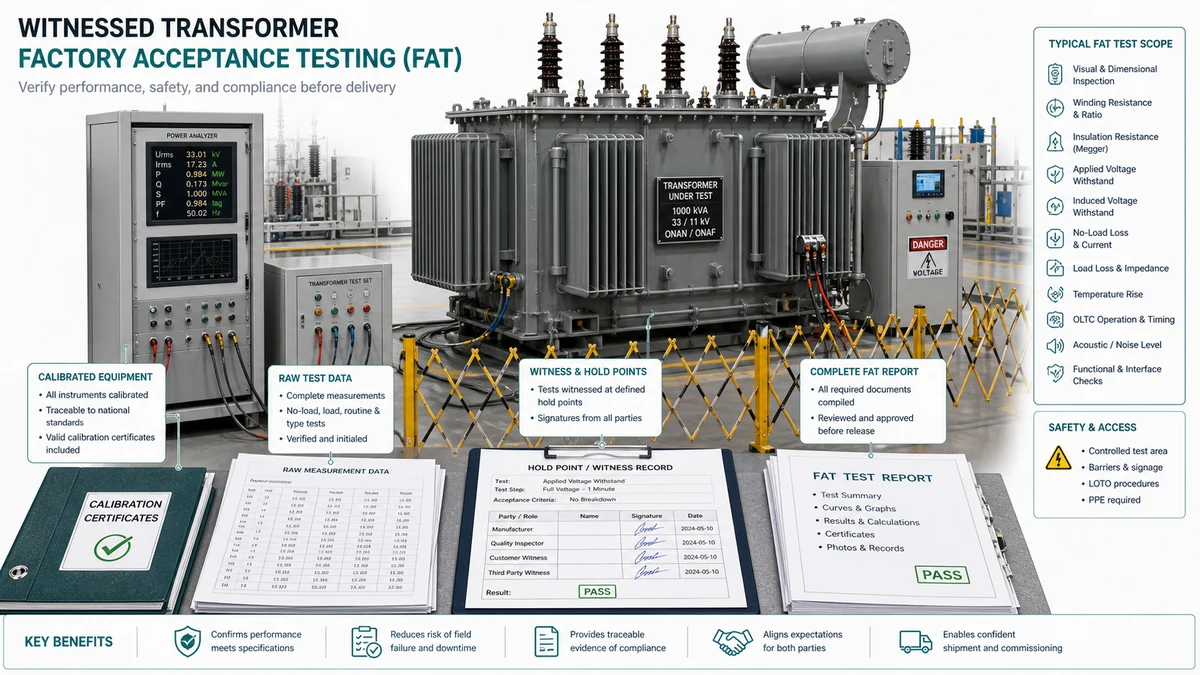
A witness test is a factory acceptance test conducted with the buyer’s representative physically on-site to observe and sign off on each measurement in real time — not a review of previously recorded data. A data pack built from witnessed tests carries a chain of custody that a desk-reviewed report cannot replicate.
Pre-test preparation: Verify the unit’s nameplate data against the purchase order, confirm calibration certificates are current, and check that the test configuration matches the agreed test plan. If calibration is expired or instrument serial numbers do not match the certificates presented, stop and request resolution before proceeding.
Test sequence and hold points: IEC 60076-1 and IEEE C57.12.00 define a standard routine test sequence that is not arbitrary — dielectric tests performed out of sequence can stress insulation in ways that affect subsequent measurements. Hold points must be written into the purchase contract, not verbally agreed.
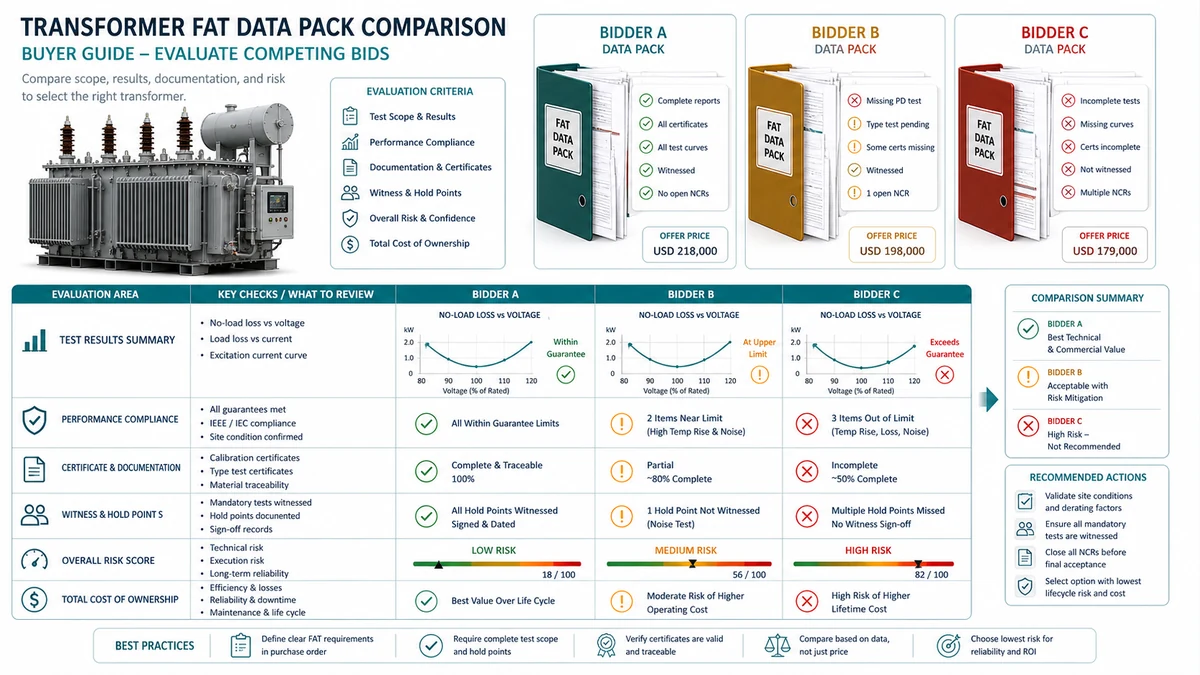
A thick binder of certificates is raw material, not evidence of quality. The framework below converts a document-comparison task into a structured risk decision.
Step 1 — Establish a mandatory document checklist before opening packs. Define non-negotiable documents in advance: type test certificates with standard reference and date, routine test results for the specific serial number, loss measurement curves signed by a witness, temperature rise report with cooling mode stated, dielectric test records including PD measurement, impulse oscillograms with pass criteria annotated, transformer ratio and vector group confirmation, no-load loss at 90%–110% rated voltage, oil quality report with DGA baseline, tap changer operation record if OLTC fitted, calibration certificates with validity dates covering the test date, and witness sign-off sheets. Any bid missing items from this list receives a conditional status.
Step 2 — Score each pack against field-risk categories.
| Risk Category | Key Document | Elevated Risk Condition | Weight |
|---|---|---|---|
| Thermal performance | Temperature rise curve, cooling mode | High ambient, restricted ventilation, high load factor | High |
| Insulation integrity | PD levels, impulse oscillograms | Humid climate, coastal salt air, altitude above 1,000 m | High |
| Dielectric fluid condition | Oil BDV, moisture ppm, DGA baseline | Long transit, tropical storage, repeated energisation delays | High |
| No-load and load losses | Loss curves at multiple voltage levels | High energy cost, utility penalty clauses | Medium |
| Tap changer reliability | OLTC operation log, contact resistance per tap | High switching duty, voltage-unstable grid | Medium |
| Mechanical integrity | Core/coil inspection photos, vibration test | Seismic risk sites, rough-terrain transport | Medium |
| Documentation traceability | Serial number on every sheet, calibration currency | Audit obligations, import inspection jurisdictions | High |
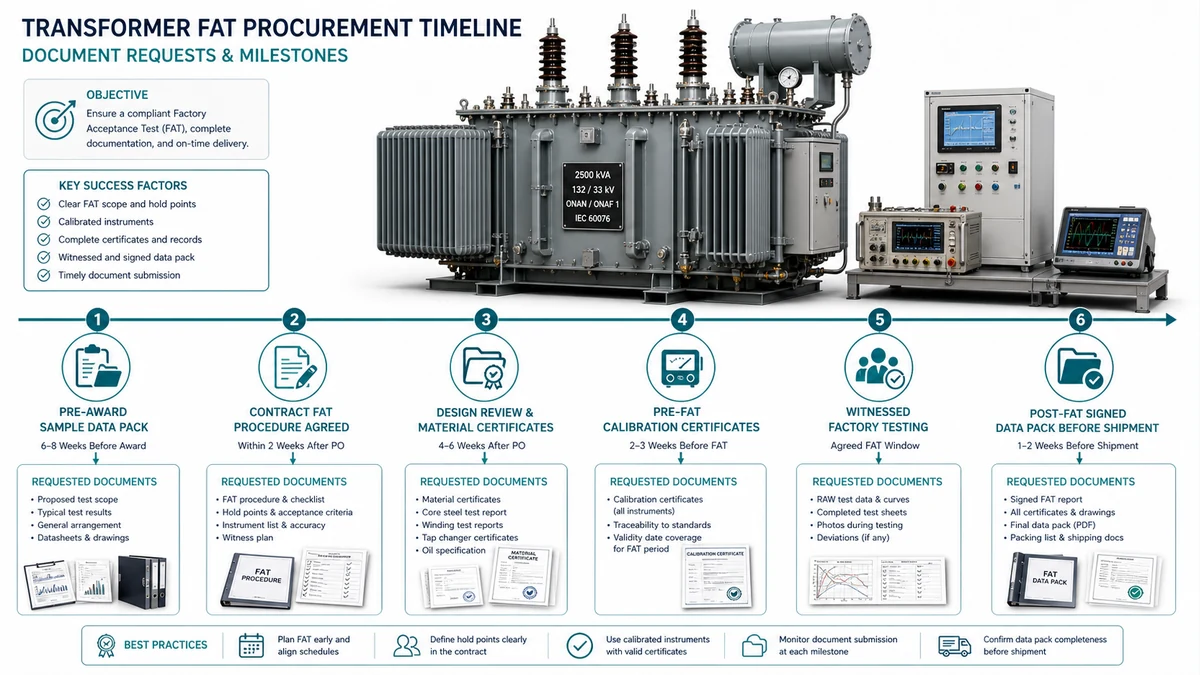
A transformer FAT data pack loses much of its value if it arrives after key procurement decisions have been locked in. The table below maps each document category to the contract stage at which it must be demanded and reviewed before the next milestone is released.
| Stage | Trigger | Documents to Request | Consequence if Missing |
|---|---|---|---|
| Pre-award | Tender evaluation | Sample prior-unit data pack, test schedule, witness agency list | Cannot assess factory testing capability |
| Contract execution | Order placement (within 30 days) | Agreed FAT procedure, test scope, witness notification periods | Scope erosion under delivery pressure |
| Design review | 40%–60% of manufacturing lead time | Material certificates for core and windings, thermal model inputs, impulse levels | Undetected material substitution |
| Pre-FAT | One week before testing | Calibration certificates for all instruments, final test sequence | Invalid test data, adjournment risk |
| FAT witness | During testing | Raw measurement outputs, point-by-point data capture | Smoothed anomalies pass undetected |
| Post-FAT | Before shipment approval | Complete signed data pack including all curves, certificates, and oil analysis | Payment leverage lost; gaps remain unresolved |
Pre-award: A manufacturer who cannot produce a prior-unit data pack carries elevated delivery risk. Incomplete historical packs predict incomplete packs on your unit.
Contract execution: Witness test notification periods — typically 10–15 working days minimum — must be contractually binding, not advisory.
Use these XBRELE references to connect the field decision to the correct product, test, and procurement workflow: XBRELE product page, XBRELE vacuum circuit breaker range, VCB ratings guide, VCB FAT/SAT acceptance checklist, XBRELE power distribution transformer range.
For external method context, compare the site procedure with the public IEEE C37.09 standards page and then apply the exact OEM manual and project specification for the supplied equipment.
Field example: during a service inspection, one phase measured outside its commissioning baseline while the other two phases remained stable. The team repeated the measurement with verified leads, checked timing and contact travel, and used the measured divergence to separate a contact-pressure problem from a generic surface-cleaning issue.
A routine test is performed on every unit and verifies that the individual transformer meets its specified ratings — examples include winding resistance, no-load loss, load loss, and insulation resistance. A type test is performed once on a design to demonstrate that the design meets performance requirements under the most severe service conditions — examples include temperature rise, lightning impulse, and short-circuit withstand.
A manufacturer may provide type-test certificates from a sister unit only if the design is demonstrably identical in all parameters affecting the tested characteristic, and only with a written similarity statement. Routine test records must always relate to the specific serial number being purchased.
The data pack should be retained for the full operational life of the transformer plus any applicable statutory limitation period. In practice, this means a minimum of 25–40 years for power transformers.
A PD result above the contractual acceptance limit is a hold point. The test must be stopped, the result recorded in full including the measured level in picocoulombs and the test voltage at exceedance, and the failure documented in the data pack.
A digital data pack is legally valid provided all records carry traceable electronic signatures from authorized signatories, the file format is non-editable or uses a controlled revision system with audit trail, and the buyer has unrestricted access without dependence on the manufacturer’s proprietary platform. PDF files with embedded digital signatures under ISO 32000 are widely accepted.
The buyer should decline to issue a shipment release until the complete pack has been received and reviewed. If commercial pressure forces a partial shipment, the buyer should issue a written conditional acceptance listing every outstanding document by title, specifying the delivery deadline, and stating that the associated payment milestone will not be released until all gaps are closed.
The factory test is performed at the manufacturer’s altitude, which may differ from the installation site. IEC 60076 and IEEE C57 define correction factors for external insulation clearances and cooling performance at altitudes above 1,000 m.
If your procurement cycle is already underway and you are unsure whether your current contract covers the full FAT data pack scope described in this guide, a focused contract gap review against IEC 60076 or IEEE C57.12.00 clauses will identify which test categories and documentation obligations are missing before the factory starts testing. Acting at the design review stage preserves all corrective options; acting after FAT completion leaves only negotiation.