¿Necesita las especificaciones completas?
Descargue nuestro Catálogo de productos 2025 para obtener planos detallados y parámetros técnicos de todos los componentes de los equipos de conmutación.
Obtener catálogo
Descargue nuestro Catálogo de productos 2025 para obtener planos detallados y parámetros técnicos de todos los componentes de los equipos de conmutación.
Obtener catálogo Descargue nuestro Catálogo de productos 2025 para obtener planos detallados y parámetros técnicos de todos los componentes de los equipos de conmutación.
Obtener catálogo
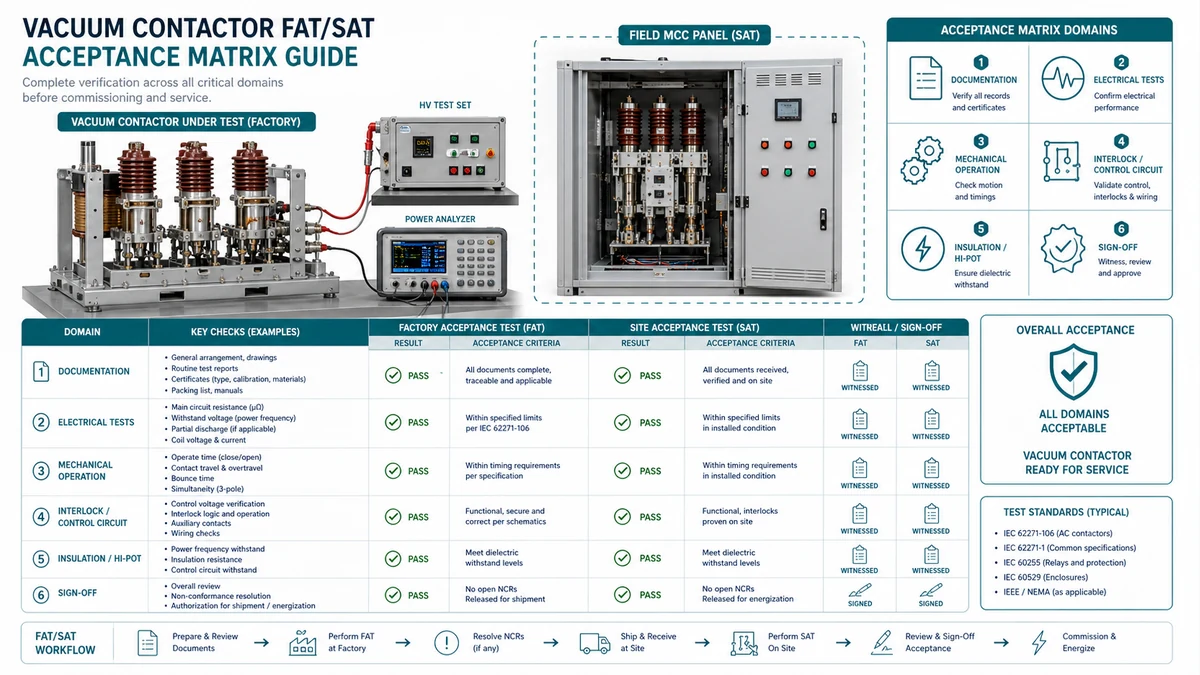
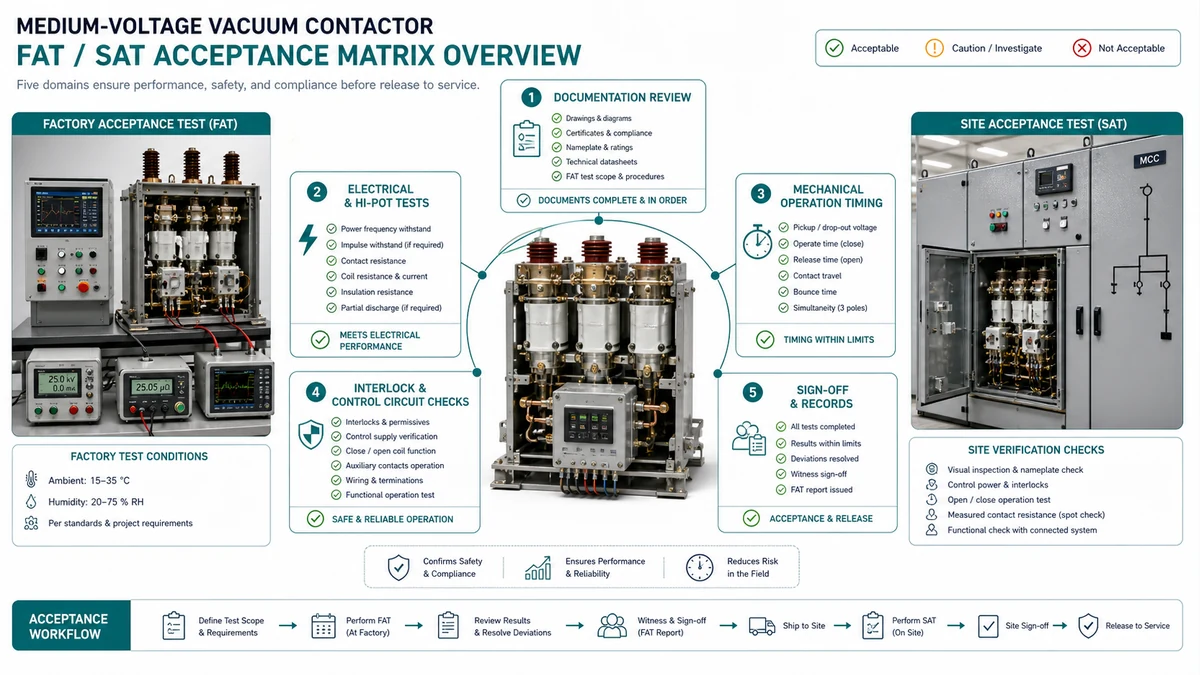
Una matriz de aceptación FAT/SAT de un contactor de vacío es el documento estructurado, línea por línea, que recoge todas las actividades de verificación realizadas en un contactor de vacío —primero en las instalaciones del fabricante (Prueba de Aceptación en Fábrica) y, posteriormente, en el lugar de instalación (prueba de aceptación in situ)—, junto con el umbral específico de aprobación o rechazo, la parte responsable y la firma de autorización correspondiente a cada elemento.
Esta guía explica qué debe incluir la matriz, cómo evaluar las propuestas de los proveedores y qué debe contener un expediente de traspaso completo, desde las especificaciones de compra hasta la aprobación final.
| Síntoma | Primera prueba | Causa probable | Próxima acción |
|---|---|---|---|
| Resistencia de aislamiento inferior a 100 Mohm en las pruebas FAT | Volver a realizar la prueba tras 30 minutos de secado a 40 °C | Entrada de humedad o interruptor contaminado | Comprobar el estado de las juntas de estanqueidad y la integridad de la carcasa; sustituir el interruptor si la señal IR no se recupera |
| Pico de corriente de fuga en la prueba de alta tensión | Reduce la tensión; vuelve a aplicarla poco a poco | Interruptor de vacío agrietado o distancia de fuga insuficiente | Sustituya el interruptor; no vuelva a realizar la prueba hasta que se haya resuelto la causa raíz. |
| Un polo de resistencia de contacto entre 2 y 5 veces mayor que los demás | Comprueba la fuerza del resorte de contacto con un calibre de paso/no paso | Desgaste irregular por contacto, desalineación o superficie contaminada | Desmontar, inspeccionar las superficies de contacto y volver a realizar la prueba |
| El contactor no se cierra a una tensión nominal de bobina de 85% | Mide la tensión en los terminales de la bobina, no en la alimentación del cuadro eléctrico. | Un cable de control de sección insuficiente que provoca una caída de tensión | Sustituya el cable de control por uno de la sección transversal especificada; vuelva a medir |
| Asimetría en el tiempo de funcionamiento entre polos > 3 ms | Comprueba la alineación del mecanismo con las herramientas del fabricante | Bloqueo mecánico o pivote desgastado | Reajustar el mecanismo; volver a comprobar la sincronización |
| Se ha vuelto a producir un fallo audible tras una interrupción en la carga en SAT | Prueba de alta tensión de integridad del vacío entre contactos abiertos | Disminución del vacío en el interruptor | Sustituya el interruptor; no vuelva a conectar la corriente |
| Temperatura de la lengüeta de la fase B: 20 grados Celsius o más por encima de las fases A y C | Microohmímetro en la terminación de la fase B | Conexión con un par de apriete insuficiente o mal realizada | Vuelva a apretar según las especificaciones; repita el escaneo termográfico tras 30 minutos de funcionamiento |
En su forma más precisa, la matriz de aceptación es un registro tabular estructurado en cuatro columnas: el elemento específico de la prueba o del documento, el criterio de aceptación derivado de la norma IEC 62271-106 o ANSI/IEEE C37.66 o de las especificaciones del proyecto, el resultado real medido (no una casilla de verificación) y una firma con fecha del inspector o del ingeniero encargado de la puesta en servicio.
La falta de documentación es el motivo más habitual por el que las sesiones FAT se retrasan o se anulan. En la tabla siguiente se indica, para cada documento obligatorio, quién es el responsable de presentarlo, en qué fase debe estar disponible y las consecuencias de su ausencia.
| Documento | Propietario | Requisito en | Riesgo en caso de pérdida |
|---|---|---|---|
| Planos de una sola línea y esquemáticos aprobados | Proveedor | Inicio FAT | No se puede verificar que el cableado se ajuste a lo previsto en el diseño |
| Ficha técnica del contactor de vacío (tensión nominal, corriente, BIL, clase de resistencia) | Proveedor | Inicio FAT | No hay valores de referencia para los límites de las pruebas eléctricas |
| Lista de materiales con números de referencia y revisión | Proveedor | Inicio FAT | No se puede confirmar que se hayan instalado los componentes correctos |
| Certificados de ensayo de tipo (IEC 62271-106 o equivalente) | Proveedor | Inicio FAT | No hay pruebas de que la asignatura de diseño se haya validado en algún momento |
| Certificados de calibración de todos los instrumentos de ensayo | Comprador / Laboratorio de pruebas | Inicio FAT | Los resultados de los ensayos no son admisibles si no se dispone de una calibración trazable |
| Procedimiento de ensayo en fábrica con límites de aceptación | Proveedor | Inicio FAT | No hay criterios acordados para aprobar o suspender; es probable que surjan disputas |
| Estudio de coordinación del aislamiento | Comprador / Ingeniero | Inicio FAT | No se puede confirmar que las opciones de BIL y de autorización sean adecuadas para el emplazamiento |
| Especificaciones de la obra / Anexo técnico de la orden de compra | Comprador | Inicio FAT | El proveedor podrá realizar las pruebas con arreglo a una norma genérica, y no a los requisitos del proyecto. |
| Especificaciones de embalaje y envío | Proveedor | Extremo FAT | Es necesario comprobar que el contactor resiste el transporte antes de la prueba SAT |
| Datos del estudio del emplazamiento (altitud, temperatura ambiente, humedad, nivel de contaminación) | Comprador | Inicio del SAT | No se pueden aplicar factores de reducción ni confirmar la clase de instalación |
| Manual de instalación y puesta en marcha | Proveedor | Inicio del SAT | No hay referencias sobre los valores de par, las holguras ni las comprobaciones de los enclavamientos |
| Registro de inspección del transporte y el almacenamiento | Comprador / Logística | Inicio del SAT | No hay indicios de que el estado físico haya influido en la llegada al lugar. |
| Planos de obra terminada (revisión posterior a la prueba de aceptación final) | Proveedor | Inicio del SAT | Las comprobaciones del cableado SAT se basan en planos anteriores a FAT, no en el hardware real. |
| Informe final de FAT | Comprador + Proveedor | Inicio del SAT | El SAT no puede iniciarse en equipos que no cuenten con un registro FAT válido. |
Cada medición realizada durante las pruebas de aceptación final (FAT) se convierte en un punto de referencia para la comparación con las pruebas de aceptación de servicio (SAT) y para los parámetros de referencia del mantenimiento futuro.
Resistencia dieléctrica de alta tensión
| Tensión nominal (kV) | Nivel de alta tensión de CA (kV rms, 1 min) | Nivel de alta tensión de CC (kV) |
|---|---|---|
| <= 3,6 | 10 | 14 |
| 7.2 | 20 | 28 |
| 12 | 28 | 40 |
| 17.5 | 38 | 54 |
Prueba de integridad del vacío
| Potencia nominal del contactor | Resistencia de contacto típica aceptable |
|---|---|
| Hasta 400 A | <= 100 microohmios por polo |
| 400 A – 800 A | <= 60 microohmios por polo |
| > 800 A | Según la ficha técnica del fabricante |
| Parámetro | Rango aceptable típico |
|---|---|
| Distancia entre contactos (clase de 12 kV) | 8-12 mm por poste |
| Toallita de contacto | 2-4 mm por poste |
| Variación de la diferencia entre los polos | <= 1 mm |
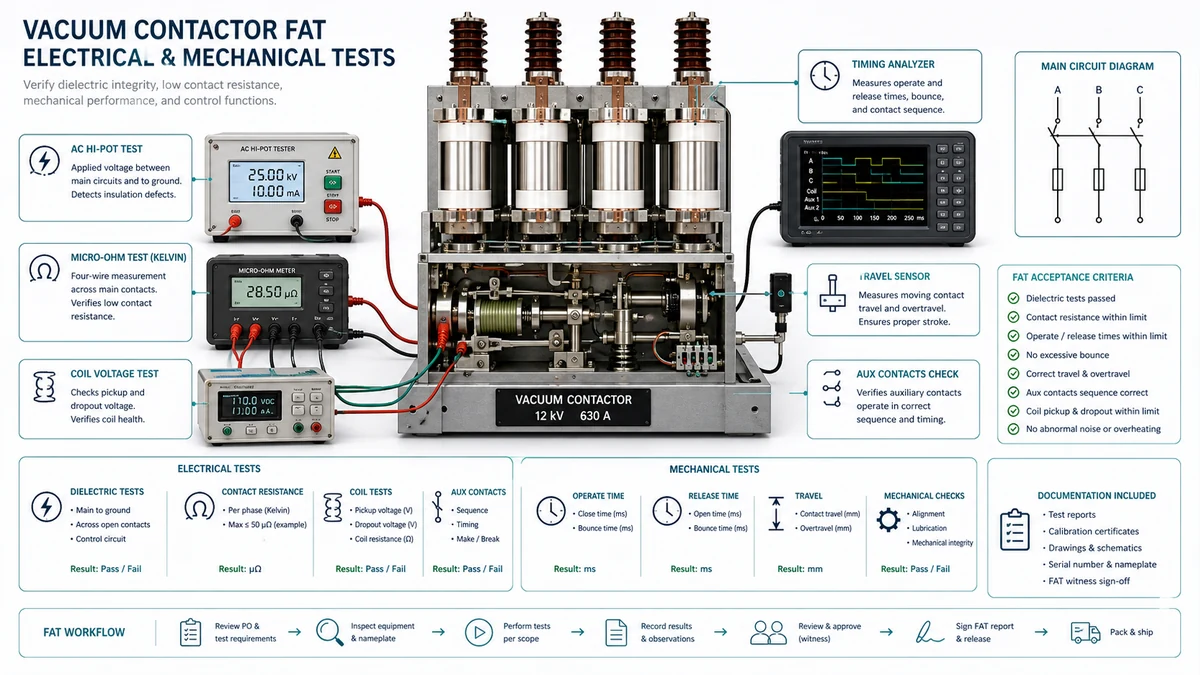
| Prueba | Referencia estándar | Criterio de aprobación | Acción en caso de fallo |
|---|---|---|---|
| Resistencia dieléctrica a alta tensión | IEC 62271-106 | Sin averías; fuga < límite | Sustituir el interruptor; comprobar el aislamiento |
| Integridad del vacío | IEC 62271-106 / especificaciones del fabricante | Sin desglose de huecos; presión < 10⁻³ Pa | Sustituir el interruptor antes del envío |
| Resistencia de contacto | IEC 62271-1 | Dentro del límite; postes situados a una distancia de 10% entre sí | Revisar los contactos; comprobar la fuerza del resorte |
| Resistencia del aislamiento | IEC 60060-1 | >= 1.000 Mohm a 1 kV | Comprobar si hay humedad o contaminación |
| Tensión de activación/desactivación de la bobina | Especificaciones del fabricante | Cierra en 85%; abre en <= 75% (valor nominal) | Ajustar o sustituir el conjunto de la bobina |
| Ciclismo de resistencia mecánica | IEC 62271-106 | Sin fallos en 50-100 ciclos | Identificar el punto de unión; repetir la prueba |
| Tiempo de funcionamiento | Especificaciones del fabricante | Dentro de un margen de +/-15% respecto al valor de referencia; asimetría polar <= 3 ms | Mecanismo de realineación |
| Contacto por fricción y holgura | Especificaciones del fabricante | Dentro de la tolerancia dimensional | Ajustar el mecanismo; volver a medir |
| Instrumento / Fuente | Propósito | Referencia de aceptación |
|---|---|---|
| Microohmímetro de CC (inyección >= 100 A) | Medición de la resistencia de contacto | Ficha técnica del fabricante; IEC 62271-1 |
| Megóhmetro de 1 kV / 2,5 kV | Resistencia del aislamiento | IEC 60060-1; especificaciones del proyecto |
| Equipo de pruebas de alta tensión de CA (calibrado) | Resistencia dieléctrica | Tablas de tensión de la norma IEC 62271-106 |
| Analizador de sincronización de contacto | Medición del tiempo de cierre y apertura | Especificaciones del fabricante: +/-15% respecto al valor de referencia de FAT |
| Llave dinamométrica calibrada | Par de apriete de los terminales y las barras colectoras | Manual de instalación del fabricante |
| Calibre de espesores / Herramientas de control «pasa/no pasa» del fabricante | Distancia entre contactos y limpieza | Especificaciones dimensionales del fabricante |
| Termómetro infrarrojo / cámara térmica | Aumento de la temperatura de corte durante la prueba SAT con carga | IEC 60529 / límites térmicos del proyecto |
| Analizador de calidad de la energía u osciloscopio | Captura de la corriente de arranque en la primera activación de la carga | Estudio de coordinación de la protección del proyecto |
| Equipo de pruebas de relés | Inyección de disparo de protección de extremo a extremo | Calendario de configuración del proyecto de relevos |
| Manual de instalación y puesta en marcha para fabricantes de equipos originales (OEM) | Valores de par, holguras, secuencias de enclavamiento | Documento del fabricante |
| Pliego de condiciones del proyecto / Anexo técnico de la orden de compra | Umbrales de aceptación específicos para cada emplazamiento | Documento emitido por el comprador |
| IEC 62271-106 | Niveles y procedimientos de la prueba FAT/SAT | IEC (edición actual) |
| ANSI/IEEE C37.66 | Requisitos de los contactores de vacío (proyectos en Norteamérica) | IEEE (edición actual) |
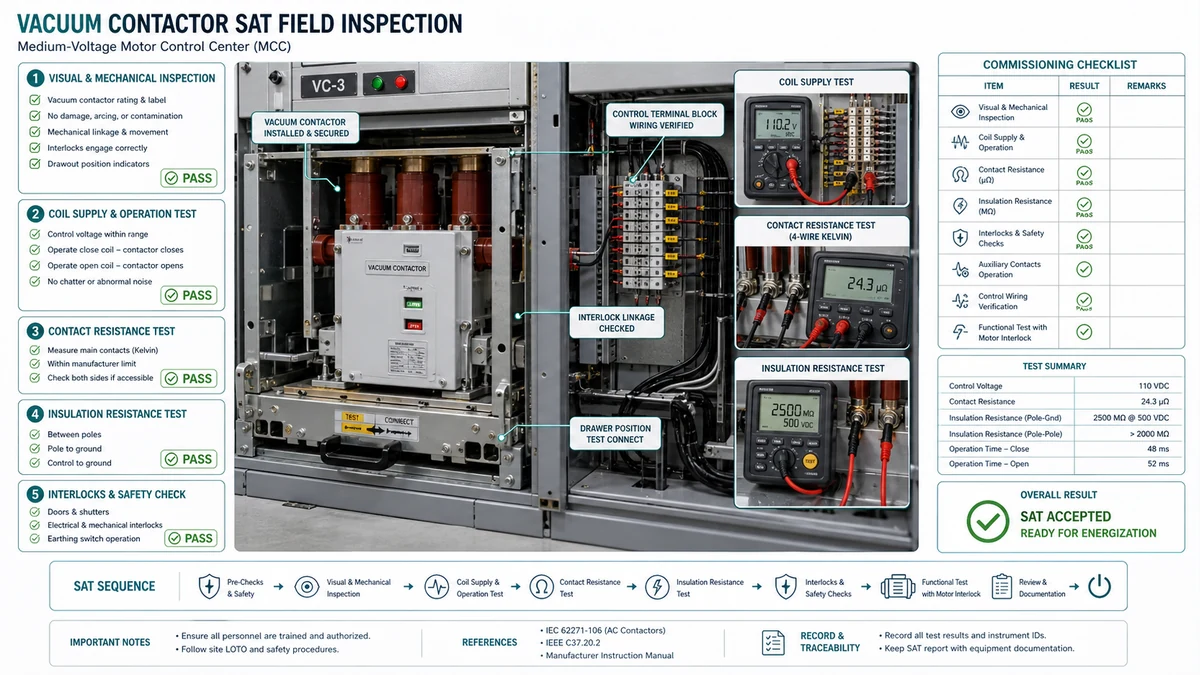
El SAT confirma que un contactor de vacío funciona correctamente en su entorno real de instalación, validando así la integración: el cableado, los niveles de tensión de control, la coordinación de la protección en las etapas anteriores, el comportamiento térmico de la caja y las características específicas de la carga.
Fase 1 — Comprobaciones previas a la activación (sin tensión, bloqueado)
Fase 2: Verificación de la alimentación y del funcionamiento
Evalúa la propuesta de cada proveedor según los criterios que se indican a continuación. Asigna puntos únicamente cuando se adjunte documentación verificable —informes de pruebas, certificados de calibración, hojas de aprobación—.
| Categoría de evaluación | Puntos máximos | ¿Qué se necesita para obtener la máxima puntuación? | Déficit habitual |
|---|---|---|---|
| Pruebas dieléctricas y de aislamiento | 20 | Prueba de alta tensión a la tensión nominal más el impulso BIL; se han registrado los números de serie individuales y se han indicado los límites de «aprobado/no aprobado» | La prueba de alta tensión se ha realizado únicamente en una muestra del lote; no hay registro por unidad. |
| Medición de la separación de contacto y del recorrido | 15 | Se ha medido la holgura con un calibre calibrado, se ha trazado la curva de recorrido y se han establecido los límites mínimo y máximo según las especificaciones. | La diferencia se indica como “dentro de los límites de tolerancia”, sin resultado numérico. |
| Verificación de la integridad del vacío | 15 | Prueba de alta tensión o de resistencia a la frecuencia industrial entre contactos abiertos según la norma IEC 62271-106; resultado anterior por unidad | Se supone que el vacío es correcto según el código de fecha de fábrica; no se ha realizado ninguna prueba |
| Tensión de activación/desactivación de la bobina | 10 | Probado a 85% y 110% de tensión de control nominal a la temperatura ambiente real del lugar de instalación | Probado únicamente a tensión nominal en un laboratorio con condiciones controladas |
| Muestra de resistencia mecánica | 10 | Se ha documentado el recuento cíclico indicando el umbral mínimo; se ha verificado la fuerza del muelle tras la prueba. | Datos de resistencia procedentes únicamente del informe de ensayo de tipo; no del lote de producción |
| Registro de las condiciones ambientales | 10 | Temperatura ambiente, humedad, altitud y vibración registradas en el momento de cada prueba SAT | Los formularios del SAT carecen de campos para datos medioambientales |
| Trazabilidad de la calibración | 10 | Todos los instrumentos son trazables a un patrón nacional; las fechas de vencimiento de la calibración figuran en los certificados. | Las etiquetas de calibración están presentes, pero no se ha comprobado si las fechas de caducidad coinciden con la fecha de la prueba |
| Integridad de la cadena de aprobación | 10 | Firmas del fabricante, del inspector independiente y del representante del cliente en cada informe de ensayo | El visto bueno del cliente está en blanco o se ha obtenido tras la puesta en servicio |
| Gestión de los casos de no conformidad | 5 | Resultados fuera de tolerancia documentados con la decisión correspondiente: reelaboración, nueva prueba o aceptación con desviación | Eventos NC que no figuran en el registro (lo cual es estadísticamente improbable en el caso de pedidos de gran volumen) |
| Revisión y control de cambios | 5 | Número de versión de Matrix, historial de revisiones y aplicabilidad a la orden de compra específica a la que se hace referencia | Plantilla genérica sin identificación específica del proyecto |
| Total | 110 |
Interpretación:
– 95-110 puntos: La matriz está prácticamente completa. Se puede proceder a la formalización del contrato, con algunas solicitudes de aclaración menores.
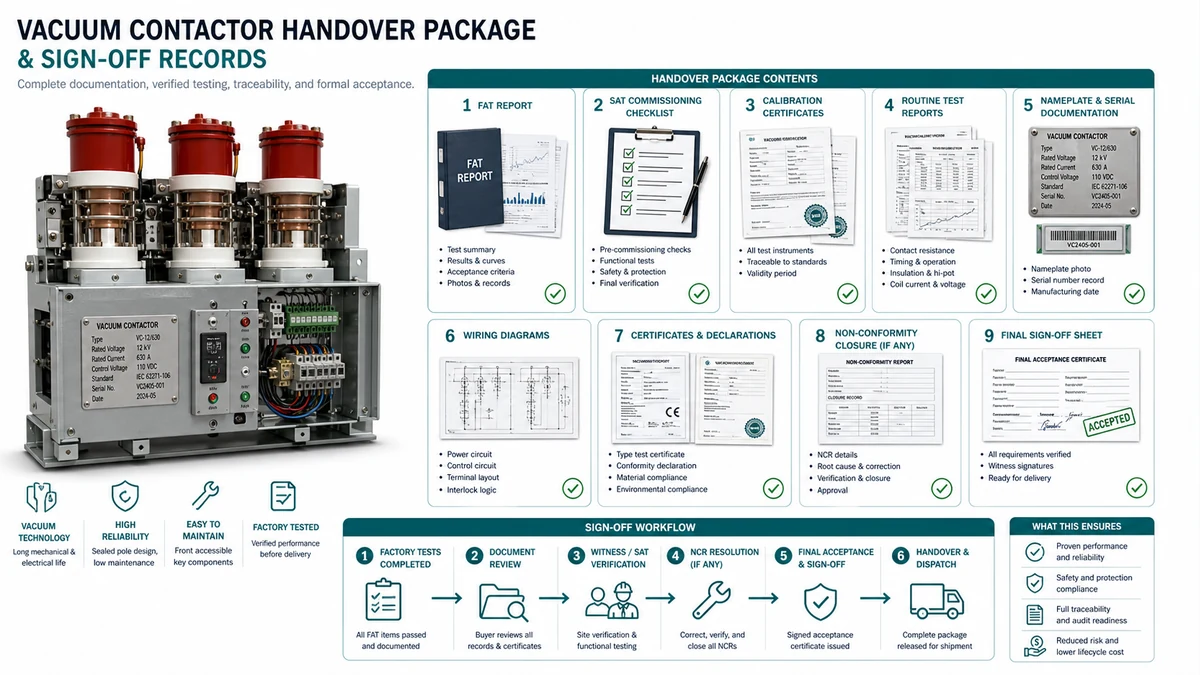
La aceptación definitiva convierte un contactor sometido a pruebas en un activo puesto en servicio. Sin un protocolo de aprobación definido, los datos de las pruebas pierden su valor de trazabilidad.
| Nivel de testigo | Definición | Función típica |
|---|---|---|
| W — Testigo | Punto de espera; el trabajo se detiene hasta que el testigo autorizado firme | Ingeniero del propietario, inspector independiente |
| R — Revisión | Expediente revisado y aprobado antes de pasar a la siguiente fase | Jefe de ingeniería, responsable de control de calidad |
| I — Información | Copia presentada; no es necesario retenerla | Equipo de puesta en marcha de la planta |
| Documento | Contenido obligatorio | Facultad de aprobación |
|---|---|---|
| Informe de la prueba FAT | Todos los resultados de las pruebas de fábrica, los certificados de calibración de los instrumentos y el registro NCR con las medidas adoptadas | Responsable de control de calidad del fabricante + ingeniero de supervisión |
| Registro de puesta en servicio del SAT | Resultados de las pruebas in situ comparados con los diagramas de cableado de referencia de la prueba FAT y los diagramas de cableado tal y como están instalados | Responsable de la puesta en marcha de la obra + ingeniero del propietario |
| Registro de informes de no conformidad | Cada desviación detectada, medida correctiva adoptada, resultado de la nueva prueba, firma de cierre | Responsable de control de calidad |
| Registro de calibración de instrumentos | Referencia del certificado, fecha de caducidad y norma de trazabilidad de cada instrumento utilizado | Supervisor de pruebas |
| Registro de referencia de la resistencia de aislamiento | Valores de resistencia de aislamiento (IR) entre fases y entre fase y tierra en el momento del traspaso, para el seguimiento de tendencias de mantenimiento futuro | Responsable de la puesta en marcha |
| Registro de referencia de la resistencia de contacto | Valores de resistencia por fase en el traspaso | Responsable de la puesta en marcha |
| Registro del tiempo de funcionamiento | Mediciones de los tiempos de cierre y apertura en el traspaso | Responsable de la puesta en marcha |
| Conjunto de planos de obra terminada | Esquema de control final de una sola línea y lista de bornes | Responsable de ingeniería |
| Formulario de activación de la garantía | Números de serie, fecha de prueba en fábrica, fecha de finalización del SAT, inicio del periodo de garantía | Responsable de contratos del propietario |
Utiliza esta lista de comprobación antes de emitir una orden de compra o de invitar a un proveedor a presentar una oferta.
Utilice estas referencias XBRELE para conectar la decisión de campo con el producto correcto, la prueba y el flujo de trabajo de adquisición: Página del producto XBRELE, Gama de disyuntores de vacío XBRELE, Guía de calificaciones del VCB, Lista de comprobación para la aceptación del FAT/SAT de VCB, gama de contactores de vacío XBRELE.
Para el contexto del método externo, compare el procedimiento del sitio con el público Página de normas IEEE C37.09 y, a continuación, aplicar el manual exacto del OEM y las especificaciones del proyecto para el equipo suministrado.
Ejemplo práctico: durante una inspección de servicio, una fase midió fuera de su línea de base de puesta en servicio, mientras que las otras dos fases se mantuvieron estables. El equipo repitió la medición con cables verificados, comprobó la temporización y el recorrido de los contactos y utilizó la divergencia medida para separar un problema de presión de contacto de un problema genérico de limpieza de superficies.
La prueba FAT (prueba de aceptación en fábrica) comprueba que el contactor cumpla los requisitos de diseño y fabricación antes de salir de las instalaciones del proveedor. La prueba SAT (prueba de aceptación in situ) comprueba que dicha unidad haya llegado en perfectas condiciones, se haya instalado correctamente y funcione dentro de los límites de tolerancia en las condiciones reales de la instalación: tensión de alimentación, temperatura ambiente, altitud y carga conectada.
La norma IEC 62271-106 es la norma principal para los contactores de corriente alterna destinados a tensiones superiores a 1 kV. En ella se definen los requisitos de ensayo de rutina (que se realizan en cada unidad), los requisitos de ensayo de tipo (que se realizan en una muestra de diseño) y los niveles de ensayo para la resistencia dieléctrica, la integridad del vacío y la resistencia mecánica.
El método estándar de prueba in situ consiste en un ensayo de resistencia a la tensión de red aplicado a través de la distancia de contacto abierta de cada interruptor. Si la distancia de contacto soporta la tensión especificada sin que se produzca una ruptura dieléctrica, el vacío es adecuado.
Para contactores con una intensidad nominal de hasta 400 A, un valor típico aceptable es <= 100 microohmios por polo, medido con un microohmiómetro de corriente continua que inyecte al menos 100 A. Para valores nominales de entre 400 A y 800 A, <= 60 microohmios por polo es un umbral habitual.
No. Los índices FAT y SAT se refieren a categorías de riesgo diferentes.
Conserve los registros durante toda la vida útil del equipo, más el plazo exigido por la normativa aplicable. En el caso de las instalaciones de distribución de media tensión, lo habitual es un plazo mínimo de 10 años, aunque algunas jurisdicciones y sectores (servicios públicos, energía nuclear, petroquímico) exigen plazos de conservación más largos.
Considéralo una cuestión relacionada con el sistema de calidad, no un resultado positivo. Un historial de cero no conformidades en más de 10 unidades es estadísticamente inverosímil si la matriz se aplicó de forma rigurosa.