Need Full Specifications?
Download our 2025 Product Catalog for detailed drawings and technical parameters of all switchgear components.
Get Catalog
Download our 2025 Product Catalog for detailed drawings and technical parameters of all switchgear components.
Get Catalog Download our 2025 Product Catalog for detailed drawings and technical parameters of all switchgear components.
Get Catalog
Compare switchgear terminal block brands, ratings, materials, certifications, and installation checks for reliable MV control wiring.
In my twenty-three years designing and commissioning medium voltage switchgear systems, I’ve witnessed countless panel failures that traced back not to the primary switching devices, but to seemingly minor components: terminal blocks, wire ducts, ferrules, and control wiring accessories. These components, while representing perhaps 2-5% of total switchgear cost, directly influence system reliability, maintenance efficiency, and long-term operational safety.
Terminal blocks serve as the neural connection points within switchgear, linking protection relays, metering systems, motor operators, and communication networks. A single poorly-rated terminal block can create cascading failures across an entire substation. I learned this lesson early in my career when a 15kV switchgear lineup at a petrochemical facility experienced control circuit failures during a summer heat wave—the generic terminal blocks we’d specified couldn’t handle the 65°C ambient temperatures inside the enclosure.
This comprehensive guide draws from real-world installation experience, manufacturer technical data, and industry standards to help engineers, specifiers, and procurement professionals select optimal control wiring components. We’ll examine leading manufacturers, establish clear selection criteria, and provide practical checklists that you can apply immediately to your next switchgear project.
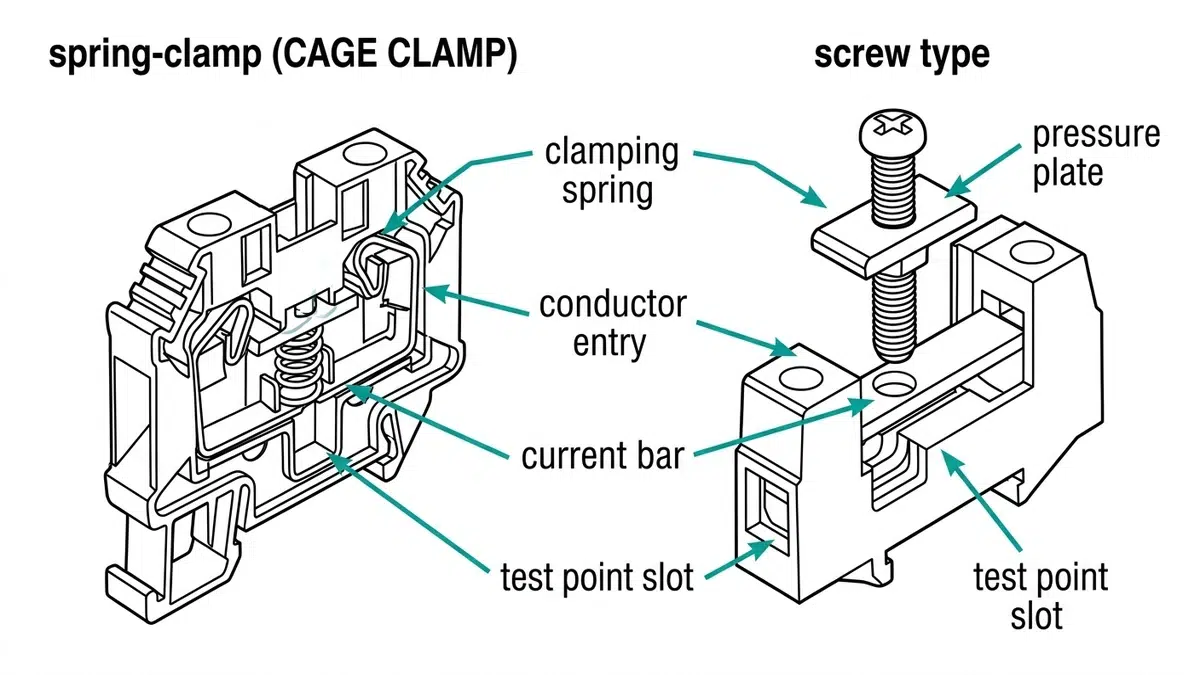
Medium voltage switchgear control circuits typically operate at 24-250VDC or 120-240VAC, requiring components rated for these voltage levels while withstanding the electromagnetic interference and thermal conditions present in MV environments.
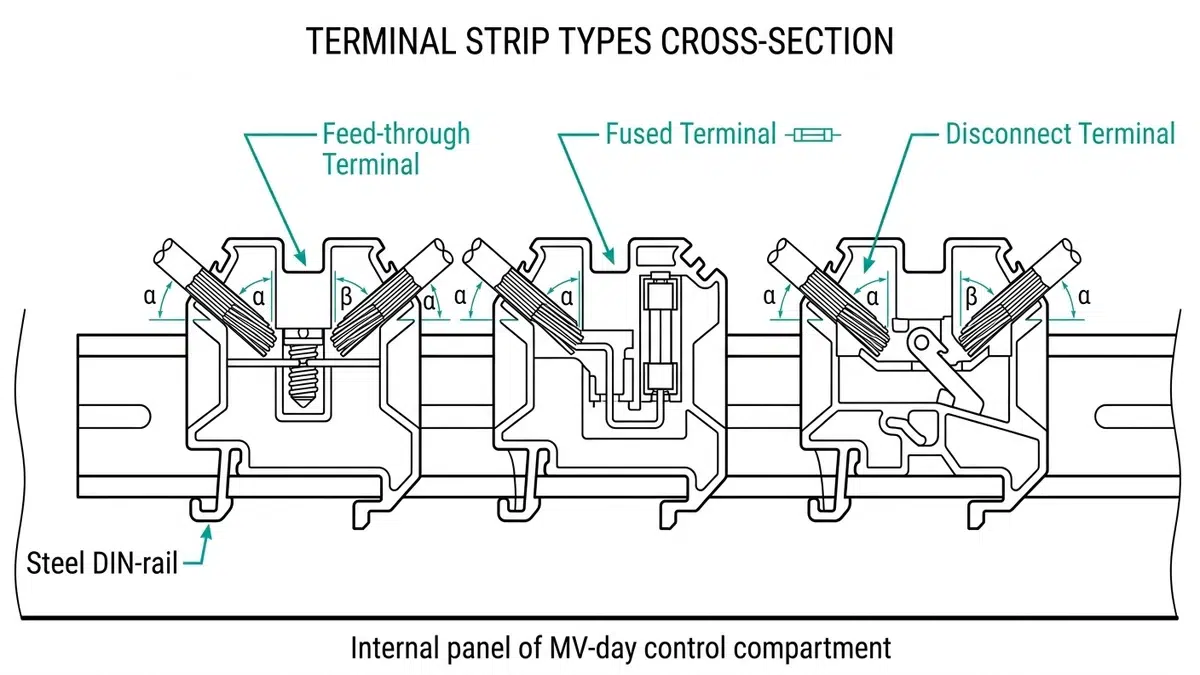
Terminal Blocks form the foundation of control wiring systems. For switchgear applications, we commonly specify:
– Feed-through terminals for general signal and power distribution
– Fused terminal blocks protecting CT and PT secondary circuits
– Disconnect terminals enabling circuit isolation during maintenance
– Ground terminals ensuring proper bonding and safety grounding
– Sensor/actuator terminals with integrated LED indicators for troubleshooting
Wire Management Components include:
– Slotted wire duct (Panduit-style or equivalent)
– Spiral wrap and braided sleeving
– Cable ties and mounting bases
– Conduit fittings and liquid-tight connectors
In the same control-panel BOM review, industrial control components such as selector switches, indicator lamps, disconnect devices, and auxiliary contacts should be checked together with terminal blocks and wire duct, because wiring layout and operator interface choices affect each other.
Identification and Marking Systems encompass:
– Pre-printed wire markers
– Terminal block labels
– Cable tags and ferrules
– Laser-printable labeling systems
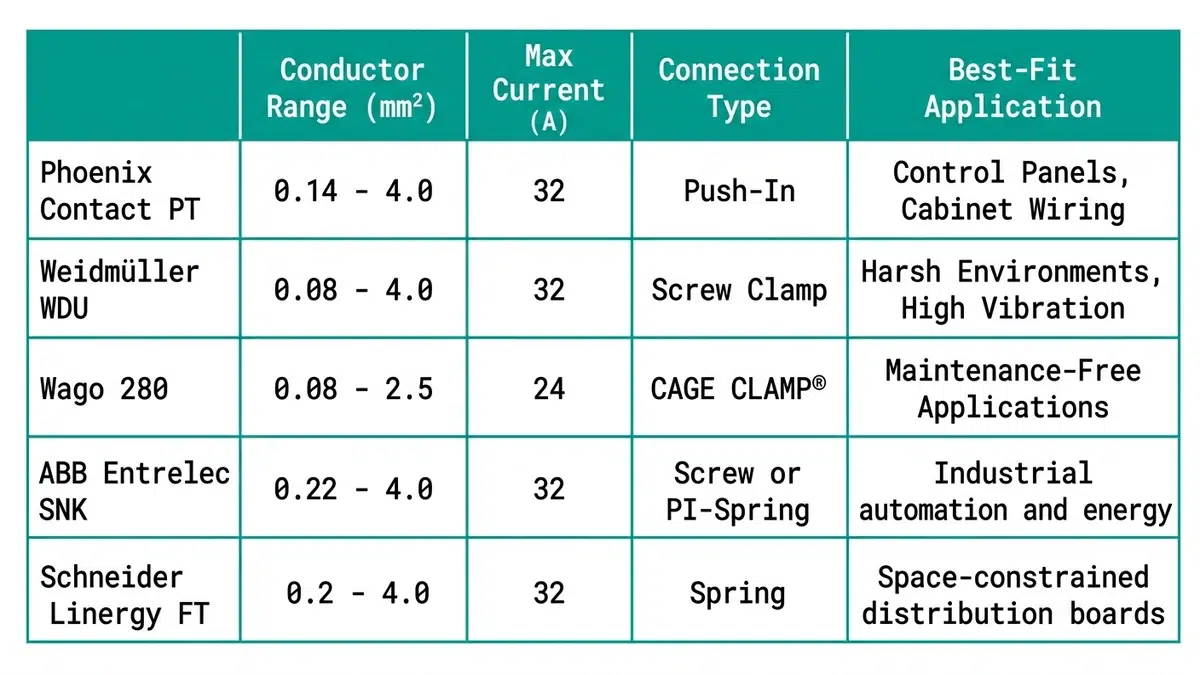
Phoenix Contact consistently ranks as the premium choice among switchgear manufacturers worldwide. Their CLIPLINE complete system offers:
In a recent 15kV switchgear project for a data center, we specified Phoenix Contact’s PTIO disconnect terminals throughout. The tool-free push-in connection combined with the test/disconnect function reduced our panel wiring time from 18 hours to approximately 11 hours per lineup section.
German engineering precision defines Weidmüller’s terminal block offerings. Their KLIPPON Connect series delivers:
Wago revolutionized the industry with their cage clamp spring connection technology. Key products include:
ABB’s Entrelec division provides terminal blocks specifically engineered for switchgear integration:
For North American markets and facilities standardized on Rockwell platforms:
Panduit dominates the North American wire duct market with their:
I’ve specified Panduit Type G duct (narrow slot, wide finger) exclusively for analog signal routing in metering compartments—the narrow slots prevent accidental wire extraction while maintaining accessibility.
HellermannTyton offers exceptional value with:
European switchgear manufacturers frequently specify Iboco products:
When specifying terminal blocks for MV switchgear control circuits, verify:
| Parameter | Minimum Requirement | Recommended Specification |
|---|---|---|
| Rated voltage | 300V (UL) / 500V (IEC) | 600V (UL) / 800V (IEC) |
| Rated current | Circuit maximum × 1.25 | Circuit maximum × 1.5 |
| Short-circuit rating | Coordinate with upstream protection | Match breaker/fuse let-through |
| Impulse withstand | 2.5kV minimum | 4kV for MV applications |
Switchgear environments present unique challenges:
Temperature ratings must account for:
– Ambient temperatures (often 40°C per IEEE C37.20.2)
– Internal temperature rise (additional 15-25°C typical)
– Heat contribution from adjacent equipment
For outdoor switchgear in desert climates, I’ve specified terminals rated for continuous operation at 105°C—standard 85°C ratings would result in connection failures within 2-3 years.
Vibration and shock resistance matters for:
– Seismic applications (IEEE 693 qualification)
– Installations near rotating machinery
– Mobile or transportable substations
Terminal block bodies:
– Polyamide (PA6.6) offers excellent mechanical strength and temperature resistance
– Polycarbonate provides superior impact resistance but lower temperature ratings
– Ceramic required for extremely high-temperature or fire-critical applications
Current bars and contacts:
– Brass provides good conductivity at moderate cost
– Copper required for high-current applications
– Tin or nickel plating prevents corrosion in industrial environments
Always verify:
– UL 1059 listing for North American installations
– IEC 60947-7-1 compliance for international projects
– CSA certification for Canadian installations
– ATEX/IECEx ratings for hazardous area applications
– UL 508A compliance for industrial control panels
After building hundreds of switchgear panels, I’ve developed these proven arrangement practices:
Functional grouping:
1. Group terminals by circuit function (protection, metering, control, communication)
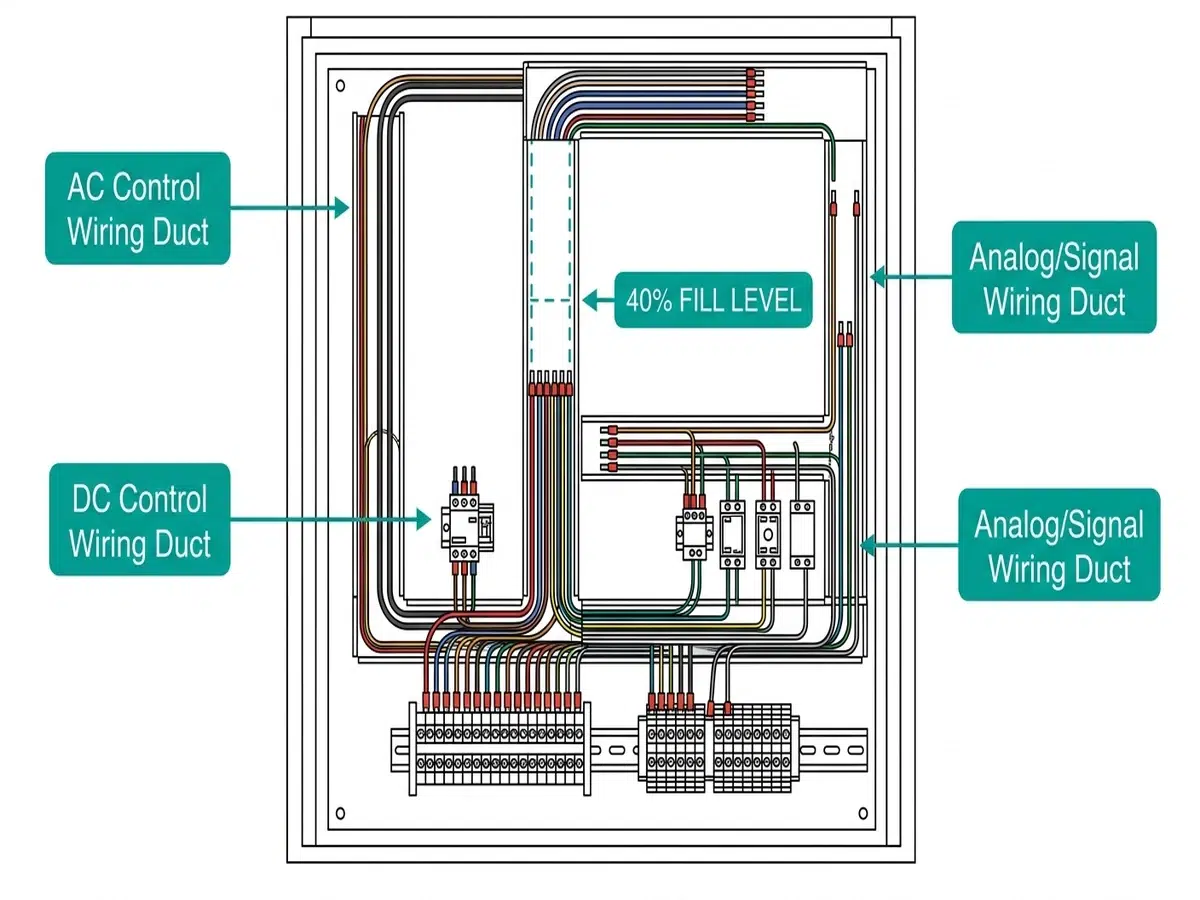
2. Maintain separation between AC and DC circuits (minimum 50mm recommended)
3. Position frequently-accessed test terminals at ergonomic heights
Spare terminal allocation:
– Provide 15-20% spare terminals for future modifications
– Group spares at end of each functional section
– Pre-label spares as “SPARE” to prevent unauthorized use
Connection failures often trace to improper torque. Document and verify:
| Conductor Size (AWG) | Typical Torque (lb-in) | Typical Torque (Nm) |
|---|---|---|
| 18-16 | 4.4-5.3 | 0.5-0.6 |
| 14-12 | 7.1-8.8 | 0.8-1.0 |
| 10 | 17.7-22.1 | 2.0-2.5 |
| 8-6 | 26.5-35.4 | 3.0-4.0 |
Pro tip: Use calibrated torque screwdrivers and document torque values on commissioning punch lists. I’ve rejected entire panel shipments after finding torque values 30-40% below specification during receiving inspection.
Ferrules dramatically improve connection reliability, particularly with stranded conductors:
While generic terminal blocks may cost 40-60% less than premium brands, consider:
Direct failure costs:
– Unplanned outage expenses ($10,000-$100,000+ per hour in critical facilities)
– Emergency service call fees
– Expedited replacement part shipping
Indirect quality costs:
– Extended commissioning time with inconsistent component quality
– Higher warranty claim rates
– Reputation damage from field failures
In one project comparison, we estimated that specifying Phoenix Contact terminals versus a low-cost alternative added $3,200 to material costs for a 15kV, 8-section lineup. That same project avoided an estimated $180,000 in potential failure costs over the 25-year equipment life.
For larger projects or ongoing switchgear programs:
Several manufacturers now offer terminal blocks with integrated intelligence:
Modern switchgear increasingly requires:
– Industrial Ethernet connectivity to protection relays
– Fiber optic terminal blocks for communication circuits
– Shielded terminal systems for EMI-sensitive signals
External Reference: The IEEE Standards Association provides comprehensive guidance on control wiring practices in their IEEE C37.2 standard for electrical power system device function numbers and contact designations, which directly influences terminal block labeling and organization.
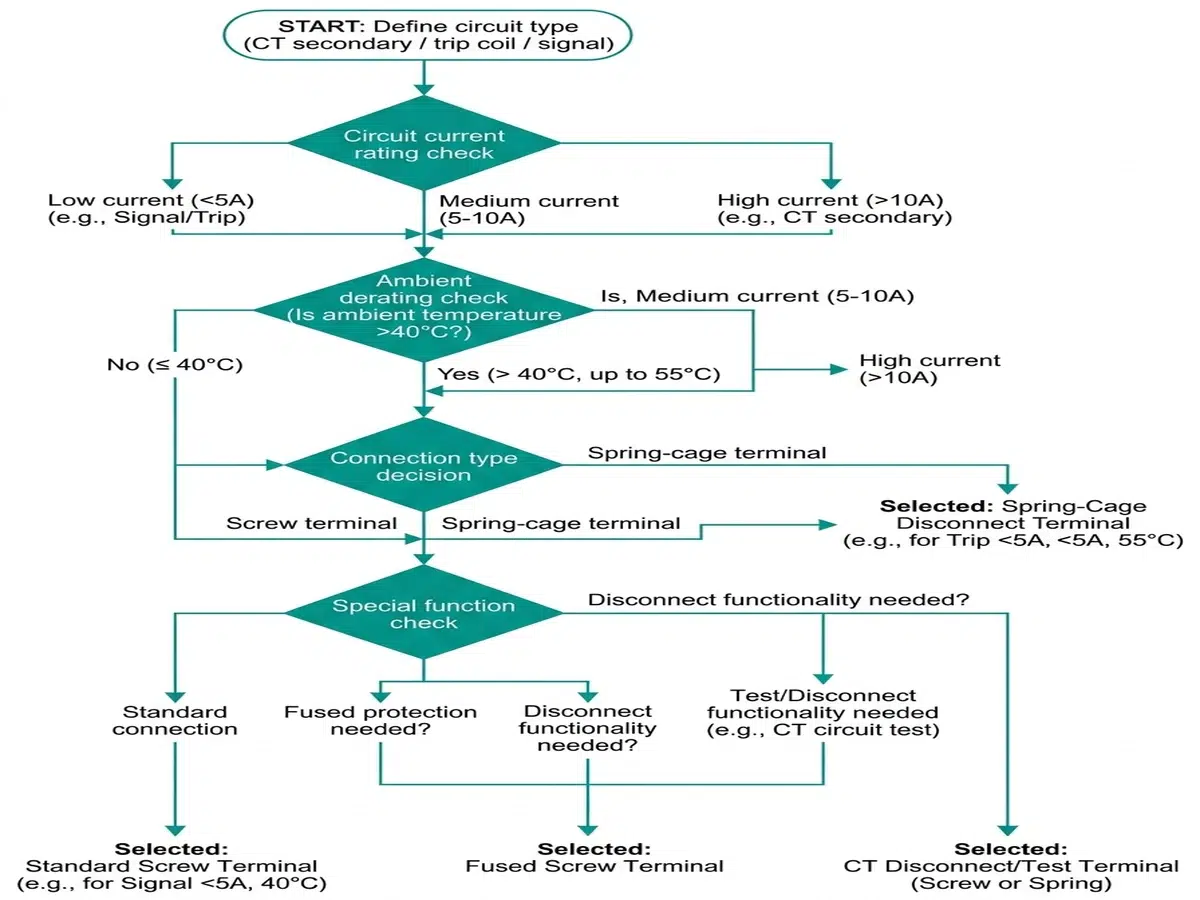
For CT secondary circuits, I recommend terminals rated minimum 10A continuous, preferably 15-20A. This provides margin for fault current contribution during disturbances. More critically, specify shorting-type terminals for CT circuits that automatically short before disconnecting—preventing dangerous open-circuit CT voltages that can exceed several thousand volts.
While technically possible with DIN rail mounting, I strongly advise against mixing manufacturers. Different terminal families have varying accessories, labeling systems, and jumper configurations. Maintenance personnel must stock multiple spare types. In one facility audit, I found seven different terminal block brands across twelve switchgear sections—creating inventory nightmares and connection compatibility issues.
Industry best practice limits wire duct fill to 40-50% of cross-sectional area for control wiring applications. This allows for future additions and prevents conductor damage during installation. For power circuits generating heat, reduce fill to 30-35%. I calculate duct size by summing conductor cross-sectional areas (including insulation) and dividing by 0.4.
For outdoor MV switchgear, specify terminals meeting:
– UL 1059 with Outdoor Use marking
– IP20 minimum protection rating (IP67 for exposed locations)
– Temperature rating covering expected ambient plus internal rise
– UV-resistant materials if exposed to sunlight
– Consider stainless steel or specially-coated hardware for coastal installations
Push-in (spring-cage) terminals from reputable manufacturers meet or exceed screw-clamp reliability when properly applied. Key advantages include consistent connection force, vibration resistance, and faster installation. Ensure the specific push-in model is rated for your conductor type (solid, stranded, or fine-stranded with ferrule) and consider that larger conductors (above 4mm²) may require screw-clamp designs.
Circuits transitioning between voltage compartments require careful attention:
– Install terminals in the lower-voltage compartment only
– Use appropriately-rated feedthrough bushings or barriers
– Maintain phase segregation per applicable standards
– Consider fused terminals for protection coordination
– Document voltage ratings clearly with permanent labels
Based on my experience maintaining switchgear facilities, maintain:
– 5% of each terminal type installed
– Complete labeling/marking supplies for one full section
– Jumpers and bridges for each configuration used
– End brackets, covers, and mounting accessories
– Minimum one each of specialized terminals (fused, disconnect, ground)
Selecting control wiring components for medium voltage switchgear requires balancing electrical performance, environmental compatibility, installation efficiency, and lifecycle costs. The manufacturers highlighted in this guide—Phoenix Contact, Weidmüller, Wago, ABB Entrelec, and others—have earned their reputations through consistent quality and comprehensive technical support.
Essential selection criteria to remember:
The components you select today will serve your facility for decades. Investing time in proper specification—and modest additional budget in quality products—returns dividends through reliable operation, efficient maintenance, and avoided failures. Apply the checklists and criteria presented here to your next switchgear project, and you’ll build control systems worthy of the sophisticated protection and switching equipment they support.